



Some experts think India could reach $25–30 trillion by 2047. This is a huge jump from its current $4 trillion. The government aims for a $10 trillion economy by then.
We’ll look at the facts and plans for India 2047. This vision, called Viksit Bharat, has big goals and realistic targets. It focuses on growing India’s economy.
Services already make up 55% of India’s economy. Experts think this will grow to 75–80% by 2047. To hit $10 trillion, India will invest in AI, semiconductors, and more. It will also link schools and businesses better.
Prime Minister Narendra Modi has a plan for India. It includes making things in India, like semiconductors and defense items. It also aims for energy independence and easier business rules. These steps are key to India’s future.
We’ll check out current trends and important policies. We’ll also talk about how to grow sustainably. For more info or to share your thoughts, email us at info@indiavibes.today.
India’s Economic Aspirations for 2047
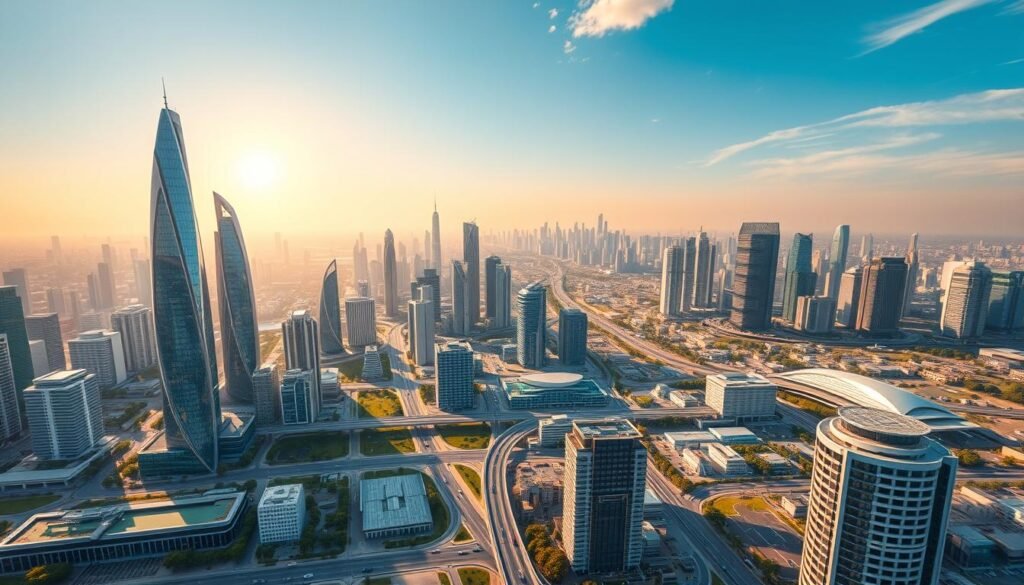
We are looking at India’s future economic goals for 2047. We want to see how the country’s growth can meet its vision while keeping nature and jobs safe. This short section will outline the steps to reach the $10 trillion goal.
The government believes reaching $10 trillion by 2047 is possible. Prime Minister Narendra Modi has outlined key strategies like structural reforms and making things in India. Experts say services and new technologies could boost this goal even higher, to $25–30 trillion.
Key Economic Drivers
Services, like IT and digital exports, are driving India’s growth. The country exports about $235 billion in software services and $380–385 billion in total services. Remittances add nearly $125 billion to the country’s balance.
Bengaluru alone makes about $120 billion from IT exports. Other areas of growth include semiconductors, deep tech, renewable energy, and manufacturing. Also, expanding agricultural exports to ₹4 lakh crore will help rural areas.
Importance of Sustainable Growth
India aims to grow sustainably. It wants to use 50% clean energy by 2030 and invest in hydrogen. Sustainable growth is seen as key for long-term success and keeping food and energy safe.
To hit high GDP targets, India needs to focus on climate-resilient infrastructure and green policies. An economic plan for 2047 that doesn’t consider sustainability risks could harm growth and social well-being.
Current State of India’s Economy

India is on a journey to reach India 2047. It’s the fastest-growing large economy, thanks to services and technology. This sets the stage for understanding India’s GDP growth and future economic plans.
The economy is close to $4 trillion. Services make up about 55% of the country’s value added and are growing. The tech sector employs over 7.5 million people, with Bengaluru having 2.5 million. There are more than 65,000 IT firms and over 20,000 startups, showing a surge in digital output and talent.
These trends influence both short-term and long-term economic projections. Rising consumption and expanding exports in software and pharmaceuticals support growth. Urban demand also plays a key role. Finance, professional services, and digital platforms are growing faster than manufacturing in many areas.
Recent GDP Growth Rates
India’s GDP growth has been strong, outpacing most large economies. This growth reflects strong services activity and domestic demand. Yet, it hides regional and sectoral challenges.
Economic Challenges Ahead
Several challenges could slow growth: public infrastructure gaps, high urban living costs, and uneven state execution. Kolkata faces business-environment challenges despite its talent. Tier 2 and Tier 3 cities need massive investment for industries and housing.
Deep tech funding is limited, making up about 5% of startup funding globally. Energy dependence and import reliance for semiconductors, fertilisers, and fuel pose strategic risks. Policy debates focus on demographic security and border risks, affecting investor confidence.
Fiscal discipline is praised internationally, but a balance is needed. Building hi-tech hubs, modern ports, and public transit will require targeted investment to achieve India 2047 goals.
| Metric | Current Value | Implication for Growth |
|---|---|---|
| Estimated GDP | $4 trillion | Baseline for India GDP growth and projections |
| Services Share of GVA | ~55% | Drives employment and urban demand |
| Tech Employment | 7.5M+ (Bengaluru 2.5M+) | Concentrated innovation hubs, regional imbalance |
| IT Firms / Startups | 65,000+ IT firms; 20,000+ startups | Robust ecosystem; funding gaps in deep tech |
| Deep Tech Funding Share | ~5% | Below global average; limits advanced R&D |
| Strategic Imports | Semiconductors, fertilisers, fuel | Supply risk; affects manufacturing resilience |
| Policy Tension | Fiscal discipline vs. capital spending | Decision point for India 2047 investment needs |
The Role of Innovation in Future Growth

Innovation in India is key to moving from making lots of things to making high-value, knowledge-based products. The country is investing in big tech missions like IndiaAI Mission and National Quantum Mission. These efforts are backed by the Union Budget 2025–26 to help private R&D and grow startups globally.
Technology and Digital Transformation
Digital India 2.0 and successes like CoWIN show India can deliver big. These are models for health, education, and logistics. Programs create demand for tech like semiconductors and AI, helping India’s economy grow.
Policy now gives money and grants to deep-tech startups. This money helps them get to market faster. Startups, universities, and labs need to work together to turn research into real solutions.
Startups Driving Economic Change
Startups in India are key to creating jobs and growing exports. The country has over 3,600 deep-tech startups in areas like AI and cleantech. Campus incubators and partnerships with industry and academia provide a steady flow of talent.
To grow deep tech, we need patient capital and specific funds. Programs like #100DesiDeepTechs and calls for a Deep Tech Fund of Funds aim to fill funding gaps. When these startups grow, they can make up 75–80% of India’s GDP, boosting its tech exports.
| Area | Strength | Near-term Priority |
|---|---|---|
| AI & Software | Large talent pool, global services market | Commercialize models, expand exports |
| Semiconductors | New manufacturing missions, localized demand | Build fabs, secure supply chains |
| Biotech & Pharma | Generic manufacturing base, vaccine platforms | Move toward biologics and high-value R&D |
| Renewables & Cleantech | Strong policy targets, solar scale-up | Project financing, manufacturing scale |
| Edtech & Skills | High adoption of online learning | Short courses, industry-aligned training |
| Logistics & Payments | UPI-led digital payments, booming e-commerce | Scale warehousing, cross-border logistics |
We suggest working together between ministries, investors, and universities. This teamwork will speed up tech progress, support startups, and strengthen India’s economy.
Check out sector trends and investment signals in a concise guide at emerging high-growth sectors in India.
Fostering Sustainable Practices
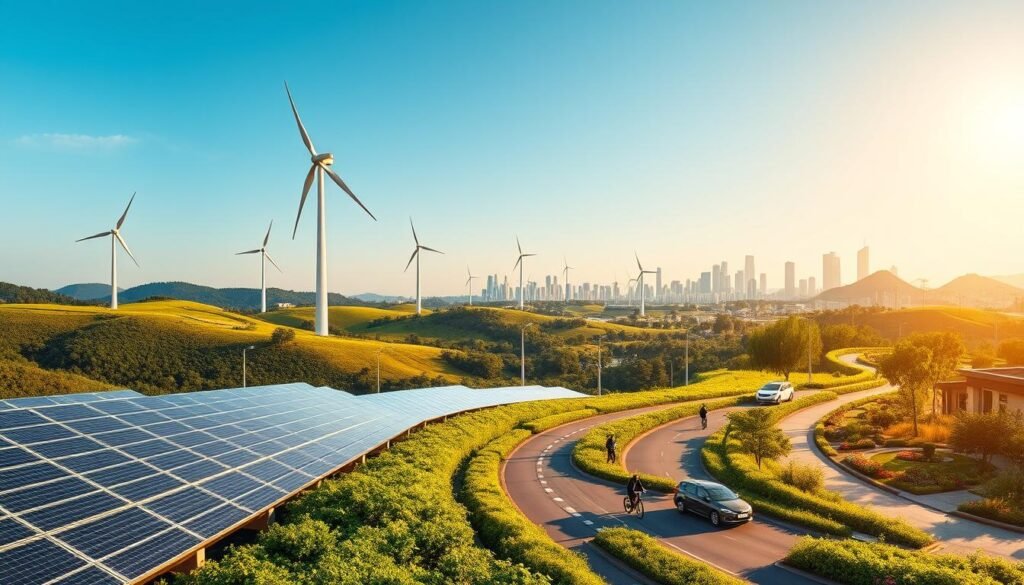
We see sustainability in India as a key to growth and strength. Small changes in policies can make a big difference. We focus on actions that help the environment and support people in rural areas and cities.
We set priorities that meet climate goals and economic needs. Setting clear targets and working with the private sector helps grow clean technology. Public programs need to match market signals for lasting impact on India’s future economy.
Green Energy Initiatives
India has made big strides in solar and wind power. The Mission Green Hydrogen aims to explore new fuels. Expanding nuclear power and opening it to private companies reduces imports and frees up money for development.
Offshore projects under the National Deepwater Exploration Mission open up new resources. We suggest upgrading grids and investing in storage to make sure renewables meet demand.
Sustainable Agriculture and Food Security
Agriculture is key to social stability and exports in India. The country is a leader in milk, pulses, rice, and wheat. Growth in agricultural exports has boosted farmer incomes and trade balances.
Programs like PM-Kisan and targeted schemes for backward districts help farmers. Irrigation projects, better seed distribution, and domestic fertilizer initiatives reduce dependence on imports.
| Initiative | Primary Goal | Short-Term Benefit | Long-Term Impact |
|---|---|---|---|
| Mission Green Hydrogen | Decarbonize industry and transport | New investment and jobs | Lower fossil fuel dependence |
| Solar & Wind Expansion | Increase renewable capacity | Reduce power imports | Stabilize energy costs |
| National Deepwater Exploration Mission | Discover offshore resources | Broaden energy mix | Enhance energy security |
| PM-Kisan & Targeted Farm Schemes | Support farmer incomes | Immediate cash transfers | Boost rural demand and productivity |
| Irrigation & Seed Programs | Improve yields and resilience | Higher crop output | Food sovereignty and export growth |
We need to track progress with clear metrics. These include the share of clean power, yield gains, and savings from reduced imports. These indicators show how rural prosperity supports sustainable development.
By adopting these practices, India can build a resilient, low-carbon, and inclusive economy. Working together, public and private sectors will be key to scaling up green energy and modernizing agriculture.
Infrastructure Development in India
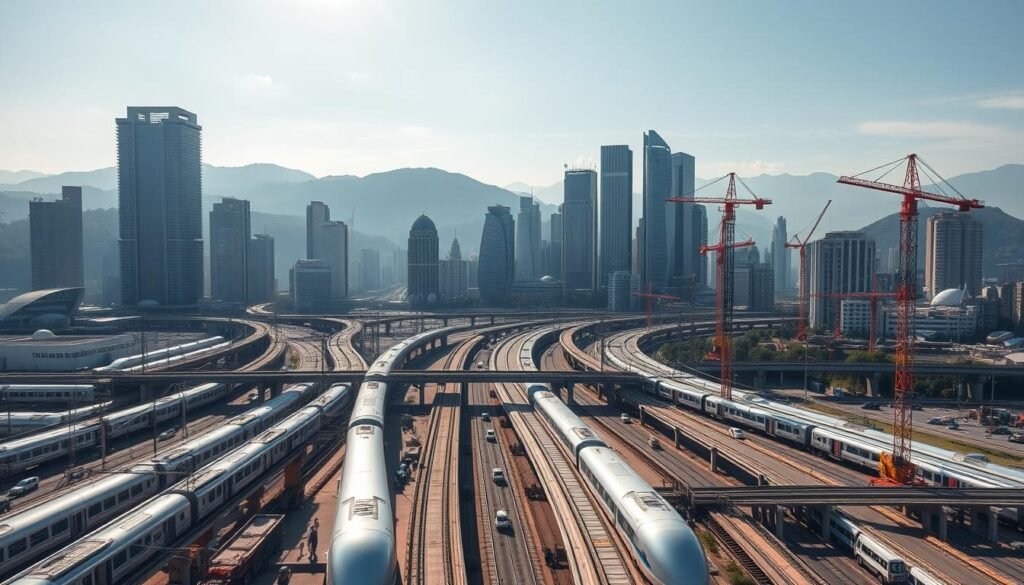
We see infrastructure as the key to India’s success by 2047. We need to invest in physical and digital networks. This will boost regional growth, balance costs, and create tech and manufacturing hubs.
Transportation Projects
Our focus is on rail, road, ports, and logistics to connect markets. Improvements in freight corridors and coastal shipping reduce costs and times. This makes secondary cities more competitive.
Examples include port expansions in Kamarajar and Mundra, expressways near Ahmedabad, and Telangana’s TS-iPASS. These efforts are key to spreading tech centers beyond big cities.
Urbanization and Smart Cities
India’s rapid growth puts a strain on infrastructure. Cities like Bengaluru, Mumbai, and Delhi face high living costs. We need to invest in public transit, housing, and utilities to keep talent.
Smart cities aim to copy Bengaluru’s success in 25–30 cities by 2047. Regional corridors and education pipelines are part of this plan. It’s about building a strong urban model.
To achieve this, we’re working on municipal finance, digital city management, and subsidies. These steps will spread opportunities and support India’s growth toward 2047.
Global Trade and India’s Position
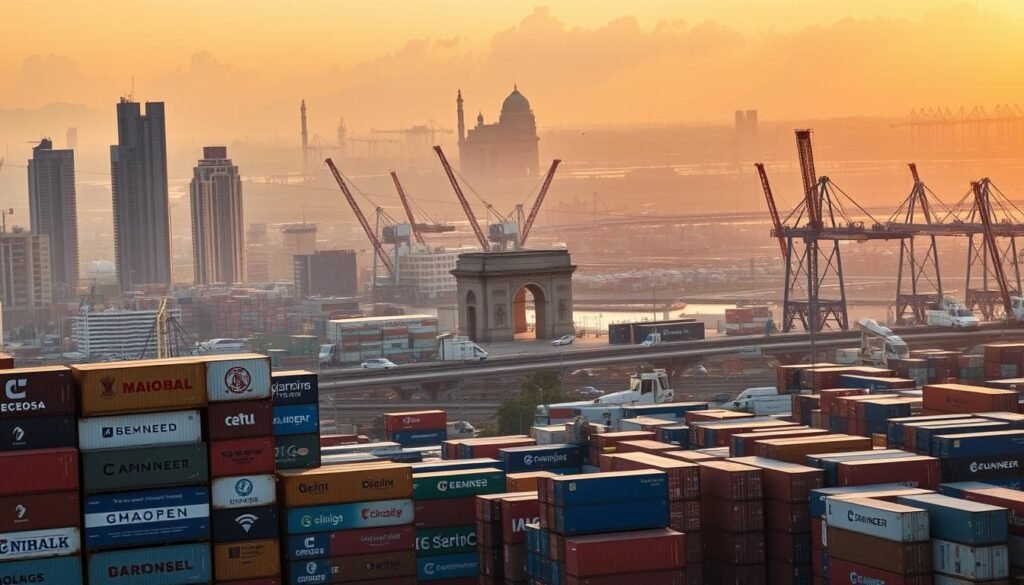
Global trade in India is a journey of growth and strength. It combines deep services expertise with a rising manufacturing sector. Software services exports, worth about $235 billion, are key to its ties with advanced economies.
This foundation gives India a strong position as it expands in semiconductors, defence, and pharmaceuticals.
Indian economy projections guide policy and investment. They help firms diversify supply chains and regulators balance openness with strategic goals. Clear goals also help exporters meet standards like “Zero Defect, Zero Effect” and gain trust in global chains.
Trade Relationships with the U.S. and Europe
Trade with the U.S. and Europe is based on services, technology, and high-value goods. Firms like TCS, Infosys, and Wipro lead in services. Talks now focus on key areas like secure chips, joint tech research, and easier rules.
New Delhi is sending signals: support for Make in India, export focus in PM Modi’s speeches, and reforms to ease exports. These steps aim to boost India’s export power.
Emerging Markets Opportunities
Opportunities exist in Africa, Southeast Asia, and Latin America. India’s agri-exports and remittances, around $125 billion, show its strength beyond traditional markets. Reforms for MSMEs aim to prepare small exporters for new markets.
Partnerships in renewables, deep tech, and semiconductors with emerging markets are expected. Indian firms can offer cost-effective engineering and talent. This opens up new value-chain opportunities that match India’s economy and export goals.
Impact of Demographics on the Economy

India’s population mix offers a unique chance. A large youth cohort is entering the workforce as technology and investment grow. This will shape India’s future economy.
Policies and industry moves are turning this chance into real results. The private sector and public programs are creating paths from campuses to high-tech jobs. We see how these efforts expand employment, raise wages, and create new clusters beyond Mumbai and Bengaluru.
Youth Population as a Workforce Asset
India’s young talent pool includes millions trained in STEM and software engineering. Startups, manufacturing firms, and research labs are tapping this talent to power innovation. Programs like PM Viksit Bharat Rozgar Yojana offer direct incentives to hire and train, pushing the youth workforce into productive roles.
Firms like Tata Consultancy Services, Infosys, and Larsen & Toubro hire at scale and run campus programs. These programs shorten the learning curve. We expect such hires to influence sectoral growth over the next two decades.
Education and Skill Development
Universities and institutes are revising curricula to include deep-tech fields like AI and biotech. The government’s expansion of research fellowships and a Centre of Excellence in AI strengthens the pipeline for advanced skills.
Industry-academia partnerships, campus incubators, and centers of excellence are making hands-on learning standard. This practical focus supports faster deployment of talent into hi-tech hubs and manufacturing parks, vital for the future economy.
| Area | Initiative | Impact on Workforce |
|---|---|---|
| Employment Promotion | PM Viksit Bharat Rozgar Yojana (stipends, hiring incentives) | Accelerates placement of young workers into formal jobs; raises earnings |
| Advanced Research | Prime Minister’s Research Fellows expansion; Centre of Excellence in AI (₹500 crore) | Builds high-end research capacity; fuels startups and industry R&D |
| Curriculum Reform | Deep-tech integration in universities | Shortens industry onboarding; increases technical readiness |
| Industry Partnerships | Campus incubators and CoEs | Supports entrepreneurial skills; creates local job ecosystems |
| Regional Development | Hubs outside metros, skill centers in smaller cities | Broadens geographic access to jobs; reduces urban congestion |
Government Policies Supporting Growth
We explore the policies that aim to boost India by 2047. These policies aim to make it easier for entrepreneurs and engineers. They simplify rules, reduce red tape, and focus on key sectors.
Economic Reforms and Regulations
The government has made big changes in the economy. They have repealed over 1,500 old laws and cut more than 40,000 compliances. They also combined codes like the Bharatiya Nyay Sanhita.
This makes it easier for businesses to operate and lowers costs. The Task Force for Next-Generation Reforms is also working. They aim to review more laws and suggest more deregulation.
The World Bank Group supports growth that is efficient and competitive. For more on their work in India, see this overview: World Bank India overview.
Incentives for Investors
The budget now includes funds to attract capital. There’s ₹20,000 crore for private R&D and ₹10,000 crore for deep-tech startups. Sectoral missions like the India Semiconductor Mission and National Quantum Mission also offer new investment opportunities.
Policy changes also make it easier to invest in sensitive areas. They offer tax exemptions and simplify GST rules for MSMEs. These steps aim to boost domestic entrepreneurship and confidence among global investors.
- Direct capital: mission funds for R&D and scale-up.
- Sector focus: semiconductors, quantum technologies, and advanced manufacturing.
- Regulatory relief: fewer compliances, simplified tax processes.
We believe these reforms and incentives will drive India’s growth towards 2047. They should make it easier to do business, attract more investment, and create jobs in important sectors.
The Role of Foreign Investment
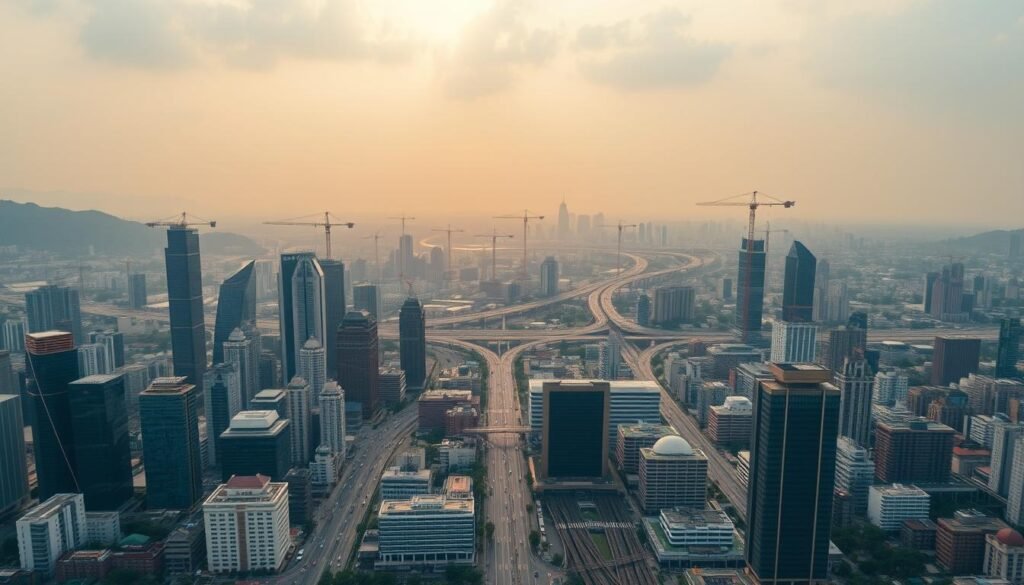
Foreign capital is key for India’s future. It can help build skills, fund new technologies, and make exports better. Leaders need to make rules clear and consistent to attract lasting partnerships.
Attracting Global Investors
We need to tell a story that draws in investors. Clear rules on intellectual property and support for new sectors can help. Focusing on areas like semiconductors and advanced manufacturing shows we’re serious.
States need to make it easy to do business. Good incentives, simple rules, and fair dispute resolution help. This mix of reforms and self-reliance can turn foreign capital into lasting projects.
Impact of FDI on the Economy
FDI does more than just bring money. It brings technology, strengthens supply chains, and builds skills. These efforts can boost innovation and exports, helping India grow.
Success needs steady rules and strong state action. A Deep Tech Fund of Funds could help fill funding gaps and support innovation.
- Technology transfer: Raises local capabilities and boosts productivity.
- Export competitiveness: FDI helps firms meet global standards and access markets.
- Job quality: Investment brings higher-skill roles and training opportunities.
We should see foreign investment as a partnership. Long-term success needs consistent policies, teamwork, and patient capital. This approach will help attract more investors and boost India’s future.
The Future of Employment in India
We are entering a critical decade for India’s economy. New sectors and technology will create jobs. But, we must protect workers during these changes. We aim to link education, industry, and social policy for everyone’s benefit.
Job growth will focus on areas like IT, deep tech, and renewable energy. The IT sector already employs over 7.5 million people. Growth in smaller cities will create more jobs and boost local economies.
Programs like PM Viksit Bharat Rozgar Yojana aim to hire more youth. Infrastructure and manufacturing projects will create more jobs. These efforts will help India’s economy grow and strengthen local job markets.
Deep-tech fields like AI and biotech will create new roles. Renewable energy projects need skilled workers. Agritech will also create jobs in data-driven farming and food processing.
India needs to adapt to automation and AI. Universities are adding deep-tech training. Centers of Excellence offer testbeds and pathways for workers to move up.
Reskilling is key: short courses, apprenticeships, and partnerships will help. Policymakers should fund long-term initiatives. This will balance automation’s benefits with job creation.
Social protections are important: unemployment insurance and support for displaced workers. These measures will help workers adapt. They also ensure green jobs are fair and sustainable.
We need action from government, industry, and academia. Together, we can shape India’s future jobs. This will help India’s economy grow while ensuring fair access to new opportunities.
Conclusion: Charting the Path to 2047
We have a clear vision for India’s future. We aim to reach $10 trillion by 2047. But, we also see a path to $25–30 trillion if we focus on deep-tech, infrastructure, and human capital.
To achieve this, we need clear goals and steps. We must balance ambition with practical policies. This will help improve the economy in all sectors.
Collaboration is key to our success. Governments, industries, and academia must work together. This is seen in Hyderabad’s growth and Karnataka’s Beyond Bengaluru initiative.
We need to invest in infrastructure and simplify national reforms. Strong partnerships between industries and academia will unlock India’s growth.
Sustainability is essential for India’s future. We aim to use AI, semiconductors, biotech, and fintech to grow services to 75–80% of GDP. We also plan to grow 25–30 hi-tech centres and reach 50% clean energy by 2030.
Securing food sovereignty and resilient supply chains is vital. This will protect employment and exports, building a strong foundation for 2047.
We invite everyone to join this conversation. Share your research to refine our roadmap. Learn more about our strategy: the roadmap to India 2047. Together, we can achieve lasting prosperity and sustainability for future generations.