



The Ministry of Agriculture & Farmers Welfare has shared exciting news. They say India’s foodgrain production hit 357 million tonnes this year. This is the highest ever recorded.
This achievement is based on data from rice, wheat, and coarse grains, as well as pulses. It’s a big win for India’s farmers and the country’s food supply.
The Food Corporation of India and the Department of Food and Public Distribution also have data. They show more food being bought and stored. States like Uttar Pradesh, Punjab, and Maharashtra also reported great harvests.
This achievement is important for many reasons. It means more food for people, influences the market, and helps plan for the future. We’ll look into how this happened and what it means for India’s farming and economy.
Overview of the Record Foodgrain Production
We give a quick look at the 357 million tonnes milestone and its context. This part explains the numbers, the crops involved, and why the India Agriculture Report and farming updates in India are important. They help planners and educators.
Summary of the 357 million tonnes milestone
The headline figure includes rice, wheat, coarse cereals, and pulses from kharif and rabi seasons. The total is for the latest marketing year and shows a big increase from the year before.
Rice and wheat make up most of the total. Pulses and coarse cereals add variety and nutrition. They also help with crop rotation and making farming more resilient.
Comparison with previous production years
- Year-on-year trend: the latest total beats last year by a clear percentage, showing a long-term recovery from some shortfalls.
- Three-year view: totals have been growing steadily after a small drop two seasons ago. Rice and wheat yield improvements per hectare are key to this growth.
- Per-hectare metrics: national average yields for rice and wheat have gone up, making them stand out in history.
Key cereals and staples contributing to the total
Rice and wheat are the main contributors, with rice leading in the east and south, and wheat in the north. Maize and millets add to coarse cereals, and chickpea, pigeon pea, and lentils boost pulse output.
Regional patterns are key for storage, transport, and processing needs. The east for paddy, the Indo-Gangetic wheat plains, and the central maize corridors each have unique infrastructure needs.
For engineers and educators, the India Agriculture Report and farming updates in India offer vital data. They guide infrastructure design, cold storage planning, and curriculum focus. Key areas include seed improvement, irrigation technology, and post-harvest engineering.
India Agriculture Report: Latest Findings and Data
We share the newest data and how we get the numbers in India’s agriculture news. This part talks about where we get our data, how we estimate crops, and how we break down production by state.
Official sources and data release details
Our main sources are the Ministry of Agriculture & Farmers Welfare, the Directorate of Economics and Statistics, and the Food Corporation of India. They all give us updates on crop production.
State agriculture departments and national surveys also help. We get these updates as PDFs and datasets. The first numbers are provisional and can change after more data comes in.
Methodology used to calculate production figures
We use many sources to figure out how much is produced. We start with sowing-area estimates from Crop Area Production and Yield (CAY) frameworks. Then, we use Crop Cutting Experiments and surveys to measure yields.
Remote sensing from satellites helps us estimate areas early on. We mix these numbers together to get the total production. We treat different crops differently, like pulses and coarse cereals versus irrigated wheat and rice.
We also look at how sure we are of our numbers. This includes checking the margin of error and confidence intervals. When we get more data, we can update our numbers.
Regional breakdown of production by state
- Big producers like Uttar Pradesh, Punjab, Haryana, and Andhra Pradesh make up a lot of the total.
- Places like Maharashtra and Karnataka are growing faster, even with less land.
- Some states are doing worse because of bad weather. Monsoon problems and floods hurt their crops.
The India Agriculture Report has detailed tables and maps for each state. These help analysts match local reports with national totals for accurate foodgrain production estimates.
Factors Driving the Record Harvest
Three main factors led to India’s record foodgrain production: timely rains, better seeds and practices, and smarter water use. These elements worked together to increase yields in both kharif and rabi seasons. This section explains these factors for those interested in farming updates India.
Favorable weather and monsoon performance
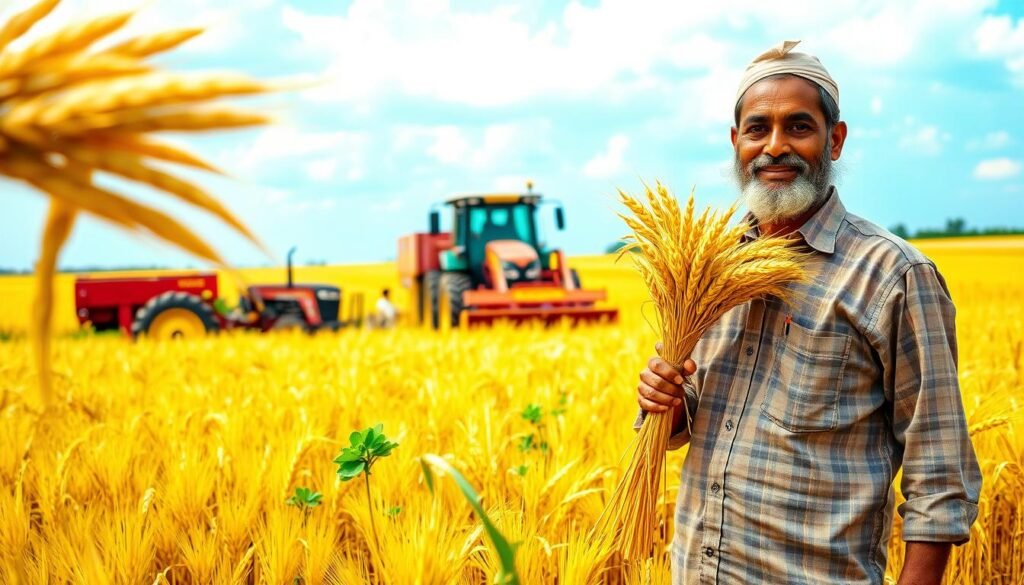
The southwest monsoon arrived on time, bringing near-normal rainfall evenly across the country. Many key growing areas saw rainfall within 5% to 10% of the long-term average. Post-monsoon rains helped reduce moisture stress, keeping yields steady in crops like maize, rice, and pulses.
Good weather conditions, like a neutral Indian Ocean Dipole and weak El Niño, helped avoid droughts. These weather patterns are now a key part of India’s agriculture news because they affect millions of hectares.
Improved seed varieties and farming practices
Using high-yielding and hybrid seeds from public and private sources boosted output. These seeds were more resistant to pests and matured faster, giving farmers more flexibility.
Using balanced nutrients and soil tests reduced yield gaps. Practices like integrated pest management and conservation agriculture lowered costs and protected soil. These methods are often highlighted in farming updates India as ways to improve.
Irrigation and water management improvements
More canals and better pumps made irrigation more reliable. Micro-irrigation systems, like drip and sprinkler, cut water use in horticulture and high-value cereals.
Modernization efforts, led by engineers, included solar pumps and automated systems. These made irrigation more efficient. Watershed projects and groundwater recharge raised soil moisture. Precision water use and scheduling helped stabilize yields during dry times, a key topic in India’s agriculture news.
- Timely rainfall reduced crop losses and lowered irrigation pressure.
- Seed R&D and widespread adoption of hybrids lifted possible yields.
- Infrastructure upgrades and smart irrigation raised water-use efficiency.
These factors combined to set a new record in India’s foodgrain production. We will continue to monitor these elements in future farming updates India, keeping everyone informed.
Role of Government Policies and Support
We look at how government policies influenced planting decisions and farm investments this season. These policies did more than just give money; they also reduced uncertainty. They encouraged the use of new technology across states.
Subsidies, price assurance and procurement
The Union government set minimum support prices for staples. This gave farmers a clear revenue floor. The Food Corporation of India and state agencies bought these crops, creating a steady market.
This season, rice and wheat MSPs saw small increases. Punjab and Haryana saw higher procurement volumes. This helped farmers buy inputs and plant on time.
Crop insurance and risk mitigation
The Pradhan Mantri Fasal Bima Yojana covered more areas and settled claims faster. State schemes in Maharashtra and Karnataka added to the national program. This made farmers more likely to invest in better seeds and fertiliser.
Extension services and farmer training
Krishi Vigyan Kendras and state extension wings ran farmer field schools. They showed how package practices could increase yields. Public-private partnerships gave farmers digital advice and market info.
This helped farmers adopt new technology faster. It promoted best practices on a large scale.
Policy levers for technical readers
- Incentives changed how farmers adopted new technology: price signals and procurement made returns look better.
- Insurance made farmers more likely to invest in hybrid seeds and machinery.
- Investments in rural roads, cold storage, and electrification improved market access and lowered costs.
For those following economic news India, these policies show up in macro indicators. Rural incomes rose, input sales increased, and cropping patterns changed. Ongoing India agriculture news shows policymakers linking support to productivity goals, not just short-term relief.
Impact on Food Security in India
We look at how the record harvest changes food availability, nutrition, and long-term food security in India. The increase in output affects public schemes, household diets, and research priorities. This brief explores buffer stocks, access in vulnerable areas, and what sustaining gains will require.
Domestic availability and buffer stocks
A historic rise in foodgrain production in India boosts the amount entering the Food Corporation of India (FCI) system and state warehouses. Larger harvests help replenish buffer stocks that feed the Public Distribution System (PDS) and bridge lean seasons. Yet, storage capacity and quality are key: grain losses from poor warehouses can reduce the benefit of higher output.
Nutrition and access in vulnerable regions
Gains in pulses and coarse cereals improve local access to protein and micronutrients where these crops are produced. Programs like POSHAN Abhiyaan can link higher output to school meals and maternal nutrition programs. Rural and remote areas face distribution gaps: conflict-affected districts, hilly terrains, and islands need tailored logistics to improve diets.
Long-term food security implications
Higher foodgrain production in India supports short-term availability but does not ensure lasting food security nationwide. Sustained outcomes depend on investments in quality storage, crop diversification toward nutrient-dense varieties, and price stability. Without these, seasonal surplus may not improve nutritional outcomes or reduce vulnerability to shocks.
For educators and researchers, there is a clear agenda. Link harvest data with nutrition outcomes, evaluate PDS performance at district level, and design social protection that adapts to changing production patterns. This work will help convert India agriculture news into evidence that strengthens policy and practice.
Economic Implications for India

We look at how more foodgrain production in India changes rural life, big economic numbers, and prices. The latest India Agriculture Report gives us the numbers to understand how people make money and what policies can help.
Effect on rural incomes and the farm economy
More food and bigger sales can mean more money for farmers. When the government buys more food, small farmers and medium-sized farms get more cash during harvest time.
But, costs like fertilizer, diesel, and labor can eat into these gains. The size of a farm matters a lot. Big farms get more benefits, while tiny ones see little change.
We use a special way to figure out how income changes. We also look at how the non-farm sector in rural areas helps. This uses data from input-output tables and surveys on what people buy.
Contribution to GDP and agricultural growth rates
More food production means more for the economy’s growth. It helps the primary sector grow and can push up GDP, even in slow times.
We connect the India Agriculture Report numbers to the country’s economic accounts. This shows how much the sector grows and how it affects other parts of the economy through lower prices.
Inflation and food price trends
Having lots of food can lower prices and slow down inflation. This means cheaper food for people, helping those who earn less.
Government actions, like selling from stockpiles or limiting exports, can also affect prices. Different foods, like rice and wheat, might go up or down, while others like pulses or oils could follow their own paths.
We use special models to understand inflation. We look at supply shocks and how policies can change prices in the short and long term.
- Data inputs: procurement volumes, support prices, and state-level yields from the India Agriculture Report.
- Analytic tools: partial equilibrium, input-output multipliers and VAR models for price transmission.
- Policy levers: buffer stock releases, targeted subsidies and trade measures that affect market stability.
Export Potal and International Trade Effects
We look at how India’s high foodgrain production opens up export chances. It keeps enough food for the country. Excess food can be sold abroad, affecting revenue and food security.
First, we figure out how much food can be sold. Non-basmati rice and parboiled rice are big sellers. Wheat and coarse grains like maize also have their markets.
- Rice: steady export volumes once domestic procurement targets are met.
- Wheat: conditional exports tied to policy clearances and buffer levels.
- Coarse grains: flexible flows to feed markets in Africa and Asia.
Global market demand and price dynamics
We watch the world market to guide exports. When the Black Sea has less food, India’s exports become more valuable. Countries like Bangladesh and Nepal, and some in West Africa, are big buyers.
- Demand drivers: import needs of South Asian and African countries.
- Price factors: freight rates, global cereal inventories, and seasonal harvests.
- Timing: early shipments capture higher windows when competitors face shortfalls.
Trade policy considerations and export restrictions
Policymakers balance exports with keeping food affordable. They use export permits and duties to control prices. This helps protect consumers.
For those in logistics, quality is key for exports. Products need to meet standards and be properly packaged. Good storage and moisture control are also important.
Trade policies will continue to be a big topic in India. We’ll follow how exports change based on global demand and domestic needs.
State-Level Success Stories and Case Studies
We look at examples from states and districts that boosted national numbers. These stories show how focused efforts, farmer groups, and new farm methods led to better yields and savings. Learn from these strategies to help farming in India grow.
High-performing states
- Punjab and Haryana: They used big machines and efficient water systems to improve farming. This cut costs and time needed to harvest by up to 40 percent in some areas.
- Andhra Pradesh and West Bengal: They worked on making paddy better. They used better nurseries, transplanting, and fertilizer schedules to increase rice yields.
- Maharashtra: They tried new things for dryland farming. This included drought-resistant crops and ways to keep soil moist, leading to more grain.
District-level innovations
- Greenhouses helped vegetables grow more. This led to longer sales times and 25–40 percent more money for farmers in test areas.
- Using less water for farming helped crops grow more. Many districts saved 20–30 percent water with drip and sprinkler systems.
- Testing soil and using nutrients wisely saved money and made crops better. Farmers saw these benefits in just two seasons.
- Using machines for farming at the district level helped with labor and reduced waste. This made farms more profitable.
Cooperatives and collective action
- Producer companies and stronger credit groups helped farmers buy inputs cheaper. This lowered costs for seeds and fertilizer.
- Dairy-style groups helped farmers get better prices for their crops. This was through buying together, using cold storage, and negotiating prices.
- Groups that sold together and used digital markets got higher prices. They also reduced waste after harvest.
These examples teach us important lessons. We should use more micro-irrigation, reach more farmers with advice, and help them sell more. These steps are often mentioned in India agriculture news and reports as ways to make farming better and more resilient.
Technological Advances in Indian Farming
We look at how new tools change how farmers make decisions and reach markets in India. They use GPS, remote sensing, and mobile advice to grow more and waste less. News and reports show more farmers are using these tools in many states.
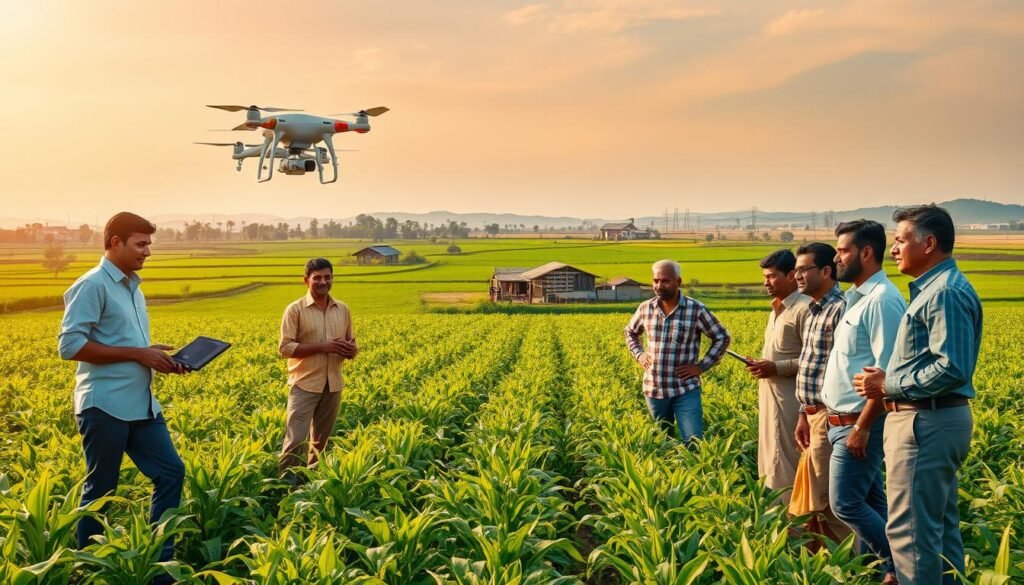
Tools like GPS-guided tractors and variable-rate applicators help farmers use inputs wisely. They reduce waste and save money. Systems also suggest the best times to plant and how much to fertilize based on local data.
Practical gains: less cost, better records, and faster work.
Remote monitoring uses drones, sensors, and satellite images from ISRO and NRSC. Drones check crop health and spray where needed. Soil sensors control irrigation, and satellites help estimate yields when data is scarce.
- Crop health mapping for targeted spraying
- Soil moisture networks to save water
- Yield estimation using satellite and field data
Mobile apps give farmers alerts and connect them to markets. Government SMS and private apps send weather and pest alerts. Platforms like e-NAM make bidding and shipping easier, and fintech apps help with buying inputs and getting credit.
But, there are challenges: different data standards, many platforms, and limited local language support. Training and easy-to-use interfaces help more farmers use these tools, as seen in farming updates India and the India Agriculture Report.
We suggest focusing on making tools work together, designing for farmers, and training at the district level. Better internet and open data policies could link sensors, satellites, and markets, making farmers trust these systems.
Challenges Remaining for Sustainable Production
We celebrate a record harvest but see ongoing risks. Sustainable growth depends on improving soil, water, and facing climate threats. Engineers, agronomists, and policymakers must unite to act on the India Agriculture Report.
Soil health is fragile in many areas. Soil organic carbon and nutrient imbalances from NPK overuse weaken fertility. Salinity and alkalinity harm irrigated lands in Punjab, Haryana, and Andhra Pradesh.
The Soil Health Card scheme is a start. It aims for balanced fertilization and soil management. We need to scale up cover crops, organic amendments, and microbial inoculants.
Engineers should design affordable soil sensors and tools. These tools should help farmers make informed decisions. Small plots need simple, low-cost solutions for soil health.
Water scarcity limits yields. Groundwater depletion is a big problem in the Indo-Gangetic Plain and western India. We must adopt micro-irrigation and on-farm recharge projects.
Changing crops from water-intensive sugarcane and rice can help. Engineers can develop drip systems and smart controllers to save water.
Climate risks are growing. Heatwaves, erratic monsoons, and storms disrupt planting and harvest. Seed companies like Syngenta and ICRISAT have drought-tolerant seeds, but wider use is needed.
Crop insurance should offer dynamic pricing and faster claims. This will help farmers stay resilient. We need climate-resilient varieties and climate-smart agronomy.
Engineers and climate scientists can improve forecasts and advisories. This will help farmers adapt to changing weather. We expect future updates to focus on these technologies and policies.
- Short-term fixes: targeted nutrient use, precision irrigation, and adaptive sowing dates.
- Medium-term investments: recharge infrastructure, sensor networks, and cold chains for diversified crops.
- Long-term priorities: crop diversification, institutional reforms, and research into resilient systems.
We look forward to future farming updates in India. Coordinated investment will protect food security and make the India Agriculture Report a reality.
Supply Chain, Storage, and Post-Harvest Management
We look at ways to protect the harvest and keep its value. Good logistics and quality control are key. They help bridge the gap between foodgrain production in India and what reaches markets. This is important for India agriculture news and farming updates that farmers and policymakers need.
Grain storage capacity and quality control:
- Public and private storage, led by the Food Corporation of India and commercial silos, cover a large share of cereal needs. Gaps remain where spoilage occurs due to poor ventilation and high moisture.
- Engineering fixes reduce losses: modern vertical silos, hermetic bags, and standardized fumigation protocols protect seed and grain quality.
- Simple monitoring—moisture meters and routine pest checks—gives early warning and keeps stocks market-ready, which supports credible India agriculture news reporting.
Cold chain and logistics for perishables:
- Perishable crops lack continuous refrigerated links from farm to retail. That shortfall lowers returns for horticulture and dairy farmers.
- Key interventions include refrigerated transport, pack-houses near collection centers, and coordinated last-mile pickup to preserve freshness and nutrition.
- Low-cost refrigeration and modular cold rooms make diversification feasible for smallholders. These improvements will appear often in farming updates India coverage.
Reducing post-harvest losses and wastage:
- Estimates put post-harvest loss for fruits, vegetables and cereals in double digits nationally. Reducing loss raises incomes without expanding cultivated area.
- Operational fixes: timely harvest with combine harvesters, on-farm threshing, decentralized storage hubs, and farmer aggregation models that boost bargaining power.
- Technical tools—solar dryers, low-cost mechanical driers and IoT-enabled inventory tracking—lower spoilage and inform market timing.
We see engineering innovations as levers: solar-assisted dryers for cereals, IoT sensors for moisture and temperature, and blockchain-style traceability for consignments. These approaches tie supply-chain resilience to the broader narrative in foodgrain production India and help shape responsible India agriculture news and practical farming updates India for the coming seasons.
Implications for Smallholder Farmers
We look at how national yield increases affect small farmers. The India Agriculture Report shows more food, but small farmers don’t always get more money. Who gets richer depends on wages, hired help, and farm size.
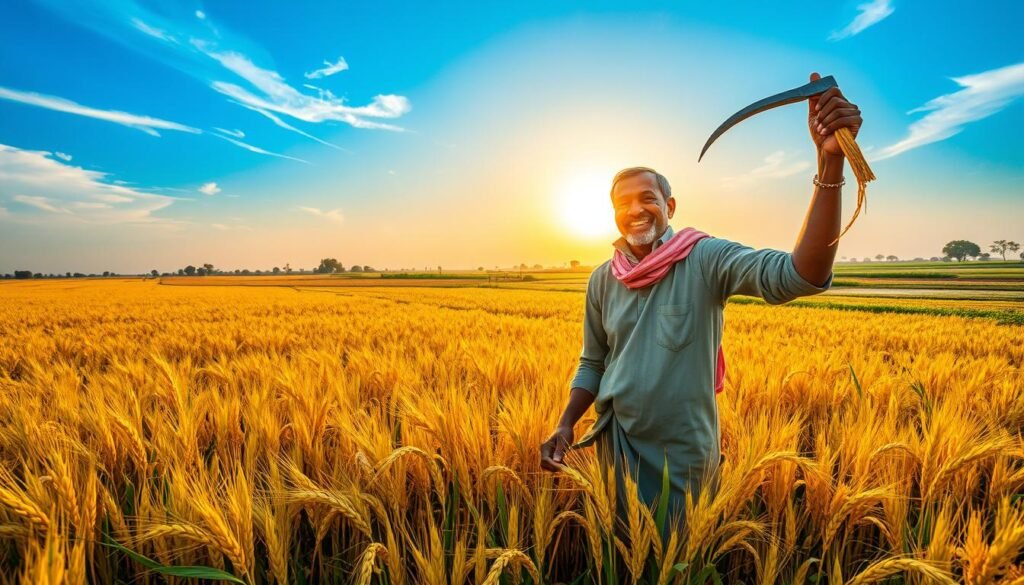
Small farms struggle because of high costs. They can’t afford big machines or get discounts on inputs. When there’s too much food, prices drop, and wages for landless workers might fall. But, mid-size farmers often make more money.
Access to credit, inputs and markets
Small farmers often can’t get loans for good seeds and fertilizers. They also face high costs to sell their products. Digital platforms and programs can help if they reach farmers and have clear terms.
- Microcredit for crops helps with money flow.
- Buying seeds and fertilizers together saves money.
- Working together to sell products improves prices.
Empowerment through cooperatives and producer companies
Groups of farmers can negotiate better prices and lower costs. Producer companies help with packaging and adding value. This way, small farmers can sell more and get better prices.
- Combining harvests to meet big buyers’ needs.
- Shared facilities for quality checks and storage.
- Direct deals with buyers and sellers.
Policy needs to be specific: subsidies, microcredit, better extension services, and support for groups. These steps help small farmers get their fair share. They reduce risks, open new markets, and make sure everyone benefits from more food.
Media Coverage and Public Reaction in India
We looked at how national and local news covered the record foodgrain output. Stories ranged from data-focused reports to personal tales of success. This mix shaped the conversation in India’s agriculture and economic news.
How national and regional outlets framed the milestone
The Hindu, The Times of India, The Indian Express, and Business Standard highlighted the harvest’s scale. They also mentioned state procurement figures. Local papers in Punjab, Uttar Pradesh, and Andhra Pradesh shared district successes and the role of cooperatives.
TV channels mixed headlines with analysis on distribution and storage. This made the India Agriculture Report findings more accessible. It also linked production data to policy discussions.
Public sentiment and farmer community responses
Many farmers were proud of their higher yields. They talked about better inputs and irrigation. Farmer unions were cautiously optimistic, but worried about prices.
Urban consumers were interested in whether food prices would drop. Social media reflected both celebrations and concerns. This shaped the immediate public discussion on India’s agriculture news.
Commentary from economists and policy analysts
Experts at NITI Aayog, economists from the Institute for Human Development, and agricultural university faculty offered their views. They talked about sustainability risks and the need for better storage. They also stressed the importance of turning output gains into rural income growth.
Policy analysts suggested reforms in procurement, stronger market links, and more investment in post-harvest systems. These ideas were key in economic news India and the India Agriculture Report.
Media framing is important. It influences public debate and helps professionals plan their outreach, policy engagement, and stakeholder communication.
What This Means for Future Farming Updates India
We look ahead to the next planting cycles with a focus on practical signals. The India Agriculture Report shows a turning point. Growers, researchers, and policymakers will watch changes in acreage, input use, and technology adoption.
Early indicators are key. Monsoon patterns, sowing acreage, and procurement decisions will guide future steps.
- Farmers might grow more oilseeds, pulses, and horticulture to improve nutrition and value. This change will show in sowing reports and market arrivals.
- Water-stressed areas might plant less rice and sugarcane. Instead, they might grow crops that need less water.
- Rotation and intercropping could become more common. This will happen where extension services and private seed companies offer support.
Policy changes to sustain production growth
- Policymakers will focus on expanding storage and improving market rules. This aims to stabilize prices and reduce losses.
- They will also support climate-smart practices and fund research for resilient crops. This will be seen in annual budgets and program announcements.
- Crop insurance and procurement rules might be updated. This will encourage better harvests and stronger buffer management for foodgrain production India.
Areas to watch in upcoming planting seasons
- Monsoon forecasts and early-season rainfall distribution are key. They set the baseline for sowing decisions across states.
- Sowing acreage and district-level yield indicators from sentinel districts featured in the India Agriculture Report.
- MSP notifications, procurement plans, and pest or disease alerts will influence planting choices and input flows.
For engineers and agritech teams, there’s a chance to make a difference. They can deploy sensors, build models for different cropping scenarios, and develop platforms that integrate weather, soil, and market signals. Working closely with NABARD, ICAR, and state extension networks will help speed up practical use and improve future farming updates India.
Conclusion
We see the 357 million tonnes milestone as a big win. It shows the power of strong monsoons, better seeds, and new farming methods. It also highlights the role of good policies.
This achievement is a result of teamwork between research, extension, and markets. It shows that just growing more food isn’t enough. We need to focus on quality too.
To make the most of this harvest, we need to invest in storage and cold chains. We also need to improve irrigation systems. This will help keep food safe and make our economy stronger.
Improving supply chains is key to better food security and more exports. This will make economic news in India more positive. We also need to take care of our soil, water, and nutrients for the future.
We encourage engineers, educators, and students to work together. They can use new technologies to help farmers. By doing this, we can make farming better for everyone and protect our environment.