



The Indian Institute of Science is a top research center in Bengaluru. It was founded in 1909 with help from Jamsetji Tata and Maharaja Krishnaraja Wadiyar IV. It’s known for combining deep learning with practical innovation.
Our campus covers 440 acres and has over 40 departments and centers. We have about 484 faculty members and more than 5,200 students. Most of our students are working on their doctorates, showing our commitment to scientific excellence.
Every year, we give out around 250 PhD and M.Tech (Research) degrees. Our work spans about 40 different fields. Our 2019 statement—”Discover and Innovate; Transform and Transcend; Serve and Lead”—shows our goal to lead in research and innovation.
For partnership or public engagement inquiries, contact us at info@indiavibes.today.
Overview of the Indian Institute of Science (IISc)
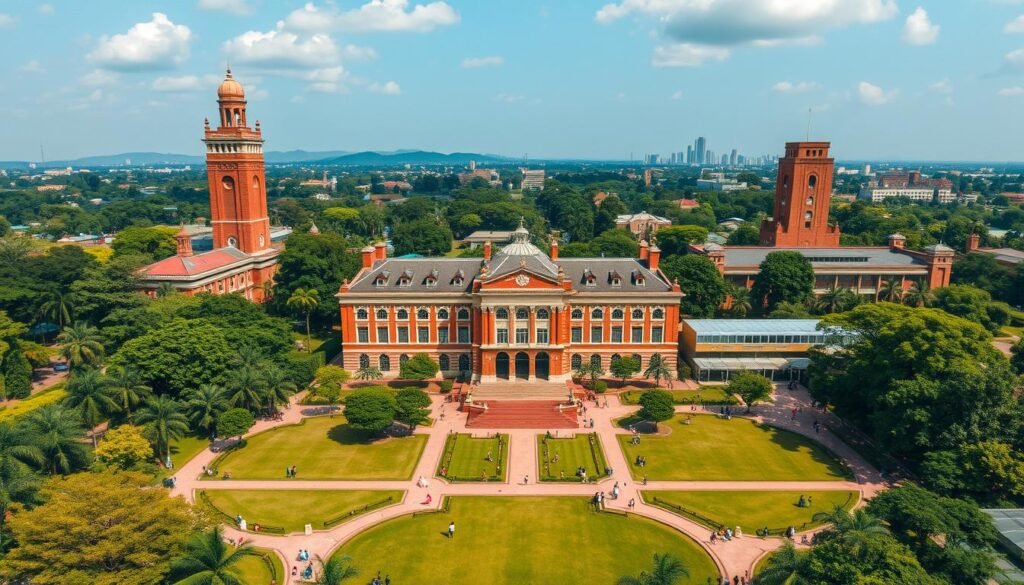
We introduce the institute with a brief look at its roots and goals. You’ll learn about the history that formed IISc and its mission. It’s a top research and academic institution in India.
History and Establishment
IISc was established in 1909, with the Viceroy’s approval. The foundation stone was laid in 1911. The first students started in 1911, studying chemistry and electro-technology.
Founding patrons helped shape the campus. Jamsetji Tata funded buildings, and Krishnaraja Wadiyar IV donated land and money. Later, Nizam Osman Ali Khan helped financially. Morris W. Travers was the first director, followed by Sir C.V. Raman and others.
Key milestones include becoming a deemed university in 1958 and Institute of Eminence in 2018. A major donation of Rs 425 crore in 2022 started a medical initiative. These events highlight IISc’s status as a premier research institution.
Mission and Vision
Our mission is to advance scientific research and education. We focus on rigorous training and innovation. We aim to balance basic research with practical applications.
We prioritize interdisciplinary research and talent development. We also value strong industry interaction and outreach. Units like the Centre for Continuing Education support these goals.
We focus on PhD programs with a strong emphasis on research. We also lead in computing and promote entrepreneurship. This approach keeps IISc at the forefront of global learning.
| Aspect | Highlights |
|---|---|
| Founding Year | Establishment 1909; first students admitted 24 July 1911 |
| Key Patrons | Jamsetji Tata; Krishnaraja Wadiyar IV; contributions from Nizam Osman Ali Khan |
| Early Leadership | Morris W. Travers (first director); Sir C.V. Raman (first Indian director) |
| Major Milestones | Deemed university (1958); Institute of Eminence (2018); Rs 425 crore donation (2022) |
| Core Mission | Advance scientific research, interdisciplinary innovation, talent development, industry impact |
| Institutional Focus | Rigorous research training, advanced computing leadership, entrepreneurship and technology licensing |
Cutting-Edge Research at IISc

The Indian Institute of Science focuses on scientific excellence. It does this through focused projects, high-performance computing, and campus-wide collaboration. The institute’s work combines curiosity-driven science with real-world applications. This keeps India at the forefront of global innovation.
Highlights of Recent Discoveries
IISc’s research has quickly moved from the lab to making a difference. Teams have developed rapid diagnostic reagents. These reagents have cut the time it takes for some tests.
A campus-incubated startup created a food-grade DNA/RNA stain. This stain is used in safer assays.
The Supercomputer Education and Research Centre hosts India’s first petascale Cray XC40. This supercomputer has powered large-scale simulations. These simulations are in materials science, climate modelling, and more.
Press coverage and the institute’s Research Highlights portal often feature breakthroughs. These breakthroughs are in biosciences, renewable energy, and data-driven engineering. They show the institute’s commitment to pioneering research.
Interdisciplinary Research Initiatives
IISc organizes work across different divisions. These include Biological, Chemical, Physical & Mathematical, and more. This structure encourages teams to work together on complex problems.
Interdisciplinary centres like the Centre for Sustainable Technologies support these efforts. They include the Interdisciplinary Centre for Energy Research and others. These centres help with projects that involve lab experiments, field trials, and policy analysis.
The Challakere Campus is home to a Solar Power Research Center and more. C-BELT—Centre for Bio-energy and Low-Carbon Technologies—links industry partners with academic groups. This supports practice-oriented work.
Such interdisciplinary research initiatives help teams combine domain depth with system-level views. This approach sustains scientific excellence. It also helps the institute stay at the forefront of research.
Innovation Hubs and Startups

We create a space where research turns into real-world solutions. Our campus is home to innovation hubs that help ideas become market-ready products. As a leading academic institution, we blend academic excellence with practical support.
This approach leads to a steady flow of startups at IISc. These startups tackle various fields like healthcare, software, and manufacturing.
Our incubators offer workspace, mentorship, and access to prototyping labs. We work with the Office of Intellectual Property and Technology Licensing and the Centre for Scientific & Industrial Consultancy. This helps manage patents and industry transfer.
This support boosts the chances of early ventures to succeed.
We support entrepreneurship with funding and programs. The Artificial Intelligence and Robotics Technology Park (ARTPARK) brought significant seed investment. This funding helps teams focus on product development, not just fundraising.
Industry interaction is key to our model. We have formal partnerships with DRDO, ISRO, Bharat Electronics Limited, CSIR, and others. These partnerships offer field trials, domain expertise, and procurement channels.
Encouraging entrepreneurship
We run mentorship clinics, demo days, and skill workshops. These programs sharpen founders’ business and technical skills. SID—the Society for Innovation and Development—manages these programs and connects teams with investors and corporate partners.
Notable startups emerging from IISc
- Strand Life Sciences — a genomics and bioinformatics company that grew from university research.
- Ittiam Systems — a signal-processing and multimedia software firm with strong industry roots.
- Morphing Machines — supported through campus incubators to commercialize advanced robotics concepts.
- Gamma Porite — a materials technology venture that began with lab-scale innovation.
We’ve seen lab-to-market translations that shorten diagnostic timelines and lower costs. For example, a food-grade DNA/RNA stain was developed here. It sped up testing workflows.
These successes show the impact of incubators and innovation hubs. As we grow, we aim to deepen industry interaction and expand incubator capacity. We want to make IISc a top choice for founders who seek rigorous science and clear market paths.
Faculty and Mentorship Programs

We create a place where deep learning meets guided support. At the Indian Institute of Science, a top research spot, we have a wide range of experts. They work in over 40 departments, helping students learn and grow.
Expertise of IISc Faculty
Our teachers are experts in many areas. This includes Biochemistry, Materials Research, and Physics. They also teach Computer Science, Aerospace, and Engineering.
Our staff includes winners of big awards and members of international groups. They lead important centers like the Centre for Brain Research.
With about 480 teachers, we focus on mentorship. This helps us stay at the top in science and engineering.
Mentorship Opportunities for Students
Our programs focus on teaching research skills. PhD and M.Tech (Research) students work on their theses. We also have integrated PhD and M.Sc. programs for new researchers.
Students get help from advisors and project mentors. We have great resources like the J. R. D. Tata Memorial Library. These help students work together with their teachers.
We also have special programs for skill development. These help students move from classwork to independent research. Our teachers guide them every step of the way.
The Role of IISc in Global Scientific Community
Indian Institute of Science is at the heart of a global network. It connects Bangalore to labs and universities worldwide. As a leading research organization, IISc promotes scientific excellence through various programs and shared resources.
Our global partnerships offer access to top-notch facilities, skilled professionals, and funding from around the world.
Collaborations with International Institutions
We have formal agreements with top institutions like Massachusetts Institute of Technology, University of Cambridge, and Max Planck Institutes. These partnerships involve joint grants, co-authored papers, and student exchanges.
Centres like the Supercomputer Education and Research Centre support global projects in computational science and materials research. Together, we work on climate modelling, biomedical engineering, and advanced materials.
Participation in Global Conferences
Our team regularly presents at major events like IEEE conferences, American Physical Society meetings, and EMBC symposia. This boosts our research’s visibility and opens up new collaboration chances.
Funding from the Office of Research Grants and departmental allocations helps with travel and conference fees. This support ensures our research is shared quickly and strengthens our global partnerships.
IISc’s Contributions to Technology Development

The Indian Institute of Science is a leading research center. It turns lab ideas into real-world products. The institute focuses on materials, computing, diagnostics, and aerospace systems.
IISc works with defense and space groups like DRDO and ISRO. It also partners with companies like Bharat Electronics Limited and Hindustan Aeronautics Limited. These partnerships help move new technologies into use faster.
The Office of Intellectual Property and Technology Licensing helps bring inventions to market. The Society for Innovation and Development supports this effort through incubation.
Impact on Industry and Society
IISc’s programs help industries develop faster and train skilled workers. For example, a HAL-funded center in Challakere trains technicians for advanced manufacturing. This training boosts hiring and job creation in the region.
The institute’s work in diagnostics and electronics improves health and technology. Faster, cheaper tests and wider access to healthcare are just a few benefits. The Supercomputer Education and Research Centre helps design safer aircraft and more efficient electronics.
Case Studies of Successful Technologies
Companies like Strand Life Sciences and Ittiam Systems started from IISc research. They grew into major successes. Their stories show how research can lead to market-ready products.
A start-up from the campus created a food-grade DNA/RNA stain. It reduced HIV diagnosis time from weeks to a day. This innovation has a direct impact on public health, leading to faster treatment and better health outcomes.
The Supercomputer Education and Research Centre has driven computational breakthroughs. It supports research that leads to new products and services. These examples show a clear path from research to industry adoption.
Student Life at IISc

Life at IISc is shaped by campus activities, study habits, and personal growth. The campus is a close community where learning, research, and fun mix. Students have access to resources for both long-term projects and quick creative ideas.
Academic Environment
The campus spans about 400–440 acres in north Bengaluru, focusing on research. It’s fully residential with hostels, dining halls, and housing for staff. This setup links work and life closely.
PhD students are the largest group, working on thesis projects with diverse coursework. The J. R. D. Tata Memorial Library and SERC provide key resources. The library has vast collections and online journals, while SERC offers computing for simulations.
Faculty mentorship and lab work make learning collaborative and challenging. Students improve their experimental skills, learn to write grants, and present at conferences.
Extracurricular Activities and Clubs
Our campus life is balanced with sports, cultural, and technical clubs. The gymkhana and sports grounds host tournaments and fitness programs. These activities keep students active while they study.
Student-led projects encourage entrepreneurship and community outreach. Teams create prototypes, host hackathons, and run workshops. Cultural festivals offer a chance for students to express their creativity through music, dance, and theatre.
The campus is home to over 100 species of plants and historical artifacts. This unique environment adds to the campus life. It encourages students to care for the environment and appreciate history.
Scholarships and Financial Aid
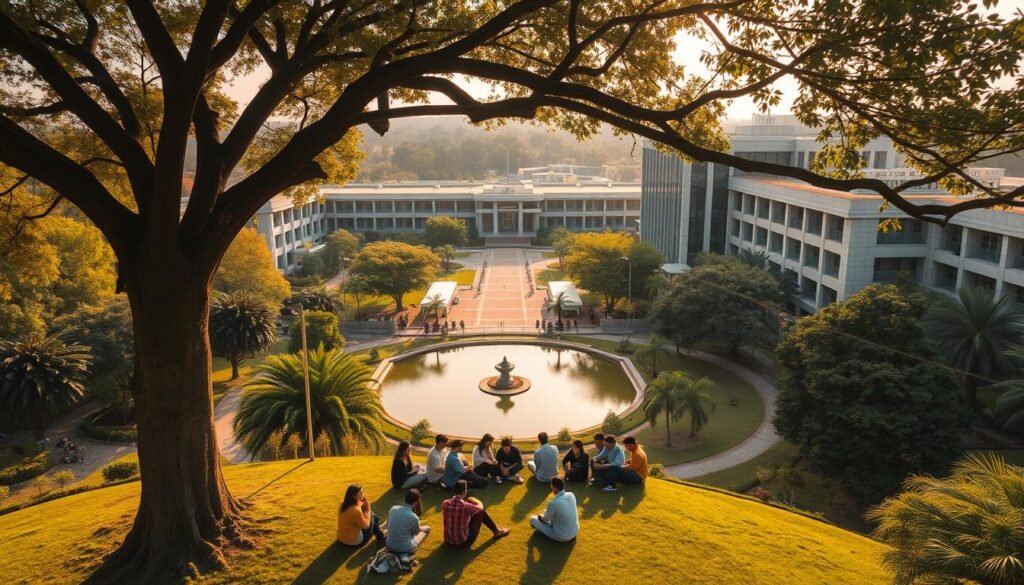
We explain how students and researchers get support at the Indian Institute of Science. The institute uses internal fellowships, partnerships with industry, and government grants. This helps keep costs down and supports research in different areas.
Overview of Financial Support Options
IISc offers many scholarships: fellowships for PhD students, project fellowships for research, and awards from industry. There are also grants from the Department of Science and Technology, corporate partnerships, and gifts from philanthropists. These help fund research and improve facilities.
The institute’s budget shows its commitment. It invests in libraries, facilities, and overall funding. This allows the institute to help students who are both talented and in need.
Application Process for Scholarships
Applicants start at the Online Admissions Applications Portal. Each department lists eligibility, deadlines, and fees on its admissions page. For research programs, departments explain how to apply and what documents are needed.
The Office of Sponsored Schemes and Projects and the Office of Research Grants help with applications. Check departmental pages for specific scholarships and confirm the forms needed before applying.
- PhD/M.Tech research intake: roughly 575 students annually.
- Key supports: stipends, contingency grants, and travel allowances tied to research funding.
- External sponsorships: industry scholarships and government fellowships augment institute aid.
Outreach and Public Engagement
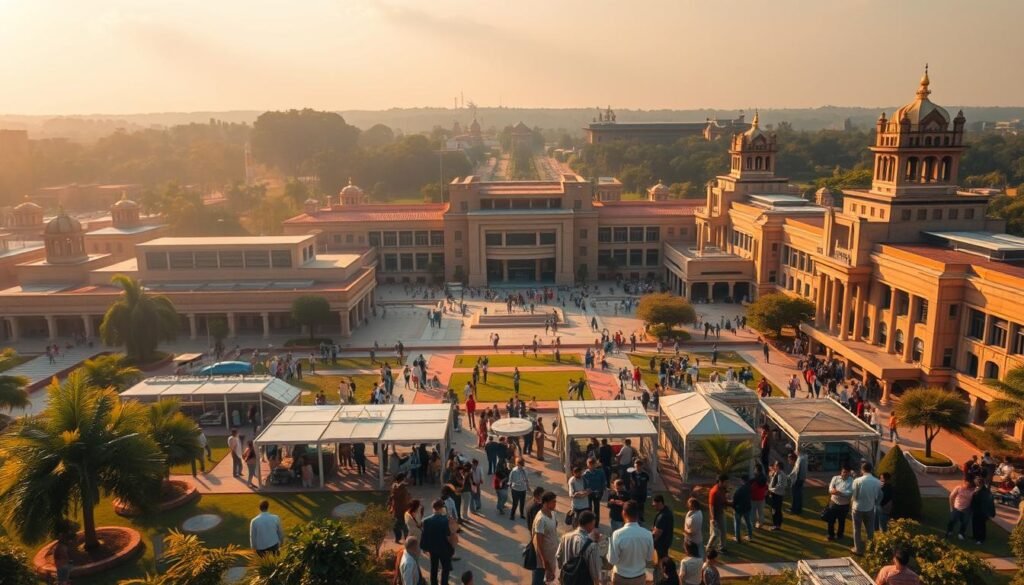
We reach out to many people through special programs. These programs connect lab work to everyday life. We focus on making a real difference by training, sharing technology, and talking openly with communities.
Our community programs focus on skills and local needs. The Centre for Continuing Education and others offer short courses and workshops. These are for technicians, teachers, and entrepreneurs.
At Challakere Campus, we work on projects that help farmers and small businesses. The Solar Power Research Center and C-BELT help with green solutions. The Climate Observatory shares data and strategies with local groups.
We team up with industry and government to make a bigger impact. Projects funded by HAL CSR and others offer training and jobs in nearby areas. This shows how our research helps society.
We make sure our message is clear. The Office of Communications and the J. R. D. Tata Memorial Library publish summaries and host talks. They make science easy for everyone to understand.
Our courses and short programs, like Computational Structural Reliability, boost skills. Public lectures and science cafés are places to ask questions and learn new things.
Working with nearby research places like Raman Research Institute and ISRO helps us more. We share events and facilities, making our outreach stronger in Bangalore and beyond.
We judge our success by how many people join, learn, and stay involved. Our mix of hands-on training, media, and projects keeps our outreach useful, open, and looking to the future.
Future Directions for IISc
IISc is set to become even more influential in research. Over the next ten years, it will focus on key areas. These include computational sciences, artificial intelligence, and robotics through ARTPARK.
It will also dive into climate science and low-carbon technologies under C-BELT. Advanced materials and healthcare research will be major focuses too. This is thanks to the postgraduate medical institute initiative.
Future research will also focus on data-driven discovery. The Supercomputer Education and Research Centre and the Department of Computational and Data Sciences will lead this effort. They will support large-scale simulations, machine learning, and cross-disciplinary data projects.
Interdisciplinary thrusts will also play a big role. These include water research, sustainable transportation, biosystems engineering, and cyber-physical systems. These areas are expected to have a significant impact and be adopted by industries.
Our goals for the next decade are clear and achievable. We aim to speed up research by improving incubation, IP commercialization, and partnerships. We also plan to grow global collaborations and offer more postgraduate programs.
We will also enhance talent development through online M.Tech. programs and short professional courses. These will align with the National Education Policy 2020.
To modernize our infrastructure, we will use our budgets, philanthropy, and sponsored research. We aim to upgrade labs and grow activities at the Challakere campus. We will also deploy the latest computational and experimental platforms.
For partnerships, public engagement, or media inquiries, contact info@indiavibes.today. This will connect you with our collaborative and outreach teams.