



Did you know banks gave out Rs. 62,426.52 crore to about 273,634 people under the Stand-Up India Scheme by April 1, 2025? This shows how a focused government loan scheme can really change the startup scene in India.
The Stand-Up India Scheme is a national effort to give start-up funding and small business loans to women and SC/ST entrepreneurs. It aims to support new businesses in manufacturing, services, trading, and agriculture-linked sectors. The scheme also offers institutional support from places like Digital India Corporation and the Ministry of Electronics & IT.
For those looking for help, Digital India’s helpdesk is ready to assist. You can reach out at support-myscheme@digitalindia.gov.in or call (011) 24303714 (9:00 AM to 5:30 PM). We stress these points because clear communication is key when dealing with a government loan scheme.
Over seven years, the program has grown with other initiatives like Startup India and state platforms like Telangana WE Hub and Kerala Startup Mission. These efforts together make the ecosystem better for women-led businesses. They also open up more funding options for early-stage founders.
Overview of the Stand-Up India Scheme

The Stand-Up India program helps new businesses start by providing loans and digital support. It works with Startup India and state programs to help local entrepreneurs. This partnership offers training and financial help to new businesses.
Objectives of the Scheme
The goal is to give more credit to founders who are often overlooked. It aims to increase lending at local branches and make information online. The scheme wants to help first-time businesses with loans and support.
Target Beneficiaries
The program helps women and SC/ST entrepreneurs start new businesses. These can be in manufacturing, services, trading, or agriculture. It supports those who are starting for the first time, promoting growth everywhere.
Key Features of the Initiative
It offers loans that cover up to 85% of project costs. This includes both term loans and working capital. Borrowers need to contribute at least 10% of the project cost.
Subsidies from the government can help cover the rest. The scheme also gives RuPay debit cards for easy transactions. Loans can be repaid over seven years, with a break of up to 18 months.
Banks are encouraged to share success stories online. This makes the program more accessible and transparent.
| Feature | Details | Benefit to Beneficiaries |
|---|---|---|
| Loan Structure | Composite loan up to 85% of project cost (term + working capital) | Reduces initial funding gap for new ventures |
| Borrower Contribution | Minimum 10% own contribution; subsidy convergence covers remaining margin | Makes projects viable for low-capital founders |
| Repayment Terms | Tenor up to 7 years with moratorium up to 18 months | Improves cash-flow management during startup phase |
| Target Groups | Women entrepreneurs and SC/ST entrepreneurs for first-time greenfield units | Drives inclusion and sectoral diversification |
| Support Ecosystem | Linkages with Startup India, training, incubation, and state incentives | Offers mentoring, skilling, and policy-level support |
| Digital Outreach | Official websites and social media used to share guidelines and success stories | Enhances transparency and applicant awareness |
Financial Assistance Offered

We explain the financial help available through Stand-Up India. This helps readers plan for funding and growth. The scheme offers term loans and working capital to meet project needs. We’ll cover loan amounts, interest rates, repayment terms, and who can get these loans.
Loan Amounts Available
Stand-Up India loans can cover up to 85% of project costs. Borrowers must put in at least 10% of the cost. Sometimes, other schemes can help cover the rest, keeping the borrower’s contribution under 15%.
The scheme has two parts: working capital and term loans. For needs up to Rs. 10 lakh, overdrafts are allowed. For more, cash credit limits are given. By April 1, 2025, Rs. 62,426.52 crore was sanctioned to 273,634 beneficiaries.
Interest Rates and Repayment Terms
Interest rates depend on the borrower’s credit rating. The rate is the lowest for that rating, capped at Base Rate (or MCLR) + 3% plus a tenor premium. This keeps rates competitive and reflects credit quality.
Repayment can last up to seven years. Borrowers can get a 18-month moratorium to help with cash flow early on. Loans are secured, and collateral or the Credit Guarantee Fund Scheme for Stand Up India Loans (CGFSIL) may be needed.
Eligibility Criteria for Financial Support
Eligibility is for first-time entrepreneurs from scheduled castes, scheduled tribes, and women. Ventures must be new in manufacturing, services, or trading. The applicant must be an individual entrepreneur, and the unit must be new.
Financial terms require a minimum contribution from the borrower. Other schemes can help meet the margin money. Programs like Kerala’s soft loan schemes for women can boost funding and viability.
We suggest applicants prepare detailed project cost estimates, credit documents, and a solid business plan. This increases the chance of getting a loan and favorable repayment terms under Stand-Up India.
Application Process Explained
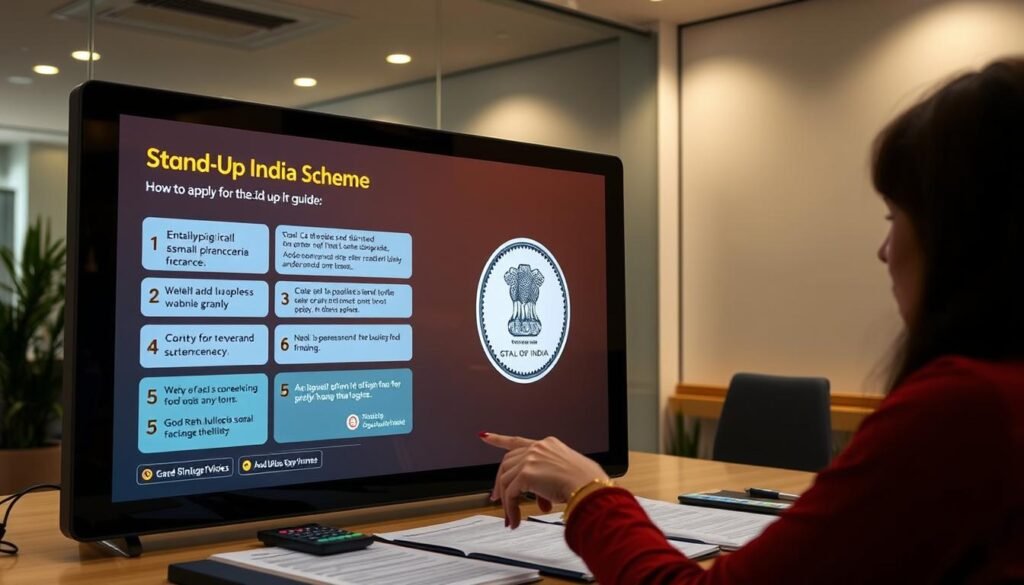
We guide applicants through the application process with clear steps and tips. This guide helps entrepreneurs understand how to apply for the Stand-Up India Scheme. It covers gathering required documents and finding online resources.
It also explains how to work with banks to check eligibility and get bank loans.
Step-by-Step Guide to Applying
First, pick a greenfield project and write a detailed business plan. The plan should show the project cost and the 10% promoter contribution. Also, estimate costs and mention any state fund convergence, keeping it under 15% if possible.
Then, visit a Scheduled Commercial Bank branch in person or use their loan portal to start the application. Banks will check your rating, credit, and interest rate. They might ask for security or a guarantee, like CGFSIL.
After approval, banks will decide how to give out the money. They might give a term loan for big expenses and an overdraft or cash credit for working capital. For help with digital forms and portal issues, contact support-myscheme@digitalindia.gov.in or call (011) 24303714 during work hours.
Required Documentation
You’ll need identity and address proofs, and documents showing you’re a SC/ST or woman entrepreneur. Also, provide bank statements and proof of the promoter’s contribution to show you can afford it.
Include a project report or business plan, cost estimates, and any necessary registrations like Udyam/MSME and GST. If you’re using state incentives, attach the sanction letters. These documents help speed up the loan process and reduce questions.
How to Access Online Resources
Use official websites like Digital India and Startup India for forms and guidance. State startup portals and incubators offer templates and help with proposal writing.
Social media and blogs share success stories and tips to improve your application. Incubators like T-Hub in Telangana or WE Hub in Telangana offer workshops and clinics to help you when applying to banks for loans.
| Stage | Action | Key Documents | Typical Outcome |
|---|---|---|---|
| Preparation | Define project, prepare business plan and cost estimates | Project report, promoter contribution proof, Udyam/MSME | Ready file for bank appraisal |
| Application | Apply at bank branch or online loan portal | Identity, address, beneficiary status documents, bank statements | Formal loan processing begins |
| Assessment | Bank evaluates rating, security, interest rate | Financials, collateral or guarantee details, subsidy letters if any | Sanction letter with terms |
| Disbursement | Loan split into term loan and working capital | Disbursement schedule, loan agreement | Funds released; working capital via overdraft or cash credit |
| Support | Use online resources and incubator guidance | Application forms, mentorship notes, portal help emails | Higher approval probability and smoother loan servicing |
Support for Women Entrepreneurs

The Stand-Up India Scheme women initiative connects national and state resources to support women entrepreneurs. Engineers and educators can transform prototypes into market-ready products. They get help through mentoring, incubation, and start-up funding.
Tailored programs for women
Many states have programs for women that match central support. Telangana’s WE Hub offers free incubation and business help for new founders.
Karnataka has special spots in government incubators for women. Kerala Startup Mission gives soft loans up to Rs. 15 lakh. Young women and SC/ST entrepreneurs get more help.
Goa and Jharkhand offer rental help. Andaman & Nicobar, Jammu & Kashmir, and Ladakh give monthly support. Maharashtra helps with internet, electricity, and exhibition costs. These efforts help women get start-up funding.
Success stories from female beneficiaries
By Nov 24, 2023, 84% of Stand-Up India loans went to women. By Jan 27, 2025, nearly 194,804 women entrepreneurs benefited.
Studies and media show businesses growing, creating jobs, and inspiring others. Engineers use incubators to turn prototypes into products. They get seed loans and state help to attract more investors.
We suggest women-led startups plan early. Match technical goals with funding and use incubators for product testing. Claim reimbursements to cut costs. This strategy helps them get more funding and grow their business.
Empowering SC/ST Entrepreneurs

We look at how policies, finance, and local programs help SC/ST entrepreneurs. They work together to make sure these entrepreneurs can grow their businesses. We talk about the support they get, new budget plans, and steps they can take to grow.
Specialized Initiatives for SC/ST Communities
The Stand-Up India Scheme SC/ST gives loans that cover up to 85% of a project’s cost. Banks can use guarantees and offer repayment plans that fit new businesses. This makes it easier for SC/ST applicants to get funding.
The Union Budget 2025-26 wants to help more by giving loans up to Rs. 2 crore to SC/ST women entrepreneurs. This shows a big push to support minority entrepreneurs at a national level.
States also play a big role. Rajasthan and Chhattisgarh have programs to help entrepreneurs. When combined with the Stand-Up India Scheme, they offer more support for growth.
Case Studies of Successful SC/ST Startups
Reports show thousands of SC and ST entrepreneurs have benefited. By January 27, 2025, about 49,031 SC and 15,962 ST entrepreneurs had received help. This shows how funding can lead to jobs and services.
Real stories show how small loans can help. Small manufacturers buy machinery, service startups go digital, and rural businesses connect with bigger markets. The key is using finance wisely and getting help from mentors and markets.
Minority entrepreneurs should use the Stand-Up India Scheme SC/ST, look for state grants, and plan their businesses well. This way, they can grow and make a difference in their communities.
Role of Banks and Financial Institutions
We explain how banks and financial institutions make the Stand-Up India Scheme work. Partner banks are the first point of contact for eligible entrepreneurs. They offer bank loans tailored to their needs. We show the steps from the start to when the money is given out.
Partnering Banks Under the Scheme
Scheduled Commercial Banks all over India are part of the scheme. Each branch looks for women and SC/ST applicants for new businesses. Big public and private banks help through Digital India and Ministry websites.
These banks set interest rates based on the borrower’s rating. The lowest rate is given, up to a cap. Branch staff check if the loan is needed, suggest loan types, and explain RuPay debit cards.
The Application Review Process
The review starts when a branch gets a filled form and documents. They check if the project is good, if the borrower can pay, and the business’s cash flow. This is all in a detailed credit note.
Branch officers then decide the interest rate based on the borrower’s rating. Banks choose between asking for collateral or using a credit guarantee. This makes it easier for more people to get loans.
After approval, the money is split into term loans and working capital. The branch finishes the paperwork, gives out the money, and sets up repayment plans. We suggest using official helplines and Startup India for any questions during this time.
Training and Capacity Building Initiatives

We explain how training programs and support help turn ideas into real businesses. Governments and banks work together with incubators and industry partners. They offer practical lessons for founders from all walks of life.
Digital platforms make learning easy: courses, helplines, and sessions are available anytime. This way, engineers and students can learn on their own schedule.
We talk about the different ways to build skills and confidence. Short modules help with business plans and managing money. Internships and visits give teams a look at markets and supply chains.
Local incubators offer guidance and seed funding for tech startups. They help with everything from planning to launching.
Skill development programs
Startup India, WE Hub, and Kerala Startup Mission run programs with mentoring and support. State schemes in Tamil Nadu and Maharashtra add more, like product development and marketing. Banks teach about loans and how to prepare for them.
Workshops and resources available
Workshops by district agencies and incubators focus on pitching and following rules. Online toolkits on central portals offer templates and checklists. Social media and blogs share success stories and point to local events.
| Format | Provider | Focus | Outcome |
|---|---|---|---|
| Short courses | Startup India / Digital India portals | Business planning, legal compliance | Ready-to-submit applications and templates |
| Incubation cohorts | WE Hub, Kerala Startup Mission | Prototyping, mentoring, market fit | Prototype validation and investor pitches |
| Financial literacy workshops | Public sector banks with local incubators | Loan processes, collateral, repayment planning | Improved loan readiness and stronger proposals |
| Exposure visits & internships | State startup missions (Himachal Pradesh, Tamil Nadu) | Market exposure, supply chain learning | Practical insights and network building |
| Hybrid webinars & helplines | Central portals and district agencies | Remote mentoring, course materials | Access for remote or busy professionals |
Challenges and Possible Improvements

We look at the real-world problems that slow down progress and shape the future of Stand-Up India. Data from FY24 shows a gap between sanctioned loans and actual funds given to entrepreneurs. This highlights the need to fix accessibility issues and improve policy delivery.
Gaps in Accessibility
There are real barriers due to regional and branch-level differences. Issues like tough documentation, strict collateral demands, and uneven digital setup make it hard for eligible entrepreneurs to access funds.
Some banks are too cautious, leading to longer processing times. This turns sanctioned loans into stalled cases. As a result, while sanctioned loans are high, disbursed funds are going down.
Feedback from Beneficiaries
We listen to feedback from beneficiaries across states. Many have seen job gains and community benefits, including for women and marginalized groups. Yet, they also share concerns about outreach, credit processing times, and the lack of support from state subsidy schemes.
Feedback suggests clear solutions: make KYC and onboarding easier, offer more guarantees to reduce collateral needs, and train bank staff to better understand tech and engineering projects.
The Budget 2025-26 aims to increase loans for SC/ST women entrepreneurs. To succeed, these policy steps need to be backed by operational changes to avoid ongoing loan issues and close accessibility gaps.
Conclusion: The Impact of the Stand-Up India Scheme
The Stand-Up India Scheme has made a big difference. It has given out Rs. 62,426.52 crore to 273,634 people as of April 1, 2025. Most of these funds went to women, with 194,804 women getting help by January 27, 2025.
This shows the program’s success in helping minority entrepreneurs and women. It proves that focused funding can help new businesses grow.
The future looks bright with the Union Budget 2025–26’s new plan. It aims to help five lakh SC/ST first-time women entrepreneurs with loans up to Rs. 2 crore. Success will depend on clear rules, bank readiness, and state support.
We need to watch how well this plan works. Better bank support and easier processes are key to making more funding work.
For engineers, students, and teachers, Stand-Up India is a great way to get funding. It’s part of a bigger startup world that includes Startup India and WE Hub. By preparing projects well and getting bank support early, we can help new businesses grow.