



Banaras Hindu University connects India’s rich heritage with modern learning. It was founded in 1916 by Pandit Madan Mohan Malaviya. He had the support of leaders like Dr. Annie Besant.
The university started under the B.H.U. Act 1915. It aimed to merge ancient wisdom with scientific research.
The university’s campus is vast, covering over 1,370 acres. It welcomes more than 30,000 students. The campus also has a residential area for nearly 18,000 people.
This size supports BHU’s excellence in many fields. These include arts, sciences, engineering, medicine, agriculture, and performing arts.
BHU is known for its high reputation. It has been named an Institution of Eminence. It also belongs to global university groups.
The university has a vast collection of texts and manuscripts. For a quick look at BHU’s journey, see this summary: BHU: a journey through excellence.
In the next sections, we’ll explore BHU’s cultural importance. We’ll also look at its research strengths. We’ll see how it uses modern teaching methods and technology to achieve its goals.
Introduction to Banaras Hindu University

We introduce a university that mixes ancient wisdom with modern learning. Banaras Hindu University has educated many scholars, engineers, and leaders. It focuses on learning in a residential setting.
A Brief History of BHU
BHU started after a big push by Madan Mohan Malaviya in the early 1900s. The Hindu University Society was set up in 1911. Then, a law was passed in 1915, and the university was founded in 1916.
The campus grew fast, becoming a place for teaching and research. Famous people like Mahatma Gandhi and scientists C. V. Raman and Jagadish Chandra Bose gave lectures. These events showed BHU’s big impact on learning and public talks.
The Vision Behind BHU’s Establishment
Malaviya wanted a place that mixed India’s spiritual ways with Western science. People like Annie Besant and Maharaja Rameshwar Singh helped create a place that taught science, technology, and ethics.
From the start, BHU aimed to be open and keep Hindu studies and Sanskrit important. This mix has had a big effect on education and culture in India.
The university is known for its research. It works on everything from basic science to humanities. You can learn more about BHU’s history on a page at philarchive.
| Aspect | Early Development | Enduring Impact |
|---|---|---|
| Founding Year | 1916 | Established a residential model for higher education |
| Key Founders | Madan Mohan Malaviya, Annie Besant, princely patrons | Combined nationalist vision with academic autonomy |
| Academic Focus | Sanskrit, śastras, science and technology | Shaped curricula linking tradition and modern research |
| Cultural Role | Public lectures by national leaders and scientists | Strengthened Varanasi BHU influence in cultural discourse |
| Research Legacy | Early science lectures and labs | Ongoing Banaras Hindu University research contributions across disciplines |
Unique Features of BHU
We explore Banaras Hindu University’s distinct character. It’s an academic campus shaped by history and culture. The university blends monumental architecture with living traditions. This gives students and scholars a sense of place that supports rigorous study and creative practice.
Architectural Beauty and Campus Design
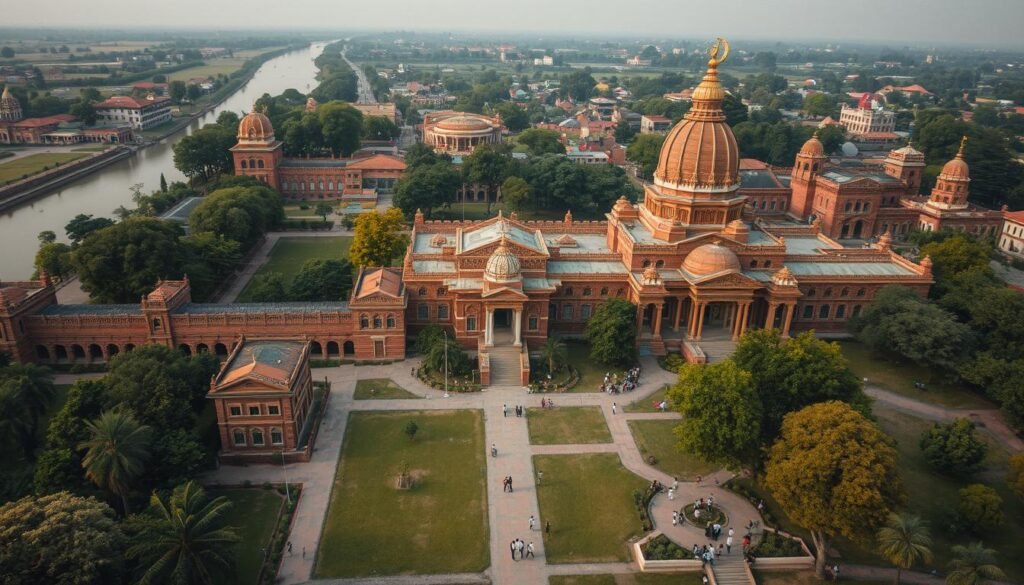
The main campus sits on the southern edge of Varanasi near the Ganges. It’s laid out in a semicircular plan with radial and arc roads. Buildings from the early 20th century show Indo-Gothic influences: arched facades, carved stone details, and broad verandas that suit the climate.
Key landmarks shape orientation and identity. Shri Vishwanath Mandir stands at the campus core as a spiritual and visual anchor. Singh Dwar marks the principal entrance, gifted by Maharaja Pratap Prakash Singh. The Sayaji Rao Gaekwad Library, completed in 1941, houses over 1.3 million volumes and supports deep archival work.
Beyond the core, the Bharat Kala Bhavan museum preserves more than 100,000 artifacts. These range from paintings to textiles and philately. The campus footprint—about 1,370 acres—supports research labs, residential quads, and green courtyards. These invite informal learning and debate.
Cultural Significance of the University
BHU functions as a temple of learning inside a sacred city. This amplifies its BHU cultural significance. Public events and academic gatherings often intersect with local religious festivals, creating a hybrid civic life.
The institution has long shaped discussions on Indian civilization and modern education. Gandhi gave one of his first public addresses in India at the university’s extension lectures. That moment shows the Varanasi BHU influence on public intellectual life.
We see BHU Indian educational heritage reflected in curricular emphasis. It includes classical arts, music, and Sanskrit studies, alongside engineering and sciences. Community initiatives and cultural programs keep traditional skills active while encouraging contemporary interpretation.
| Feature | Details | Impact |
|---|---|---|
| Campus Layout | Semicircular plan with radial and arc roads; ~1,370 acres main campus | Clear orientation, pedestrian courtyards, integrated greens |
| Major Landmarks | Shri Vishwanath Mandir; Singh Dwar; Sayaji Rao Gaekwad Library | Spiritual center, ceremonial entrance, rich research resources |
| Museums and Collections | Bharat Kala Bhavan with 100,000+ artifacts | Preserves art and crafts; supports art history and conservation |
| Regional Reach | Rajiv Gandhi South Campus in Barkachha, Mirzapur (~60 km) | Expands agricultural research and rural engagement |
| Cultural Role | Site of public lectures, classical music, and religious observance | Reinforces BHU cultural significance and Varanasi BHU influence |
| Educational Tradition | Combined focus on humanities, arts, sciences, and applied research | Embodies BHU Indian educational heritage while supporting innovation |
Academic Programs and Degrees Offered
Banaras Hindu University offers a wide range of programs. These include arts, sciences, engineering, medicine, management, and humanities. The university combines traditional and modern courses to maintain high standards.
There are six institutes, 14 faculties, and about 140 departments. Students can choose from bachelor’s, master’s, diplomas, and integrated programs. Professional degrees include engineering, medicine, law, agriculture, and management.
Students have access to residential facilities and cross-disciplinary options. This approach helps develop practical skills. It ensures a balance between classroom learning and hands-on experience.
Undergraduate and Postgraduate Courses
Programs cover a wide range of subjects. These include arts, social sciences, commerce, science, performing arts, journalism, and more. The IIT-BHU conversion has expanded engineering courses and research opportunities.
Admissions are based on merit. We focus on mentorship, internships, and industry connections. This prepares students for global careers and local leadership.
Research Opportunities at BHU
BHU supports research through dedicated centers and journals. The Institute of Environment & Sustainable Development and the Institute of Medical Sciences host projects. These include funded research and clinical studies.
Doctoral programs and research groups offer ongoing support. Facilities include well-equipped labs and a large teaching hospital. This setup helps publish research findings.
We work with national and international partners to enhance research. This effort boosts BHU’s academic reputation and meets societal needs.
Distinctive Teaching Methods

Banaras Hindu University combines old teaching methods with new ones. This mix helps students learn deeply and face today’s challenges. It uses immersive learning, bilingual teaching, and community projects to stand out.
Traditional Pedagogy vs. Modern Learning Approaches
BHU started by linking Indian culture with science. It uses a residential model for deep learning. This model creates strong peer groups and daily mentorship.
It focuses on long seminars, close guidance, and learning beyond classes. This approach makes learning intense and personal.
Now, BHU teaches in both English and Hindi, making learning more accessible. This keeps the local language alive while meeting global standards. It shows BHU’s commitment to both tradition and modern learning.
IIT-BHU and the Institute of Medical Sciences lead in research-based teaching. They use labs, clinical work, and projects to teach by doing. This shows BHU’s ability to innovate while staying true to its roots.
Successful Case Studies of Innovative Teaching
The Krishi Vigyan Kendra trains farmers and students in real-world settings. It applies classroom learning to practical problems. This is a hands-on way to learn about agriculture and extension science.
Early on, BHU hosted lectures by national leaders and scientists. These talks turned into teaching tools. They connected students to big ideas and scientific progress.
Interdisciplinary centers like the Institute of Environment & Sustainable Development focus on real-world problems. Students work on climate, water, and urban issues. This approach encourages teamwork, systems thinking, and practical solutions.
Clinical education at Sir Sunderlal Hospital combines classroom learning with patient care. Medical students learn by doing and helping others. This shows BHU’s commitment to practical, service-based learning in health sciences.
These examples show a clear pattern. BHU uses immersive learning, bilingual teaching, research, and community projects. This strategy keeps BHU’s heritage alive while preparing students for the future.
Integration of Technology in Learning

We see technology as a link between Banaras Hindu University’s rich history and its modern education. It brings together smart classrooms and online archives. This way, digital tools help in learning science and arts while keeping the cultural legacy alive.
Digital tools give access to lectures, lab data, and journals. IIT-BHU and the Institute of Science run labs that publish research. This shows the university’s commitment to research and collaboration.
We support programs that mix face-to-face learning with online courses. The university uses systems to make registration and research easy. This digital setup helps in keeping education top-notch and admin smooth.
Digital Resources and Online Learning Options
Online courses, recorded seminars, and e-journals make learning available everywhere. Departments like computer science and biotechnology have online papers and data. This supports research and learning.
We connect industry programs with our courses to keep skills up-to-date. A recent partnership is like Samsung’s AI training: industry-academic training. This gives students real-world experience.
Future-Ready Curriculum
We’re changing the curriculum to include more subjects. For example, engineering and environmental science together. This shows the university’s commitment to research in many areas.
Our courses teach technical skills, critical thinking, and cultural awareness. This mix prepares students for the world while keeping the cultural legacy alive. We keep updating to meet new tech and society’s needs.
Student Life at BHU

At Banaras Hindu University, campus life is a mix of living, learning, and cultural exchange. It mirrors Varanasi’s daily life: from sunrise prayers to evening seminars. This blend helps students grow and connect with each other.
Extracurricular Activities and Student Organizations
Clubs at BHU cover a wide range, from performing arts to science and social service. Groups like Bharat Kala Bhavan and the Drama Club host workshops and shows. These activities help students develop leadership and project skills.
Living on campus is also key to student life. With over 65 hostels, students are part of close-knit communities. These communities organize sports, music nights, and study groups. This setup boosts personal growth and peer learning.
- Performing arts: regular productions, music and dance ensembles
- Academic societies: guest lectures, research presentations, student journals
- Volunteer networks: health camps at Sir Sunderlal Hospital, literacy drives
Campus Events Celebrating Indian Heritage
Festivals are a big part of the academic year at BHU. Cultural fairs, Diwali processions, and Vasantotsav unite the community. These events showcase Indian crafts, classical music, and Sanskrit scholarship.
The university’s museums and institutes host exhibitions and lectures. These events trace BHU’s cultural legacy in India. Students get to curate shows, lead tours, and document heritage, skills useful beyond campus.
Varanasi BHU’s influence is seen in its connection with the city. Public lectures, religious ceremonies, and joint cultural projects attract visitors and scholars. This interaction highlights the university’s role as a hub for tradition and innovation.
BHU’s Contribution to Indian Culture and Society

Banaras Hindu University plays a big role in shaping culture in Varanasi and beyond. It combines learning, rituals, and community service. Museums, temples, labs, and clinics all coexist here. This mix is key to BHU’s cultural impact in India.
Promoting Indian Art and Literature
We manage places that keep Indian culture alive. Bharat Kala Bhavan is home to paintings, textiles, and ancient texts. Scholars from around the world visit here.
It also hosts festivals and talks on arts and literature. This shows BHU’s importance for artists and students.
Community Engagement and Social Initiatives
We take our research to the community. The Krishi Vigyan Kendra helps farmers improve their crops. This work benefits local farmers.
Our medical institute and hospital provide care and training. They show how BHU’s research helps people in real ways.
Our campus is filled with history. From hostel names to temple rituals, it connects learning to everyday life. This helps everyone see the value of our work.
Global Collaborations and Partnerships

Banaras Hindu University (BHU) connects with the world to boost research, teaching, and cultural exchange. It was founded with a global vision by Annie Besant and Madan Mohan Malaviya. Today, it’s a key place for international academic work.
International students from about 48 countries join us. The International Centre, set up in 2004, manages exchanges and programs. This diversity enriches campus life and opens doors to global careers.
International Student Programs
We offer special help for foreign students, including orientation and language support. This makes BHU more accessible and competitive worldwide.
Scholarships and research fellowships draw graduate students. Summer schools and exchange semesters offer a chance to experience Indian culture and science. This helps Banaras Hindu University’s research grow.
Research Collaborations with Global Institutions
We work with universities and research centres through the BRICS Universities League and other partnerships. IIT-BHU and IMS-BHU lead in engineering and medical research.
Our joint research and grants help in fields like agriculture and medicine. These partnerships boost BHU’s reputation and global influence.
We also reach out to alumni and host international conferences. This keeps partnerships strong and research relevant. Our teams show how science and culture can work together.
Alumni Achievements and Impact

Banaras Hindu University’s graduates have made a big impact. They have excelled in science, arts, governance, medicine, and technology. This shows BHU’s strong academic standing and wide influence in India.
Many notable figures have come from BHU. Madan Mohan Malaviya founded the university. Hariprasad Chaurasia took Indian music worldwide. C.N.R. Rao led chemistry advancements in India. Their stories show how BHU’s education leads to innovation.
Graduates from BHU’s various faculties share a common bond. They come from IIT-BHU, the Institute of Medical Sciences, and the Faculty of Performing Arts. This bond helps them in research, industry, and public service. It shows how BHU’s tradition and modern studies work together.
BHU has structures to keep alumni involved. The International Centre, University Court, and alumni chapters help. They organize mentoring, fundraising, and research that help students and faculty.
We present a compact comparison of alumni impact across key sectors:
| Sector | Representative Alumni | Type of Impact |
|---|---|---|
| Science & Research | C.N.R. Rao, H.J. Bhabha collaborators | Foundational research, national labs, academic leadership |
| Arts & Culture | Hariprasad Chaurasia, Girija Devi | Revival and global promotion of Indian music and dance |
| Medicine & Public Health | IMS alumni, public health leaders | Clinical excellence, policy, rural health programs |
| Engineering & Technology | IIT-BHU graduates in startups and industry | Product innovation, research partnerships, entrepreneurship |
| Public Service | Administrators and policymakers | Governance, education reform, cultural policy |
Alumni networks help bring talent back to BHU. They offer mentoring and job opportunities. This cycle keeps BHU’s academic excellence and cultural legacy strong.
We end by highlighting the importance of stewardship. Active alumni bodies keep BHU relevant. They provide governance, support, and foster collaborations to tackle today’s challenges.
Conclusion: The Future of BHU
Founded in 1916, Banaras Hindu University aimed to keep Indian heritage alive while pushing modern education forward. This mission is seen in its museums, the Bharat Kala Bhavan collections, and its unique residential culture. This mix has made BHU a leader in arts, sciences, and public life.
BHU’s success comes from its strong points: a big campus, top institutes like IIT-BHU and IMS-BHU, vast libraries, and research centers. With Institute of Eminence status and good funding, BHU can grow its global research, improve online learning, and expand green programs.
The future of BHU is about keeping traditions alive while innovating. We suggest boosting the International Centre for projects, using technology in teaching, and keeping cultural heritage alive. These steps will help BHU stay a place where old and new meet to shape future leaders.
For research and academic partnerships, contact info@indiavibes.today. Let’s work together to make BHU’s influence even stronger and keep its academic excellence high.