



Banaras Hindu University connects India’s ancient wisdom with modern learning. It was founded by Pandit Madan Mohan Malaviya in 1915. The university opened on February 4, 1916, with a mission to make knowledge eternal.
BHU is a leading university in India, located in Varanasi. It has a large main campus and a south campus in Barkachha. The university supports over 30,000 students, with nearly 18,000 living on campus.
BHU is unique because it combines tradition and modern education. It has units like the Indian Institute of Technology (IIT-BHU) and the Institute of Medical Sciences. Here, students learn in research labs and temples of learning.
The university is governed by the BHU Act of 1915. The President of India is the Visitor, and the Vice-Chancellor is the chief executive. BHU manages a budget of nearly ₹1,808.75 crore and balances ceremonial and executive roles.
For those interested in Tradition and Modern Education in Varanasi, BHU is a great example. It shows how heritage and innovation can work together. A Top University in India, BHU shapes minds and society.
Introduction to Banaras Hindu University

The history of Banaras Hindu University began with a dream to merge learning with cultural care. It was founded by public leaders and local supporters. The campus in Varanasi became a place where learning and daily life merged. We aim to show how this institution started its journey in Tradition and Modern Education.
A Historical Overview
Madan Mohan Malaviya proposed a residential university after his 1905 Indian National Congress speech. The Hindu University Society, formed in 1911, got support from Annie Besant and local rulers like Maharaja Rameshwar Singh. This support led to BHU’s founding in 1916, with Lord Hardinge laying the foundation stone on February 4.
The Benares Hindu University Bill was passed on October 1, 1915. This created a central university under the B.H.U. Act 1915. Malaviya wanted a teaching-and-residential model, combining science and technology with Indian culture and religion.
Early achievements included the incorporation of Central Hindu College and university extension lectures in 1916. Leaders like Mahatma Gandhi and scientists like C. V. Raman were featured. The campus grew from initial faculties to a large structure with nearly 140 departments, showing growth in research and teaching.
Mission and Vision
The mission is to make scientific knowledge useful for national growth while keeping Indian heritage alive. The university aims to balance modern scholarship with cultural care through residential life and inclusive admissions.
Academic goals have always mixed technical education with cultural studies. This mix defines the university’s identity in Varanasi and guides its focus on Tradition and Modern Education today.
| Aspect | Early Phase (circa 1916) | Contemporary Profile |
|---|---|---|
| Founding catalyst | Madan Mohan Malaviya and Hindu University Society | Central university shaped by B.H.U. Act 1915 |
| Key supporters | Annie Besant; Maharaja Rameshwar Singh; Prabhu Narayan Singh | National scholars, international collaborators, government bodies |
| Model | Teaching-and-residential focus | Residential traditions with modern institutes and departments |
| Academic mix | Classical studies and emerging science programs | Interdisciplinary STEM, humanities, and cultural studies |
| Milestones | Foundation stone laid February 4, 1916; extension lectures 1916 | Centenary in 2015–2016; growth to ~140 departments |
| Location and cultural link | Varanasi as spiritual and educational center | Continued role in preserving Indian heritage while advancing research |
The Unique Heritage of BHU
Banaras Hindu University combines academic rigor with tradition. It bridges the past and present, where Ritual, research, and residence come together. Visitors can feel the pulse of Varanasi culture in the Campus Life.
Cultural Significance
BHU is a cultural hub for Varanasi and scholars across the nation. It hosts lectures, performances, and exhibitions that engage the community. The Bharat Kala Bhavan’s collections enhance courses in art, history, and conservation.
Public history is a focus: commemorative coins, stamps, and the Vishwa Panchang show Cultural Heritage’s impact. The university press publishes works that keep traditional knowledge alive.
Architectural Marvels
The campus showcases Indo-Gothic architecture: red-brick facades, pointed arches, and Indo-Islamic motifs. The semicircular layout and radial roads guide movement between halls, greens, and courts.
At its heart is Shri Vishwanath Mandir, with a 252-foot tower. The temple complex, started in 1931 and finished over decades, is a center for rituals, pilgrimages, and quiet reflection.
Influences on Modern Education
BHU shaped curricula that balance science with religion and arts. This approach influences teaching methods. Students learn through museum objects, language texts, and ritual practice alongside lab work.
Cultural Heritage at BHU goes beyond artifacts. It shapes teaching methods, project design, and community partnerships. This prepares graduates for work in heritage, technology, and policy.
Academic Excellence at BHU

Banaras Hindu University is known for its academic rigor and innovation. It is a Top University in India, recognized as an Institute of Eminence. This shows its commitment to quality in teaching, research, and community service.
Faculty BHU has both experienced and new teachers. They guide students in various fields. The presence of top professors at IIT-BHU and the Institute of Medical Sciences enhances learning.
Renowned Faculty Members
Our faculty includes experts in many areas. They publish in top journals and lead projects. This helps set high standards and offers great mentorship for students.
Cutting-edge Research Opportunities
Research at BHU covers labs, hospitals, and field stations. It supports doctoral and postdoctoral students in biotechnology, environment, and social sciences. Our journals and presses share research with the world.
Diverse Academic Programs
We offer programs from undergraduate to PhD in arts, law, management, journalism, and STEM. Our programs blend traditional and modern subjects to meet today’s needs.
Academic Excellence at BHU comes from its strong Faculty, wide Research Opportunities, and diverse programs. This makes BHU a top choice for scholars in India.
Modern Learning Facilities

Banaras Hindu University offers both traditional and modern learning spaces. These include libraries, labs, field stations, and online tools. They support teaching, research, and campus life.
Advanced Libraries
Our library network is key for research. The Sayaji Rao Gaekwad Library has over 1.3 million volumes. It’s the main spot for books, manuscripts, and journals.
BHU also has three institute libraries, eight faculty libraries, and more than 25 departmental libraries. These libraries offer specific materials and quiet spaces for studying and research.
State-of-the-art Laboratories
Our labs are equipped for various fields, from molecular biology to civil engineering. They have the latest tools, skilled staff, and safety measures for advanced studies.
Medical students benefit from Sir Sunderlal Hospital, a teaching hospital and large referral centre. It provides clinical training and supports medical research.
Agricultural research is conducted at Rajiv Gandhi South Campus. It has field plots, Krishi Vigyan Kendra facilities, and testing areas. These support studies across the Vindhya Range.
Digital Learning Resources
We use Digital Learning Resources to reach more learners. BHU Press and the Publication Cell publish books and journals. Online archives and e-resources make research outputs accessible.
Online journals, a central platform, and a Web Information Manager keep course materials and announcements online. These tools enhance blended learning and remote collaboration.
Residential and cultural spaces connect these facilities to daily life. With over 65 hostels and extensive faculty housing, students and staff have access to study areas, museums, and lecture complexes. These spaces enrich the learning environment.
Integration of Technology in Education

Banaras Hindu University combines old traditions with new teaching tools. The campus has modern digital upgrades for teaching, labs, and global connections. This mix helps students and teachers work together smoothly across different subjects.
Teams at the university create Digital Learning Resources for all. They publish e-books, online journals, and course materials. This makes learning easier for those who study from home and improves classes for those on campus.
E-learning Platforms
The university’s E-learning Platforms BHU offer online and blended courses for students everywhere. The International Centre helps students from abroad and supports partnerships. The platforms have tools for recorded lectures, live sessions, and tests that fit today’s teaching methods.
Teachers use systems to share work, readings, and data. This setup helps students with research: they can access lab data and work with others worldwide without limits.
Smart Classrooms
Smart Classrooms are now in engineering and science areas. IIT-BHU technology and ICT-enabled rooms bring simulations and remote access to experiments. This lets teachers show experiments clearly and in real-time.
Teaching tools connect classroom lessons with lab work. Labs at IIT-BHU and other places support advanced research in fields like genomics and materials science. This mix of hardware and software expands what students can learn in class.
| Area | Primary Use | Key Benefit |
|---|---|---|
| Digital Learning Resources | Course content, e-journals, archives | Easy access for remote and on-campus students |
| E-learning Platforms BHU | Online courses, assessments, collaboration | Scalable teaching and international outreach |
| Smart Classrooms | ICT-enabled lectures, simulations | Improved engagement and visual learning |
| IIT-BHU technology | Advanced instrumentation, remote labs | Enables hands-on Research Opportunities |
| Publication & Web Services | Digital dissemination and site management | Professional distribution of research and courses |
Student Life at BHU
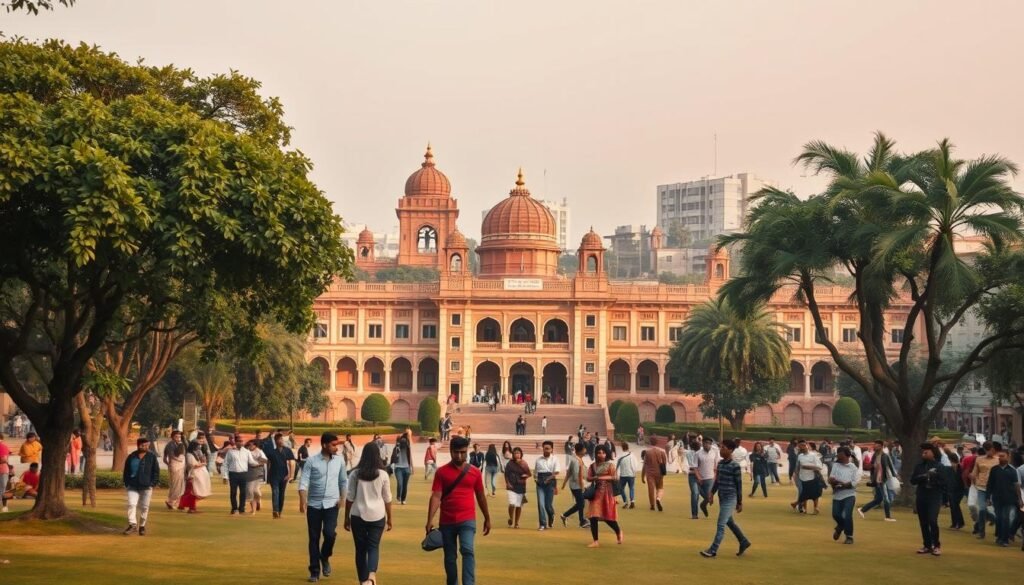
We look into how daily life shapes Student Life BHU and Campus Life. The campus’s residential nature fosters a strong sense of community. Shared rituals, faculty interactions, and events link academic work with cultural practices.
Diverse Student Community
BHU welcomes over 30,000 students from India and about 48 countries. This diverse group brings different languages, festivals, and study habits. Residential areas and faculty housing encourage conversations beyond seminars.
Hostels named after rivers and leaders add to the campus’s identity. Around 18,000 students live in 66 hostels: 41 for males, 21 for females, and 4 for international students. These hostels create small communities for mentoring and studying together.
Extracurricular Activities
Campus Life is rich with music, theatre, and sports. Student clubs and societies host cultural festivals, lectures, and performances. Bharat Kala Bhavan and performing arts groups are at the heart of the arts scene.
Activities like debating, robotics, and student media are available. Institutes like IIT-BHU and IMS-BHU offer strong placement support. They also host hackathons and medical camps for practical experience.
Support Services
Academic advising and departmental resources help students stay on track. Health care is provided by Sir Sunderlal Hospital for students and the community. The International Centre helps foreign students with visas and integration.
Career guidance teams, alumni networks, and placement cells offer job paths. These services support students’ personal and professional growth, allowing them to focus on learning.
Global Collaborations and Partnerships

We see international work as key to excellence at Banaras Hindu University. Our Global Collaborations BHU include formal agreements and joint projects. These efforts boost research and student chances. The International Centre leads these partnerships, welcoming scholars and handling foreign student admissions.
We focus on global research in fields like engineering and medicine. Our projects involve BHU faculty, IIT (BHU) researchers, and international partners. We tackle big issues like sustainable farming, health, and clean energy. Being part of the BRICS Universities League opens doors for more grants and exchanges.
H3: International Research Initiatives
Our research is showcased through collaborative labs and joint papers. Faculty work on big studies and write for top journals. The International Centre helps set up funding for labs and visiting professors.
H3: Exchange Programs
Our Exchange Programs offer students a chance to learn and grow globally. They can take part in short trips, semester exchanges, or summer research. Students from BHU get to experience different cultures and universities in Asia, Europe, and Africa.
We aim for practical results like better job chances and stronger research. Our work with the BRICS Universities League keeps BHU in the global spotlight. The International Centre ensures quality and consistency in our programs and research.
Contributions to Indian Society

Banaras Hindu University turns scholarship into real-world service. It shows its impact through many ways. For example, it helps farmers grow more food, provides medical care, and preserves culture.
Community Engagement
Community Engagement at BHU focuses on practical programs. The Rajiv Gandhi South Campus helps farmers with new farming methods. This benefits both farmers and students.
Public Health outreach makes health care more accessible. Sir Sunderlal Hospital and the Institute of Medical Sciences work together. They offer preventive campaigns and medical camps.
Social Responsibility Programs
Social Responsibility Programs at BHU include training and development projects. The university runs literacy drives and vocational workshops. These programs tackle local challenges.
Museums like Bharat Kala Bhavan host cultural events. These events help people understand their culture better. They also support scientific research.
Research and outreach work together at BHU. This approach helps students and faculty grow. It also benefits the community in many ways.
Alumni Success Stories

We celebrate a legacy of achievement in science, literature, public service, and industry. Banaras Hindu University has nurtured leaders. Their careers show the university’s commitment to learning and making a difference.
Alumni Success BHU is seen in figures like Harivansh Rai Bachchan in literature and C. N. R. Rao in chemistry. These Notable Alumni Achievements show BHU’s role as a Top University in India. They highlight its long-lasting influence on national life.
IIT-BHU and IMS-BHU have strong placement cells. Career Guidance BHU connects students with recruiters in engineering, healthcare, and research. This helps students move from campus projects to professional roles.
Our Alumni Network offers mentorship and practical advice. Alumni come back as guest lecturers and advisors. They share lessons in entrepreneurship and technology transfer. Career Guidance and Networking programs turn contacts into real opportunities.
Incubation units at technical schools support startups and patenting. Knowledge transfer from labs to industry speeds up product development and social impact. These efforts make BHU a top choice for starting a career in India.
We present key facets of alumni impact and career support in this compact overview:
| Area | Examples | Student Benefit |
|---|---|---|
| Notable Alumni Achievements | Harivansh Rai Bachchan, C. N. R. Rao, K. N. Govindacharya | Inspiration, role models across fields |
| Career Guidance BHU | IIT-BHU placement cell, IMS-BHU career services | Structured recruitment drives, industry ties |
| Alumni Network | Institute chapters, international outreach | Mentorship, internships, guest lectures |
| Career Guidance and Networking | Industry panels, alumni-startup mentorship | Job pathways, entrepreneurial support |
| Knowledge Transfer | Incubators, cross-disciplinary projects | Commercialization, societal solutions |
Looking Ahead: The Future of BHU
Banaras Hindu University is heading towards a future that blends tradition with new ideas. It’s growing its main and south campuses. This will improve labs, hospitals, and homes for students and researchers.
This move will make BHU’s learning modern while keeping its cultural heritage alive.
Upcoming Projects
BHU has exciting plans ahead. It will grow its programs at IIT-BHU, IMS-BHU, and more. These plans include new centers for sustainability, health, and tech.
These projects will open up more research chances and fund new labs and courses.
Enhancing Global Presence
BHU is set to become more global. It’s joining the BRICS Universities League and aims to attract more international students. This will boost its research and teaching reputation worldwide.
Technology and teaching methods will also get a boost. BHU will use more online learning, smart classrooms, and digital books. For more info or to collaborate, email info@indiavibes.today. Check out BHU’s founding story and vision.