



The Election Commission has a big update: 370 million SIR forms have been given out in 12 states. This is part of a big effort to update electoral rolls and make voter lists better. It shows a strong push to make sure more people can vote and that votes are counted right.
The SIR Enumeration Form is key to this effort. It helps with door-to-door checks, using the ECINET app for online entries, and even allows voting without ID for some. It’s a real-life example of how big projects work, from engineering to teaching.
In this article, we explain how these forms are being used. We talk about how data is added to voter lists, the work happening in the field, and important dates like the SIR Deadline on 4 December. Our goal is to make it clear how these forms will help make voter lists cleaner. This is important for fair elections and getting more people to vote.
Overview of the SIR Enumeration Form rollout by the Election Commission
We explain how the Election Commission is handling the big task of giving out the SIR Enumeration Form. We also talk about the important steps that led to this point.
Scope of distribution: the effort spans 12 states. It involves printing 370 million forms based on population and voter density. Teams are working hard to reach every household, both in cities and rural areas, by visiting them directly and using the ECINET app.
Objectives behind the campaign: the main aims are to refresh and clean up the electoral rolls. They want to add new voters who are 18, remove any duplicates, and fix any wrong information. They also aim to include more people who have been left out before.
Timeline and key milestones: the journey started with getting policies in place and designing the forms. Then, they printed the forms and hired enumerators. They tested everything with pilot runs and trained the teams. Now, they are fully rolling out the program.
They have set goals for how many forms to give out each day and how many households to visit. They also have targets for using digital versus paper forms. They track how well they are doing to make sure they meet their goals.
What the SIR Enumeration Form contains and why it matters
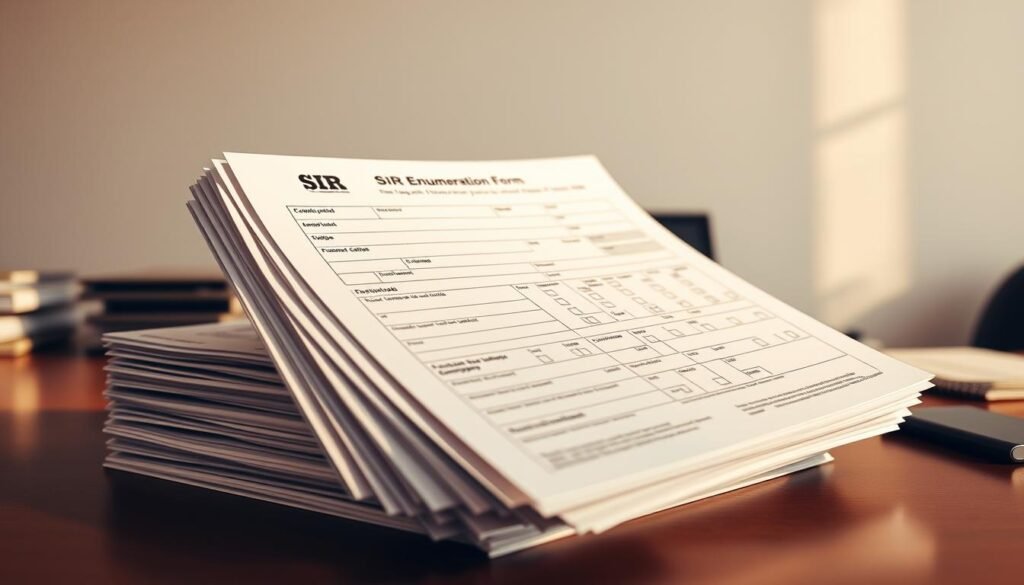
We explain the SIR form fields and how they affect electoral rolls and voter list updates. The form aims to gather enough information for reliable identification. It also makes the process easy for those without documents.
Fields and data collected on the form
The Election Commission approved the form’s layout. It includes name, age or birthdate, gender, and address. It also asks for family ties and a mobile number for contact.
Optional fields are Aadhaar and previous voter ID details. There’s a special section for those without documents.
Each field has rules to ensure accuracy. Mandatory fields are marked clearly, and date fields follow a specific format. Numeric IDs must meet certain length and checksum requirements to avoid errors.
These checks help when moving data from paper to digital systems or using the ECINET app.
How the form data feeds into the electoral process
Enumerators collect data on paper or through the ECINET app. Digital data is sent to the Election Commission’s databases securely. Paper forms are scanned or transcribed and checked against current voter lists.
This process ensures accurate voter list updates. It prevents duplicate registrations and flags any inconsistencies for review.
Privacy and data protection considerations
Keeping personal data safe is key for public trust. The commission uses access controls and encryption for data collected through the ECINET app and other means. Data retention policies limit how long sensitive information is stored.
Public extracts use redaction to protect individual data. Special measures are in place for no-document-proof submissions. These include restricted visibility and verification trails to reduce misuse risk.
Compliance follows the Information Technology Act and Indian data-protection guidelines. Engineers must balance the need for detailed SIR form fields with privacy concerns when designing systems.
States covered: breakdown of the 12 states and regional priorities
We map the SIR Enumeration Form rollout across 12 states to clarify distribution patterns and local goals. The Election Commission allocated forms based on population, voter registers, and on-the-ground needs. This makes planning clearer for engineers, trainers, and local election offices.
List of states and distribution volumes by state
The official allocation tables list each of the 12 states with per-state distribution volumes tied to registered voter counts. Andhra Pradesh, Bihar, Gujarat, Karnataka, Kerala, Madhya Pradesh, Maharashtra, Odisha, Rajasthan, Tamil Nadu, Uttar Pradesh, and West Bengal appear among the allocations. Planners should consult the Election Commission spreadsheets for exact numbers when scheduling transport and staffing.
Regional challenges and local implementation strategies
Remote and tribal areas require language-appropriate forms and targeted outreach to ensure inclusion. We work with local election offices to recruit enumerators fluent in regional languages. We also set up mobile enumeration camps in hard-to-reach pockets.
Urban zones demand density-based door-to-door scheduling and faster ECINET adoption to reduce paper handling. City teams focus on shifts, peak-hour routing, and verification hubs to match high distribution volumes.
Border districts and migration-prone regions need extra de-duplication checks and coordination with municipal records. Teams deploy cross-referencing routines and field spot checks to prevent repeat entries.
Literacy gaps, seasonal migration, and rugged terrain shape logistical choices. The Election Commission pairs panchayats and municipal bodies with technical trainers. They deliver targeted digital training for the ECINET app and supervise paper handling.
Door-to-door distribution strategy and logistics
We explain how teams reach every home, the journey from print to porch, and the checks that keep it right. Our goal is to deliver SIR forms reliably across India, keeping data safe and covering all areas.
How enumerators are trained and deployed
Training mixes classroom lessons on form fields and privacy with app practice. Role-play prepares them for checks and security. Each is tested and certified before being assigned.
Deployment is based on polling booth maps for accurate coverage. Team leaders manage clusters and set daily goals. We schedule visits and use clear ID to avoid disruption.
Supply chain and material handling for large-scale delivery
Printing is done centrally, then sent to regional hubs. From there, it goes to district offices in scheduled shipments. Kits are prepared for enumerators with SIR forms, lists, and manifest sheets.
Barcode labels and manifest controls track shipments. Chain-of-custody records track transfers to field staff. This design cuts down on loss, speeds up replenishment, and allows for quick issue resolution.
Monitoring and verification mechanisms in the field
We use several checks to ensure integrity: real-time dashboards, paper-return checks, and random spot-checks. Timestamped logs and QR-code scans track each SIR form.
Citizens can report missing forms or suspect behavior through hotlines. Supervisors visit the field and compare counts with returned packets. These steps ensure distribution, collection, and final processing match up.
Online enumeration and the ECINET app integration
The Election Commission’s ECINET app supports online enumeration. It keeps the SIR Enumeration Form structure. The app makes digital data capture easy for big campaigns.
The ECINET app has a digital layout that matches every SIR Enumeration Form field. It allows photo capture and biometric linkage. It also tags visits with GPS and has role-based access.
The app encrypts data and syncs it to central servers. It works offline, caching data and allowing uploads when networks are back. This helps enumerators work even in weak network areas.
Benefits of online enumeration
Online enumeration cuts down on transcription errors. It uses in-app validation rules and checks formats right away. This makes validation and updates faster.
It also lets you monitor data in real-time. Supervisors can see everything through dashboards. This makes it easy to track and manage data.
Connectivity and device challenges
Network issues are common in rural areas. Limited battery life and device shortages are problems too. We suggest using rugged devices and power banks.
Also, plan syncs to avoid data loss. This helps keep data safe during long field days.
Operational mitigations
The ECINET app is designed to work offline first. It uses small data packets to save bandwidth. If there’s no internet, it caches data for a safe sync later.
When offline, enumerators use paper forms. They scan and transcribe these later. This ensures data is accurate and complete.
No document proof option and its implications for voters
We explain how the Election Commission’s allowance for no document proof submissions affects voter inclusion and operational workflows. The SIR Enumeration Form now offers pathways for people without formal ID—migrants, homeless persons, and other marginalized groups—to appear in preliminary rolls.
Eligibility and verification without documentary evidence
Eligibility hinges on credible local attestations, not immediate documentary proof. A registered voter or a local government official, like a panchayat secretary, can sign the SIR Enumeration Form to support an applicant.
Enumerators can record witness declarations and make field notes that describe residence or habitual presence. These entries move through the ECINET tracking chain for later cross-referencing with civil records.
Safeguards to prevent misuse and fraudulent entries
Safeguards include multi-layer verification: witness signatures from verified electors, confirmation by municipal staff, and supervisor checks in the field. The ECINET log stores the verification trail for audit teams to review.
Operational limits restrict how many no-document-proof inclusions a single enumerator can submit. Backend anomaly-detection flags unusual patterns for manual inspection by data validation teams.
Support channels for applicants lacking ID documents
Local election office help desks and community outreach teams guide applicants through the no-document-proof process. We encourage applicants to provide supporting testimony or later submit identity documents when available.
A grievance redressal mechanism accepts complaints about suspected fraudulent entries and triggers targeted rechecks. Engineers and policy teams balance voter inclusion with data integrity by refining audit rules and verification workflows.
How the SIR process updates the electoral rolls and voter list accuracy
We explain how the SIR process helps update electoral rolls. It makes voter lists more accurate across different areas. This process uses automated checks and local reviews to find and fix errors quickly.
Data validation starts right away: ECINET checks for the right format and all needed fields. This helps cut down on mistakes. The system uses exact matches when it can and likely matches for names and addresses that might be different.
Records are checked against past electoral rolls and government lists. This step helps avoid duplicates and spots any oddities for manual checks by supervisors and data officers.
Thanks to better matching, voters’ locations are more precise. This means polling stations can be assigned more accurately. It also makes it easier to communicate with voters during elections.
Local election offices do the final check. They publish draft lists, listen to objections, and solve any issues during a public review period. Then, they officially add the accepted changes.
The SIR process cuts down on errors with in-app checks, GPS stamps, and supervisor checks. These steps help fix issues faster and make electoral rolls more reliable.
We expect to see better voter lists. They will include more first-time voters and groups that were left out before. There will be fewer duplicates and more trust in the accuracy of voter lists.
Public awareness campaigns and communication efforts by the Election Commission
We run an outreach program to spread the word about the SIR Enumeration Form and voter services. Our goal is to reach out to different communities, clear up any confusion, and increase voter turnout. We do this through focused Election Commission campaigns.
Media outreach covers many platforms: national TV, regional radio, leading newspapers, social media, and SMS alerts. We use this mix to see which methods work best in each area.
Community meetings and pop-up help desks are set up in various places. These include panchayat halls, urban resident association offices, colleges, and markets. People can ask questions and get help from our trained staff and volunteers.
Informational materials include brochures, posters, videos, and pictorial guides. These explain how to fill out the SIR Enumeration Form and use the ECINET app. This helps those who prefer digital submissions.
We make materials in Hindi, English, and major regional languages of 12 states. We use audio-visual formats and local dialects to reach elders and communities with limited literacy. This strategy helps improve understanding and reduce errors.
We work with civil society groups, NGOs, disability rights organizations, and student associations. Local leaders like sarpanch and ward councillors help us reach more people and host events.
We track how well our campaigns are doing by looking at form uptake rates, ECINET adoption, helpline calls, and fewer refusals. These numbers help us know where to focus our efforts and which methods are most effective.
Deadlines and important dates: SIR Deadline 4 December and next steps
The Election Commission has set the SIR Deadline 4 December as the last day to submit SIR forms. It’s important for residents and enumerators to meet this deadline. Forms submitted by then will be included in the current electoral roll. Forms submitted late might be included in the next cycle, which could delay their inclusion in future polls.
What the 4 December date means for residents: Households need to make sure their SIR form was submitted. This can be done by handing it to an enumerator, submitting it to a local election office, or using the ECINET app. Keep any proof of submission, like an acknowledgment slip or digital receipt.
What the 4 December date means for enumerators: Enumerators must finish their visits and submit forms by the deadline. The ECINET app can help track progress with time stamps and GPS logs.
Post-deadline processing: After the deadline, the data is checked and validated. Then, draft revised electoral rolls are displayed publicly. There’s a period for objections and claims, followed by dispute adjudication and the final publication of the updated roll.
How to check status after you submit: Residents can check their status on the Election Commission’s website, in the ECINET app, or by contacting local offices. They can also call state EC helplines or visit polling station notice boards. ECINET shows receipts and updates on progress.
Practical tips for follow-up: Keep receipts or screenshots from ECINET, note time stamps and GPS evidence when available, and watch for public display notices. If an entry is missing after processing, contact the local office to start verification.
We suggest checking local election office communications for important dates. These include public display, objection filing windows, and final roll notifications after the deadline. Taking timely action and keeping records helps ensure a resident’s spot on the electoral roll.
Common issues reported during distribution and how they’re addressed
We keep an eye on feedback from the field to catch patterns fast. Our logs show delays, damaged or missing forms, and sometimes enumerators don’t show up. People are asked to check their identity before sharing personal info to fight fraud.
Delays, missing forms, and reporting mechanisms
If people say they’re missing forms or got them late, they can call state Election Commission helplines. They can also use online portals or visit local election offices. Each complaint gets a ticket number for tracking.
Enumerator identification and preventing impersonation
Enumerators have official badges and an ID linked to the EC roster. Supervisors check teams and use QR badges to confirm assignments. Public advisories tell people to ask for ID and call the helpline if something looks wrong.
Correction procedures for errors on submitted forms
If there’s an error on SIR forms, people can ask for corrections at local offices or online. Digital records help fix things faster. Paper-form corrections need scanning, transcription, and verification.
Repeated mistakes lead to more serious actions, like going to district election officers and administrative penalties.
Impact on upcoming elections and voter participation prospects
We look at how the SIR Enumeration Form rollout might change voter turnout and election processes. Clearer voter lists mean less confusion at polling stations. This makes it easier for people to vote, which could increase turnout among those who have been missed before.
How more accurate rolls can affect turnout and representation
Accurate voter rolls mean fewer disputes and shorter waits on election day. When voters can easily find their names and polling stations, they feel more confident. This leads to fewer lost votes, improving representation for communities that have faced barriers.
Projected changes in voter demographics and registration rates
Efforts to include more people, like those without documents, and targeted enumeration can boost registration. This is true for migrants, young adults, and the urban poor. Changes in voter demographics can shift local political balances and where campaigns focus.
Implications for political stakeholders and election logistics
Political parties, candidates, and planners will use the updated data to improve their strategies. They can better plan staffing, ballot production, and voter education. This leads to more efficient election planning based on solid data.
Engineers and election officers see the value in accurate data. It lets them simulate voter turnout and plan targeted efforts. These efforts aim to boost voter participation and reduce election day challenges.
How citizens can participate: steps to fill and submit the SIR form
We make it easy for voters to join in. First, check if a door-to-door enumerator has visited. They often hand out SIR forms at homes. You can also get extra forms at local election offices, Common Service Centers, and community help desks.
For digital filing, download the ECINET app from app stores. Follow the app’s instructions. Authenticate, fill out the SIR form, attach photos, and save your digital acknowledgment.
Where to find help
Local election offices, Common Service Centers, and NGOs offer support. State EC helplines are ready to help with questions or complaints. They can assist with documentation or submission receipts.
What information to prepare
Have your personal details ready: name, age, gender, address, and phone number. Include family relations or previous voter details if needed. Aadhaar is optional. If you don’t have documents, prepare witness details or a local authority attestation as the Election Commission suggests.
Tips for a successful submission
Double-check spellings and addresses before signing. When using the ECINET app, ensure photos are clear and internet is stable. Keep any receipts or acknowledgments for future reference.
Grievance redressal and accessibility
Face issues? File an online complaint or call a helpline. Visit your local electoral office for help. Support centers offer in-person assistance and services for people with disabilities, including doorstep services and accessible formats.
Conclusion
The Election Commission has released a lot of information about the SIR Enumeration Form. They have sent out 370 million forms to 12 states. This effort combines door-to-door visits with the use of the ECINET app.
They also have a policy where you don’t need to show any documents. This is to make sure everyone can get on the voter list. They want to reach out to all communities before December 4th.
This effort is a big lesson for engineers, teachers, and students. It shows how to use technology to improve voting systems. The choices made in designing this system are very interesting.
These choices help balance how accurate the data is, how private it stays, and how well it works in tough conditions. The Election Commission’s plan teaches us a lot about managing big projects.
Citizens should fill out their SIR Enumeration Form before December 4th. They should also check their voter list status after it’s processed. People working in this field can learn a lot from this project.
This SIR initiative is a great example of how to improve voting systems. It shows how careful planning and community involvement can make a difference. It’s a model for public innovation that strengthens democracy.