



Did you know that millions of informal workers have gained a guaranteed pension through the Atal Pension Yojana? This has changed how India views retirement security.
We think a simple, affordable retirement plan can make a big difference. This is true for engineers, students, and educators planning long careers in India. The Atal Pension Yojana (APY) is a government program that helps with financial security.
APY is for workers in the unorganized sector and any Indian citizen with a savings account. You can join from 18 to 40 years old. Pension starts at 60, but from October 1, 2022, income-tax payers can’t join.
The scheme offers fixed pension amounts, spouse benefits, and returns pension wealth to nominees after both pass away. You can open an account at many banks and the Department of Posts. Enrollment is easy through branch forms or the online eAPY process.
In the next sections, we’ll explore eligibility, enrollment, contributions, and benefits. This will help you see if APY is a good choice for your retirement in India.
What is the Atal Pension Yojana?

We explain the Atal Pension Yojana to help you understand its role in securing your retirement. It’s a government program that offers a steady income for millions of workers in the informal sector. Here’s a brief overview of its structure and main goals.
Overview of the Program
The APY program is run by the Pension Fund Regulatory and Development Authority. It aims to provide a guaranteed monthly pension to subscribers from age 60. To join, you need an active savings bank account and make regular contributions.
You can choose a pension amount from ₹1,000 to ₹5,000. The government ensures the pension is paid, even if investments don’t cover it. Each account has a Permanent Retirement Account Number (PRAN), and you can only have one APY account.
Key Objectives of the Scheme
The scheme aims to provide income security in old age to workers in the unorganized sector. It’s seen as a way to reduce financial risk in retirement.
The program encourages a pension culture in India by making it easy and affordable. It also supports families by providing cover for spouses and nominees, helping them when the subscriber can’t work anymore.
| Objective | Mechanism | Expected Outcome |
|---|---|---|
| Expand social security reach | Low-cost access via banks and post offices; single PRAN account | Higher enrollment from informal workers; broader pension coverage |
| Guarantee retirement income | Defined pension slabs; government covers shortfall | Predictable monthly income from age 60 |
| Promote contribution culture | Auto-debit contributions; simple product design | Regular saving habits; improved financial planning |
| Protect families | Spouse and nominee benefits; continued cover | Reduced old-age dependency; sustained household security |
| Enable oversight and growth | APY Dashboard MIS for monitoring | Transparent program management; data-driven improvements |
Who is Eligible for Atal Pension Yojana?

We explain who can join this Indian retirement scheme and what documents are needed. Clear rules help people decide fast. We cover age, income, and account requirements for APY eligibility.
Age and Income Criteria
Indian citizens between 18 and 40 can join. Contributions start at 18 and end at 60, when the pension begins. This means a long contribution period for benefits.
Starting October 1, 2022, those who have paid income tax can’t join. APY is for workers in the unorganized sector and all citizens who meet other criteria.
You need an active savings bank account for monthly contributions. This account is key for easy administration and timely pension credits.
Required Documentation
To sign up, you need basic KYC documents: ID proof, bank account details, and nominee info. Aadhaar is best for quick verification, but other IDs work too.
Linked phones and mobile numbers help with alerts. After signing up, you get a PRAN. Keep your bank, nominee, and contact details updated for smooth service.
How to Enroll in the Atal Pension Yojana?

We make APY enrollment easy for you. We explain the main steps and compare two ways to sign up: visiting a branch or using the online service. Both paths lead to getting a PRAN and activating your account.
Step-by-Step Enrollment Process
Follow these steps for online or offline APY registration.
- Visit your bank branch or India Post office where your savings account is held, or go to the eAPY portal for online registration APY.
- Obtain and complete the APY Registration Form at the branch/post office, or finish the eAPY registration form online.
- Provide your savings account number, PRAN details if applicable, nominee details, and KYC documents. Select your pension slab (₹1,000–₹5,000) and contribution frequency.
- Authorize an auto-debit mandate so contributions are deducted automatically. Keep sufficient balance on debit dates to avoid missed payments.
- Receive an acknowledgement slip and PRAN activation confirmation. Subscribers get periodic SMS alerts and annual statements for record keeping.
Online vs. Offline Registration
We compare features to help you decide how to join Atal Pension Yojana. Consider your comfort with technology and access.
| Aspect | Online Registration APY | Offline Registration APY |
|---|---|---|
| Access | eAPY portal; remote access from home or office | Bank branch or India Post office visit; in-person support |
| Speed | Immediate form submission; faster for tech-savvy users | May take longer due to in-branch processing and queues |
| KYC & Documentation | Upload digital copies; e-KYC where available | Staff assist with document checks and form filling |
| Support | Self-service help, APY Dashboard MIS for service providers | Personal assistance from bank or post office staff |
| Best for | Tech-savvy subscribers and remote applicants | Those without internet access or who prefer guided help |
Both methods complete APY enrollment and issue a PRAN. Account management lets subscribers request one annual change in pension slab and alter contribution periodicity once a year. Choose the path that fits your comfort level when joining Atal Pension Yojana.
Understanding the Benefits of Atal Pension Yojana

We explain the main benefits of APY so you can understand its value. This program is designed to help both informal and formal sector workers. It aims to provide strong social security.
Subscribers can choose a fixed retirement payout. The pension amounts range from ₹1,000 to ₹5,000 per month. It starts at age 60 and continues for life.
After a subscriber’s death, their spouse gets the same pension. This creates a lasting safety net for families.
Guaranteed Pension Amounts
The scheme offers clear, lifetime payouts. This makes financial planning easier for many professionals. If investment returns are higher than expected, the payout can increase.
If the pension wealth is less than promised, the government helps. If both the subscriber and spouse pass away, the money goes to a nominated beneficiary. These features ensure long-term stability.
Tax Benefits for Subscribers
Contributions to APY are made from post-tax income. Check current rules for any deductions under Indian tax provisions. Periodic statements and the PRAN record help with record-keeping and tax planning.
For professionals balancing income and savings goals, tax benefits APY can be part of a broader retirement strategy. The scheme’s simplicity and alignment with National Pension System practices increase its appeal among those seeking reliable social security.
| Feature | What it Means | Who Benefits Most |
|---|---|---|
| Guaranteed pension slabs | Fixed monthly pension of ₹1,000–₹5,000 from age 60 | Low- to middle-income workers seeking predictable income |
| Spousal entitlement | Spouse receives same pension for life after subscriber’s death | Married subscribers and family planners |
| Government shortfall support | Central government covers gaps if corpus is insufficient | All subscribers relying on guaranteed pension |
| Potential enhanced pension | Higher payouts possible when returns exceed assumptions | Long-term investors who want upside with protection |
| Tax record support | PRAN and periodic statements aid tax planning | Salaried professionals and students planning finances |
| Social security alignment | Part of India’s broader retirement architecture | Policy-minded citizens and advisors |
Contribution Structure Under the Scheme
We explain how payments work under the Atal Pension Yojana. This way, readers can pick a plan that fits their timeline and income. It’s simple: choose a pension target, enroll at a chosen age, and follow the contribution schedule. Small changes up front can change long-term results.
Monthly contributions are auto-debited from your linked savings account. You can choose monthly, quarterly, or half-yearly. Make sure to keep enough balance to avoid missed debits. You can also make voluntary top-ups to boost your pension wealth. You can change your frequency once a year in April.
Monthly Contribution Details
Contribution amounts depend on the pension slab you choose and your age at entry. Younger joiners pay less per period because they have more time to accumulate. Banks and authorized points of presence provide exact schedules for each pension target.
APY contributions show the effect of contribution size, frequency, and actuarial assumptions. Subscribers can see monthly contribution APY values in tables lenders publish when they enroll.
Different Contribution Patterns Based on Age
Time is a powerful factor. The same pension target requires smaller payments if you start early. Below are examples for a ₹1,000 monthly pension target, based on Pension Fund Regulatory and Development Authority guidance.
| Entry Age (years) | Years of Contribution | Indicative Monthly Payment (₹) | Notes |
|---|---|---|---|
| 18 | 42 | 42 | Longest accumulation period; lowest periodic cost |
| 20 | 40 | 50 | Small rise versus age 18; cost-effective |
| 25 | 35 | 76 | Noticeable increase as years shorten |
| 30 | 30 | 116 | Middle of the curve for most contributors |
| 35 | 25 | 181 | Costs rise faster with each lost year |
| 40 | 20 | 291 | Shortest common entry window; highest payments |
These figures show how contribution patterns change by age. Earlier entry means lower regular payments for the same pension goal. We recommend checking bank-provided tables and confirming APY contributions before committing. This way, your contribution-based pension aligns with your household plans.
Pension Amount and Maturity Period
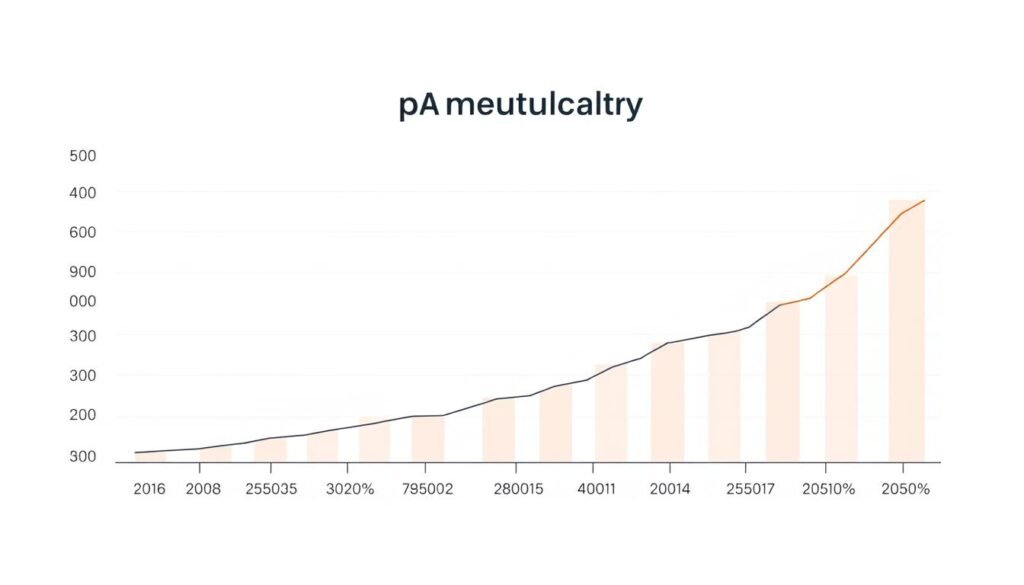
We explain how the pension amount is set and what the maturity period means for subscribers. This helps professionals weigh the trade-offs between contribution levels, expected returns, and lifetime security.
How Pension Amount is Decided
Subscribers choose a target monthly pension between ₹1,000 and ₹5,000. The required contribution is calculated by the administrator based on the entry age and actuarial assumptions. These assumptions translate the chosen pension target into a regular premium that must be paid until maturity.
The final payout after age 60 depends on accumulated pension wealth: total contributions plus investment returns. If actual returns exceed actuarial expectations, the pension amount APY can increase the corpus and lift the payable pension. The government protects a guaranteed pension decision: when returns fall short, a minimum pension is secured so beneficiaries do not receive less than promised.
Duration of Pension Payment
Pension payments start when the subscriber reaches 60 and continue for life. The duration of pension payment is lifetime for the subscriber, providing predictable monthly income in retirement.
When the subscriber dies, the spouse receives the same monthly pension for life. After both spouses pass away, any remaining pension wealth is paid to the nominee as a lump sum. If the subscriber dies before 60, the spouse may either continue contributions until the original maturity age or withdraw the accumulated pension wealth immediately.
Withdrawal Rules and Conditions
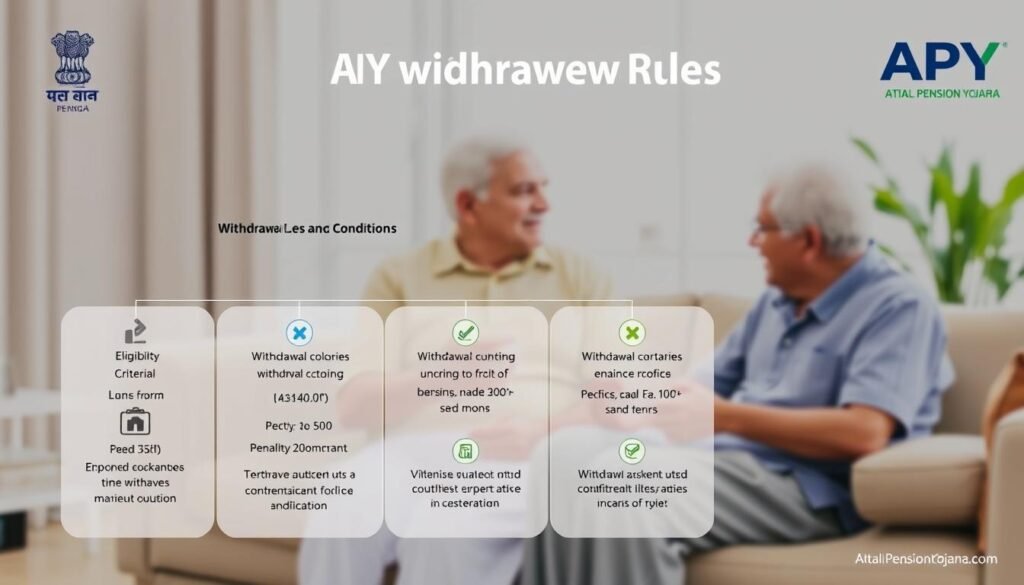
We explain the main rules for withdrawing from Atal Pension Yojana accounts. This helps subscribers plan better. We cover early exits, what happens if someone dies, and how the pension wealth moves at maturity.
Premature exit options
Exiting early before 60 is allowed but with strict rules. If the government helped with contributions, only the subscriber’s money and returns are returned. The government’s part stays in the scheme.
If someone dies before 60, the spouse can keep paying or take the money. This choice decides if the account stays open or if the funds are withdrawn.
Missing payments can cause problems. Banks send alerts and include messages in statements. Keeping enough money in the bank helps avoid these issues and keeps the APY account active.
Maturity benefits explained
At 60, the subscriber starts getting the monthly pension they chose. The pension wealth corpus funds these payments. If investments do better than expected, the pension might be higher, showing the APY’s maturity benefits.
When both the subscriber and spouse pass away, the remaining money goes to the chosen beneficiary. It’s important to name a nominee at the start. Married people’s spouses are the default nominee. This ensures the pension wealth corpus is transferred correctly.
Importance of the Atal Pension Yojana for Future Planning

We believe retirement planning is a team effort. It involves individuals, families, and institutions. The Atal Pension Yojana (APY) is a simple, affordable way to create a steady income for years to come. This section highlights why APY is key for long-term planning and fits into India’s pension scene.
Financial Security in Retirement
APY provides a steady income for retirees. This is very important for those in the informal sector without employer pensions. Starting early with small payments can lead to a significant pension later on.
APY also protects families if the subscriber dies before retirement. This protection helps ensure financial stability for families. It’s a way to lower the risk of poverty in old age.
Role in India’s Pension Landscape
APY works alongside the National Pension System and private options to cover more people. Its government backing and availability through banks and India Post make it accessible everywhere. This helps informal workers join the formal pension system.
The scheme supports the goal of reducing poverty among the elderly and expanding social protection. APY makes it easy to join and offers a reliable part of a mixed retirement plan.
| Feature | Benefit | Impact on Retirees |
|---|---|---|
| Guaranteed Pension | Predictable monthly income | Reduces income volatility after retirement |
| Early Enrollment | Lower monthly contributions | Improves lifetime returns via compounding |
| Bank/Post Office Access | Wide reach across India | Boosts coverage in rural and remote areas |
| Spousal and Nominee Protections | Continuity of benefits | Reduces family vulnerability on subscriber’s death |
| Government Guarantee | Policy-backed security | Increases trust and adoption among low-income groups |
Government’s Role in the Atal Pension Yojana
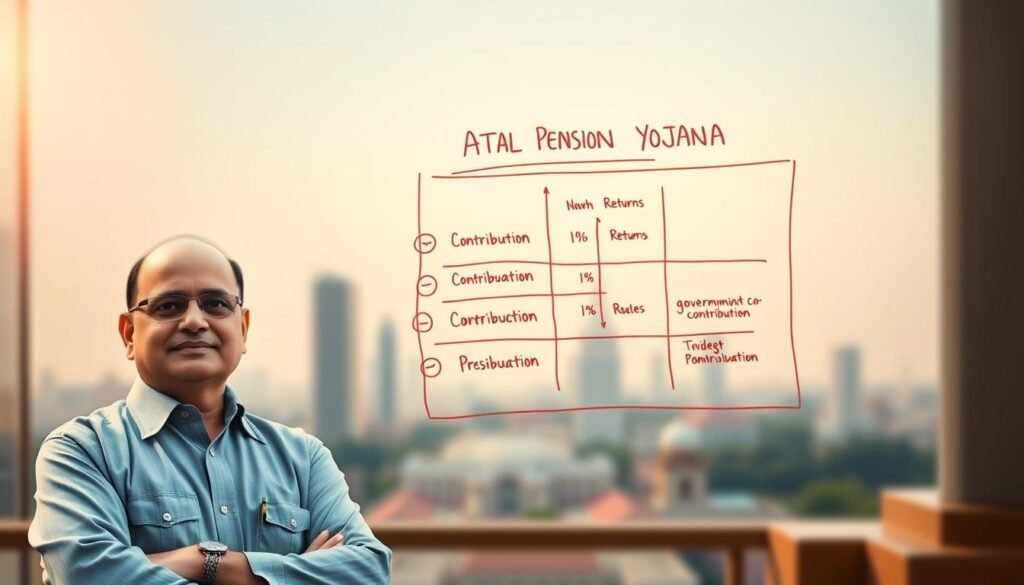
We explore how public policy and financial support shape the Atal Pension Yojana. The government’s actions build trust, ensure access, and provide stability for millions. This includes informal workers and low-income families.
Funding and Support Mechanisms
The Atal Pension Yojana has a clear funding model. The central government guarantee ensures a minimum pension for subscribers. This guarantee covers monthly pensions from ₹1,000 to ₹5,000 from age 60, even if investment returns are low.
PFRDA manages APY within the National Pension System framework. It issues operational circulars and maintains the APY Dashboard MIS. It also provides training for banks and post offices to improve delivery. These efforts support timely payouts and consistent record keeping.
Early-stage incentives included a limited government co-contribution. Eligible non-taxpaying subscribers who joined before March 31, 2016 received 50% of their annual contribution (up to ₹1,000) for five years. This policy ran from fiscal 2015–16 to fiscal 2019–20 and boosted initial uptake.
Policy Impacts on Citizens
Policy changes have shaped who benefits most from APY. From October 1, 2022, new enrollments by income tax payers were excluded. This change focuses the scheme on lower-income and untaxed segments, sharpening its social targeting.
Government backing increases confidence in guaranteed payouts. It encourages retirement planning among informal workers. Tools like auto-debit, PRAN linkage, and nominee rules improve continuity. Portability across banks and post offices makes APY practical for migrant laborers and seasonal workers.
| Aspect | Mechanism | Citizen Benefit |
|---|---|---|
| Guaranteed Pension | Central government guarantee covers shortfalls | Assured monthly income from age 60 |
| Administration | PFRDA oversight; APY Dashboard MIS; training | Transparent operations and standardized processes |
| Early Incentive | Government co-contribution (2015–16 to 2019–20) | Higher initial enrollment among eligible subscribers |
| Targeting | Exclusion of income-tax payers from new enrollments (Oct 2022) | Focus on lower-income, untaxed populations |
| Delivery Tools | Auto-debit, PRAN, nominee rules, portability | Reliable contributions, easy transfers across banks |
We see the government’s role in APY as both protector and facilitator. Clear funding arrangements and responsive policies shape strong impacts for vulnerable households. This raises financial resilience across India.
Common Misconceptions About Atal Pension Yojana
We often hear conflicting claims about pension plans. In this part, we separate hearsay from reality. We present clear, practical points so readers can make informed choices. Our aim is to clarify doubts APY subscribers commonly face and to surface Atal Pension Yojana facts that matter.
Myths vs. Facts
Myth: APY is only for unorganized-sector workers. Fact: The scheme targets that group, yet any eligible Indian aged 18–40 with a savings account may join, with tax-payer exclusions applying after 2022.
Myth: The government never covers shortfalls. Fact: The central government guarantees the minimum pension and funds any gap between returns on the corpus and the promised payouts.
Myth: You can hold several APY accounts. Fact: One APY account per person is allowed and each subscriber receives a unique PRAN to prevent duplicates.
Myth: The spouse loses all benefits if the subscriber dies before 60. Fact: The spouse may continue contributions to vest the pension at 60 or withdraw the accumulated corpus. If the subscriber dies after 60, the spouse receives the same lifelong pension.
Clarifying Doubts for Future Subscribers
Enrollment: You can open APY offline at banks or post offices, or enroll online through eAPY portals. PRAN issuance and SMS alerts follow registration to keep subscribers informed.
Missed contributions: Maintain enough account balance to avoid defaults. Banks send notifications for missed debits. Extended default can affect vesting and future pension benefits.
Pension changes: Subscribers can revise their chosen pension slab once a year during the accumulation phase. Plan changes require formal requests through the bank or pension intermediary.
Tax treatment and co-contribution history: Tax implications evolve; consult your bank or a tax advisor for current rules. Government co-contribution applied to early adopters and was time-limited to specified years around 2015–2016.
| Common Claim | Reality | Action for Subscribers |
|---|---|---|
| APY limited to informal workers | Open to eligible Indian citizens aged 18–40 with a savings account | Verify eligibility with bank and enroll via eAPY or offline channel |
| Government does not guarantee payouts | Central government guarantees minimum pension and funds shortfall | Keep contribution records and monitor annual statements |
| Multiple APY accounts allowed | Only one account per person; PRAN enforces uniqueness | Confirm PRAN on issue and report duplicates immediately |
| Spouse loses benefits if subscriber dies early | Spouse can continue contributions to vest or withdraw corpus; post-60 death leads to lifelong spouse pension | Discuss survivor options with bank and update nominee details |
| Missed contributions have no consequence | Prolonged default may affect vesting and benefits | Maintain sufficient balance and respond to bank notices |
Future of Atal Pension Yojana
The future of APY looks bright in India’s social protection story. The Pension Fund Regulatory and Development Authority keeps updating the program. They release dashboards, circulars, and MIS reports for service providers to track their work.
Technology is making APY easier to join and manage. Now, people can enroll online and keep track of their accounts digitally. This change helps millions of people.
Policy changes are always on the table. The program can adjust age bands, contribution rules, and who can join. For example, a new rule started on October 1, 2022, to exclude taxpayers. Everyone should watch for updates from the PFRDA.
Banks and India Post are working to improve their services. This helps APY grow and makes it easier for users to get help.
APY is becoming key for social security in India. It helps those in the informal sector get pensions. It’s a low-cost way to fight poverty and ensure retirement.
APY is a great example for financial design. It shows how policy can help people plan for the future. It’s a lesson for engineers, educators, and students.
We think APY will have a big impact if more people join early. Strong financial literacy and ongoing improvements are key. As APY grows, everyone should stay involved to build a better retirement future for India.