



Nearly 100 million Indians live in homes that don’t meet basic standards. This makes PM Awas Yojana eligibility very important for housing policies.
We explain the main Pradhan Mantri Awas Yojana eligibility rules. This helps engineers, planners, students, and teachers know who can apply. The scheme started in 2015 to provide housing for all. It’s now in PMAY-U 2.0, with new rules and who’s not included.
The PMAY eligibility is based on family size, no pucca house in India, and income level. It uses government help, state funds, and the people’s own money. It also uses MIS, DBT, geo-tagging, and quality checks for clearness.
This part covers who can get into the PMAY scheme. It talks about family rules, the pucca-house test, and more. These basics help us understand income limits, age rules, and how to apply in the next parts.
Understanding PM Awas Yojana and Its Impact
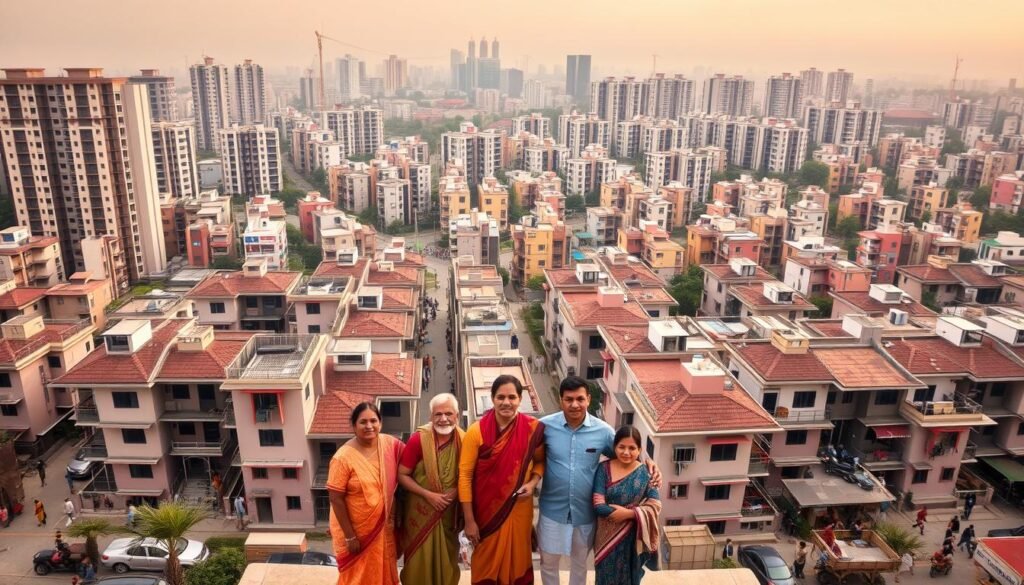
Let’s start with a quick overview of the program and its importance. PMAY combines policy, finance, and technology to address a big housing shortage. It improves living conditions and boosts local economies through urban and rural projects.
Overview of PM Awas Yojana
PM Awas Yojana aims to provide housing for all through two main tracks: urban and rural. It offers financial help for construction, buying, or renting homes. The program uses online tools and technology to track progress and ensure transparency.
Goals and Objectives
PMAY’s main goal is to build strong, safe homes with essential amenities. It also aims to create jobs in the construction sector. The program encourages the use of sustainable building technologies.
Importance for Low-Income Families
PMAY helps low-income families by reducing the housing shortage. It offers subsidies based on affordable housing standards. The program also focuses on gender equality and supports vulnerable groups.
| Aspect | What it Delivers | Relevance to Engineers and Planners |
|---|---|---|
| Basic Amenities | Kitchen, toilet, water, electricity, sewerage | Design standards, utility integration and service delivery metrics |
| Technology Adoption | Prefab, precast, tunnel formwork, LGSF, 3D volumetric | Field trials, scalability studies and performance monitoring |
| Transparency Tools | Geo-tagging, MIS dashboards, DBT | Data-driven planning, reduced leakages, academic analysis |
| Urban Eligibility | PMAY urban eligibility for urban poor, renters and first-time buyers | Policy targeting, municipal coordination and rental housing solutions |
| Economic Impact | Job creation, supply chain demand, local economic boost | Impact assessments, employment metrics and cost-benefit analysis |
Who Can Apply for PM Awas Yojana?
We help you understand who can apply for PMAY. The main rule is that the applicant family must not own a permanent house in India. Families that meet income criteria can apply for PMAY-G or PMAY-U 2.0, based on where they live.
Eligibility Criteria Overview
We make it clear what you need to apply for PMAY. A family is considered as a husband, wife, and unmarried children. An adult earning member is counted separately if they don’t own a permanent house. You’ll need to provide Aadhaar, income certificates, land documents, and an affidavit to prove you don’t own a permanent house.
Those who got housing help from the government in the last 20 years can’t apply for PMAY-U 2.0. States and local bodies check records through their MIS platforms. They might ask for more local documents before they approve your application.
Target Demographics
We focus on helping certain groups with PMAY. These include EWS, LIG, and MIG families in cities and planned areas. They are the main target.
Special help goes to widows, single women, people with disabilities, senior citizens, transgender persons, SC/ST families, religious minorities, Safai Karmis, street vendors, Vishwakarma artisans, Anganwadi workers, and Beedi, Construction Workers. Slum dwellers and chawl residents also get special attention.
Income Limits Explained
We explain the income limits for PM Awas Yojana. EWS covers households with up to ₹3 lakh annual income. LIG is for those with incomes between ₹3 lakh and ₹6 lakh. MIG categories had different CLSS subsidy levels in earlier versions.
CLSS vertical closed in 2022, but PMAY-U 2.0 keeps EWS, LIG, and MIG labels. Some documents mention MIG ceilings up to ₹18 lakh. Always check the latest scheme documents for income limits as they can change.
| Category | Typical Annual Income Range | Notes |
|---|---|---|
| EWS | Up to ₹3,00,000 | Priority for the poorest urban households; eligible for central assistance under PMAY-U 2.0 |
| LIG | ₹3,00,001 to ₹6,00,000 | Eligible for assistance and targeted urban programs; verification required |
| MIG | Varies by version and state | Historical CLSS subsidies applied to MIG-I and MIG-II; check current PM Awas Yojana income criteria in official documents |
| Exclusions | N/A | Those who availed government housing aid in past 20 years are excluded from PMAY-U 2.0 |
Before applying, check if your State or Union Territory has agreed with the Ministry of Housing and Urban Affairs. You need to enroll with the SLSMC and ULB. Having all your documents ready and verified locally can speed up the approval process.
Age Requirements for PMAY Applicants
We look at age rules to help applicants understand PM Awas Yojana eligibility age and PMAY age criteria. These rules are for adults and ensure fair treatment for all. Local Urban Bodies and State Nodal Agencies check these details.
Minimum Age Criteria
Applicants must be legal adults to apply. The scheme needs an adult head of household. Some say 21 years old in certain cases, but official PMAY materials focus on being an adult and having the right family documents.
We suggest checking the Unified Web Portal or state guidelines for the PM Awas Yojana eligibility age before applying. Local rules might have extra age limits for certain housing types or subsidies. This helps avoid delays.
Benefits for Senior Citizens
Senior citizens get priority if they meet income and housing needs. They might get ground-floor homes and faster local processing.
Widows, divorced or deserted women, and transgender people are also priority groups. They need legal documents like separation decrees or abandonment certificates. These can replace spouse or parent Aadhaar if needed.
Aadhaar is key for identity checks. But, there are exceptions for those who lost parents or were raised in institutions. Forms have a “late” option and need supporting certificates. It’s wise to have certified documents ready for ULB and SLNA checks to meet PMAY requirements smoothly.
Income Group Classification
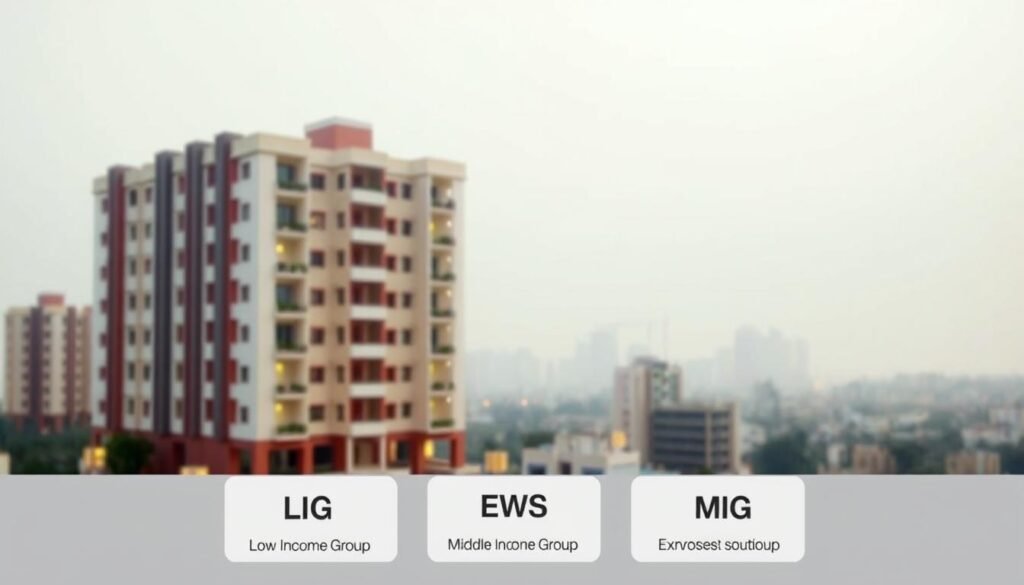
We make it clear where you fit in income-wise so you know what benefits you get. This helps make sure everyone gets what they need fairly. We check your income with special certificates and systems.
Economically Weaker Sections (EWS)
EWS is for families making up to ₹3 lakh a year. They get priority in many housing projects. Knowing the EWS LIG MIG rules helps officials help the right people.
Low-Income Group (LIG) Standards
LIG families make between ₹3 lakh and ₹6 lakh a year. Some programs help them too. Officials use PM Awas Yojana rules to see who gets help.
Middle-Income Group (MIG) Specifications
PMAY used to have special help for MIG families. Even though that’s ended, PMAY-U 2.0 might help them again. Always check the latest rules for income and benefits.
| Category | Annual Income Band (₹) | Typical Support |
|---|---|---|
| EWS | Up to 3,00,000 | Priority under BLC and many AHP projects; higher quota in vulnerable areas |
| LIG | 3,00,001–6,00,000 | Eligible for selected interventions; assistance levels vary by vertical |
| MIG | Above 6,00,000 (bands per latest guidelines) | Supported via specific verticals and credit-linked designs; benefits vary by state |
Support can change by State and Union Territory. Places like hills and North-East get more help. It’s good to check the latest rules before applying.
Residential Status Criteria
We explain who can get housing help under PMAY. Clear rules help applicants choose the right scheme. They can then complete verification steps with confidence.
Must Be a Citizen of India
Applicants must be Indian nationals. The scheme needs proof of citizenship for all. Aadhaar is often used to check identity and prevent duplicates.
Having an Aadhaar card, passport, or voter ID is key. It shows the applicant is eligible. We suggest keeping originals and scanned copies for submission.
Resident Status Requirements
Eligibility depends on where the applicant lives. PMAY urban eligibility covers certain towns from Census 2011 and later. Towns under urban development authorities are also included.
Systems like MIS and geo-tagging check residence claims. They prevent duplication. DBT transfers use Aadhaar and bank data for secure benefit delivery.
Landless families might get heritable, non-transferable pattas. This is under the Beneficiary-Led Construction category. It’s important to apply under the right scheme, PMAY-G or PMAY-U, based on where you live.
Special Provisions for Women

We focus on making housing fair for everyone. The scheme helps women own property and improves their social and economic status. It combines legal protection, planning, and rules to make a big difference.
Women as Beneficiaries
PMAY makes sure houses are owned by women or jointly with men. Single women, widows, and other vulnerable groups get priority. If there’s no adult female, the house can be owned by a male, but widowers and others can own it individually.
Rules for documents are clear: married women are counted as part of their husband’s family. Married applicants must include their in-laws’ Aadhaar details. We suggest following state portal rules for specific document needs.
Empowerment Through Housing
Having a house helps families financially and gives women more say at home. Designers and planners must make homes accessible for everyone. This includes ground-floor layouts and features for women and people with disabilities.
| Provision | Practical Effect | Who Benefits |
|---|---|---|
| Ownership in female name or joint title | Legal property rights that support financial inclusion | women beneficiaries PMAY, families with female heads |
| Priority for single and vulnerable women | Faster placement on beneficiary lists and targeted support | widows, single women, transgender applicants |
| Portal documentation rules | Consistent family composition data; state-specific inputs required | PMAY eligibility women who apply online |
| Design guidance for accessibility | Safer, more usable homes for women and PwDs | planners, engineers, and households |
| Legal succession and transfer rules | Clear path for heirs to claim title and benefits | families of deceased beneficiaries |
We urge applicants to check their PMAY eligibility early. Good documentation and inclusive design lead to real change in housing for women in cities and rural areas.
Existing Housing Status
We explain how current dwelling ownership affects eligibility and what first-time applicants should know. The scheme focuses on families without a durable home. This no pucca house requirement is key to PMAY screening. Clear rules help officials target unmet housing needs and guide applicants through available verticals.
First-Time Homebuyers Advantage
We give priority to PMAY first-time homebuyers who don’t own a pucca dwelling in India. Such households qualify for most PMAY verticals if income and other conditions are met. This allows new homeowners to access interest subsidies, grants, or construction support under applicable components.
Families without a durable structure—defined by durable walls and roof materials like brick, RCC, timber, GI sheets, machine-made tiles or asbestos—get preference. The policy prevents duplication of benefits and directs resources to truly unmet households.
Requirement for Existing Home Ownership
Ownership of a pucca house anywhere disqualifies the family from PMAY in many cases. If any family member owns such a dwelling, the household normally fails the existing home ownership PMAY test. Officials verify property records and on-ground condition before approval.
Households with very small pucca areas may get help. A pucca house under 21 sq. m can qualify for expansion to 30 sq. m in select situations. If expansion is impractical, the family may be considered for a new dwelling under PMAY-U, subject to state rules and availability.
BLC beneficiaries can build on their own vacant land after proving title. For landless applicants, state governments sometimes provide pattas to enable inclusion. A critical restriction: beneficiaries who received central, state, or local housing assistance within the past 20 years are usually excluded to avoid double-dipping.
Houses completed under the scheme must remain residential and cannot be sold, transferred, or leased for five years from possession in most verticals. This lock-in preserves scheme intent and protects future beneficiaries.
Benefits of PM Awas Yojana

We highlight the main advantages of the PM Awas Yojana. It offers financial help, better living conditions, and upgrades to community infrastructure. These efforts aim to provide long-term stability for low and middle-income families.
Financial Assistance and Subsidies
Grants and subsidies help lower the costs of buying or renting a home. The amount of help varies by state and project type. For example, some states get up to ₹2.50 lakh per unit.
There were also loan benefits through CLSS. This helped with interest payments for different income groups. Even though CLSS ended in March 2022, it showed how to help financially through interest subsidies.
Technology Grants make building homes cheaper. The government supports these efforts with ₹3,000 per square meter. States also chip in, making it easier to adopt new building methods.
Additional Housing Benefits
People get homes with basic amenities like water, electricity, and toilets. The government tracks progress through technology and direct bank transfers. This ensures homes meet quality standards and reach those who need them most.
ARHC programs address the need for affordable rentals. They convert old buildings or build new ones. This has led to thousands of approved units for migrants and workers.
Slum redevelopment and AHP projects also help. They include homes for the economically weaker sections. Grants support these efforts, creating jobs and promoting energy-efficient building practices.
Rules like lock-in periods help keep homes in families. This prevents quick sales and keeps homes affordable. It also makes families feel more secure.
The PM Awas Yojana offers many benefits. It provides financial support, quality incentives, and social benefits. Together, they make housing more accessible and sustainable for millions.
Application Process for PMAY
We help you understand how to apply for PM Awas Yojana. You can apply through the Unified Web Portal of PMAY-U 2.0, Common Service Centres (CSCs), or your local Urban Local Body (ULB). Pick the method that feels most comfortable for you.
First, check if your State or Union Territory is part of the scheme. You need a memorandum of agreement with the Ministry of Housing and Urban Affairs. Then, see if a demand survey or city demand assessment is needed in your area.
Here’s a simple guide to apply for PM Awas Yojana. Each step is easy to follow to help you fill out the form correctly.
Step-by-step application guide
- Check if your area needs a demand survey with the ULB or municipal office.
- Register on the Unified Web Portal of PMAY-U 2.0, visit a Common Service Centre, or go to the ULB to get the form.
- Fill out the form carefully: enter your Aadhaar, bank account, and contact details as they appear on your documents.
- Upload digital copies or submit originals of your identity, address, income proof, and land documents.
- The ULB or implementing agency will compile project lists and send them to the State-Level Sanctioning and Monitoring Committee (SLSMC) for approval.
- After approval, central assistance is released through direct benefit transfer. Beneficiaries must complete geo-tagging and update progress to get further instalments.
Required documentation
Get all the PMAY required documents ready before starting. This list helps you know what to submit for BLC, CLSS, AHP, and other components.
| Document Type | Typical Acceptable Items | When Needed |
|---|---|---|
| Proof of identity | Aadhaar, PAN, Voter ID, Passport | All applicants |
| Proof of address | Ration card, utility bills, municipal records | All applicants |
| Income proof | Income certificate issued by competent authority | Determining eligibility group |
| Land or tenure proof | Land ownership papers for BLC; tenancy documents for ARH/ARHC | Component-specific |
| Affidavit | Undertaking declaring no pucca house ownership | All components that require self-declaration |
| Category or special status | SC/ST, PwD certificate, divorce/legal separation, guardian/orphan certificates | Priority or special cases |
Do a final check of your documents: make sure Aadhaar is linked to your bank account for DBT. Keep geo-tagged photos during construction. The PM Awas Yojana system uses Aadhaar validation and checks against other MIS platforms to avoid duplicates, so accurate details are key.
If you’re wondering how to apply PMAY simply, here’s what to do: register, upload your documents, track your application status, and complete geo-tagging and approvals to receive instalments. For local questions, contact your nearest CSC or municipal office.
Timeline for PMAY Applications
We outline the PMAY application timeline to guide applicants. From submission to fund release, the process involves several steps. These include local verification, committee approvals, geo-tagging, and digital dashboards.
This information helps engineers, field officers, and beneficiaries plan their work and finances.
Application Review Process
ULBs and implementing agencies start the review. They gather demand survey results and make lists of eligible beneficiaries. These lists then go to the State Level Sanctioning and Monitoring Committee for review.
When needed, the lists are sent to the Central Sanction and Monitoring Committee.
The PMAY review process uses the PMAY-U Dashboard and MIS. It tracks sanctions, disbursements, and construction milestones. Geo-tagging checks are a must: beneficiary-captured geo-tags must get ULB approval within 15 days. If not, the system auto-approves them.
Field inspections and third-party quality monitoring are part of the MIS. This ensures a clear audit trail.
Approval Duration
The time it takes for approval varies by State/UT and type of PMAY. Meeting schedules for SLSMC and CSMC affect central and state approval times. Approval can take from a few weeks to several months.
For construction-linked assistance, BLC central aid is given in three parts. These are released via DBT at milestones marked by geo-tagging. States can release the first part of their share early to speed up work.
Expect a few weeks or months from application to the first instalment. Delays often come from committee meetings, geo-tag verification, and quality checks. The PMAY review process and dashboard tools help make things more predictable and efficient.
Common Challenges and Solutions
Applicants often hit roadblocks in the PMAY process. Small mistakes can lead to big problems: lost documents, questions about ownership, or tech issues on the portal. We’ll look at simple solutions to help applicants overcome these hurdles.
Addressing application rejections
Many times, PMAY applications get rejected because of ownership issues. If any family member owns a permanent house in India, the application is not valid. Also, if the family got help from the government in the last 20 years, they can’t apply.
It’s important to check who lives in the family and who owns the house before applying. Make sure to provide clear documents and avoid any disputes. Also, get income certificates from the right places and fix any Aadhaar problems before you apply.
Clarifying documentation issues
Problems with documents are common in PMAY. This includes missing income proofs, Aadhaar issues, or no proof of land ownership for building projects. For families who lost a parent, choose the “late” option and upload the necessary documents.
For those who got divorced or were left by their partner, provide legal papers. Use high-quality photos and keep a construction diary for your project. If you need help, the local ULB or CSC can assist with uploading and using the portal.
| Common Cause | Immediate Fix | Where to Get Help |
|---|---|---|
| Ownership disqualification | Gather affidavits, certified land records; confirm family list | Sub-Registrar office; local revenue department |
| Prior assistance within 20 years | Check past sanction letters; submit proof of ineligibility if applicable | State HUD department; ULB office |
| Missing income certificate | Obtain certificate from competent authority with correct format | Revenue officer; municipal office |
| Aadhaar mismatch | Update Aadhaar details to match other documents | UIDAI centers; Aadhaar enrolment points |
| Geo-tagging or ULB delays | Upload clear geo-tagged images; follow up with ULB/CSC | Common Service Centers; ULB technical cell |
| Quality concerns in construction | Use TPQMA audits, RACHNA training, LHP demos for best practices | State technical cell; third-party monitoring agencies |
Delays in getting approvals from SLSMC and CSMC can stop the funds from being released. States might speed up and release their share to start the work. Even though technology is a problem, unified portals and mobile apps try to make things easier.
If you have a problem, use CPGRAMS or the PMAY-U grievance module. If you can’t get help locally, go to State or UT offices. Keep following up and keep records of your communication to solve PMAY application problems.
Success Stories and Testimonials
We share real stories from the field: PMAY has changed neighborhoods and boosted livelihoods. In cities like Chennai, Rajkot, and Lucknow, new building methods have been tested. These methods cut construction time and make buildings stronger.
Real-Life Impact
In cities and rural areas, PMAY has provided affordable rentals near work. Training programs have helped locals use new technologies. This has improved their skills and work.
PM Awas Yojana has brought many benefits. People now have steady electricity, safe sanitation, and lower housing costs. These changes have also led to better health and more stable incomes for informal workers.
Voices of Beneficiaries
Through mobile apps and the PMAY portal, we’ve collected many stories. A family in Lucknow is relieved from overcrowding in their new home. In Rajkot, tenants have shorter commutes and earn more because work is nearby.
These stories help shape policy. Awards and state performance show the impact of PMAY. Gujarat’s success in CLSS implementation offers lessons for others.
We present a compact table summarizing delivery, training reach and ARHC conversions. This helps planners and practitioners.
| Metric | Scale | Impact Highlight |
|---|---|---|
| Houses Delivered | Millions across India | Improved shelter security for low-income households |
| Light House Projects | 6 cities | Faster, cost-effective construction methods demonstrated |
| Capacity Building | ~52,000+ participants | Broader uptake of modern construction technologies |
| ARHC Conversions & New Builds | Thousands of units | Affordable rentals near employment hubs |
| Beneficiary Feedback | Portal & app entries | Reported gains in dignity, safety and finances |
PMAY success stories are varied. They include urban housing, rural schemes, and rental conversions. We use these stories to improve practice and make the program more responsive to citizens.
Beneficiaries are at the heart of PMAY. Their feedback drives improvements, informs training, and validates new technologies. This helps us make the program better for everyone.
Conclusion: The Future of Affordable Housing
PMAY-U 2.0 (2024–2029) is a big step forward. It uses new technology and policies to help more people. The government is committed to making homes affordable for everyone.
Innovation is key. New housing ideas and training programs help build better homes. These efforts make it easier for cities to grow in a smart way.
Eligible families should apply for PMAY through the Unified Web Portal. Make sure to have all the right documents ready. Professionals and teachers can help by joining training programs.
By keeping up the good work, we can make cities better for everyone. We can build homes that are smart, open, and fair for all Indians.