



Nearly 60% of advanced fluid simulations take days on high-performance clusters. But, recent work shows machine learning can cut that time to hours while keeping accuracy.
We think the mix of fluid mechanics and AI is changing Plumbing Engineering Design and AI practices worldwide. This change comes from the ML-for-CFD review by Wang et al. and resources like https://github.com/WillDreamer/Awesome-AI4CFD. We see three main ways: data-driven surrogates, physics-informed neural networks (PINNs), and ML-assisted numerical solvers.
Traditional CFD has big challenges—high cost, hard to capture turbulence, and stability issues. Machine learning helps by speeding up simulations, making design loops faster, and handling turbulence better.
Now, academic programs and industry events focus on data-driven AI and open-source CFD. This shift opens doors for Plumbing technology and Digital Transformation in Plumbing Engineering in India. It leads to smarter systems, better water use, and quick prototyping of complex networks.
We aim to make advanced simulation methods easy for engineers, students, and educators. For teams looking for help, Consac (https://www.consac.com) provides consulting for AI-enabled design workflows in modern plumbing projects.
Introduction to Plumbing Engineering Design
We explore the heart of plumbing today: delivering clean water, handling waste, managing rainwater, and keeping us healthy. Our goal is to show how Plumbing Engineering Design and AI work together. They make systems better, safer, and more efficient in cities like Mumbai, Delhi, and Bengaluru.
Plumbing is more than just pipes and fixtures. Good design keeps water clean, makes systems reliable, meets safety standards, and follows rules like NBC India. In places like hospitals and big buildings, strong plumbing tech cuts down on problems and protects the structure.
We talk about four key roles of plumbing in cities: bringing clean water, taking away waste, handling rainwater, and stopping contamination. Each role needs smart design choices that balance cost, material, and durability.
Plumbing has moved from simple rules to using data. Old days used tables and hand calculations. Now, we use simulations, energy-based methods, and CAD/BIM for better designs.
New tech is key to this change. Tools like CFD help study pressure and flow. But, CFD is expensive and complex, so simpler methods are needed.
Machine learning is a big help. It uses data and models to speed up design. This makes planning faster and smarter.
In India, water scarcity and strict rules push for better plumbing. Smart buildings and green goals make Advanced Plumbing Engineering very important. Planners must use sensor data, predict needs, and find leaks to keep systems working well.
This article is for engineers and students. It’s full of technical details for real-world projects. It shows how to use Plumbing technology and AI together for efficient, safe, and strong systems.
| Topic | Traditional Approach | Modern Approach |
|---|---|---|
| Sizing and Layout | Empirical tables; simplified hydraulic formulas | Network simulation; CAD/BIM-driven optimization |
| Hydraulic Analysis | Steady-state approximations | CFD; finite volume methods; transient solvers |
| Computational Cost | Low; manual effort | High for full CFD; reduced with ML surrogates |
| Design Optimization | Rule-based iteration | Inverse design; ML-assisted control; performance targets |
| Regulatory Context | Code compliance checks | Code compliance plus sustainability and sensor-driven monitoring |
| Application in India | Basic compliance in many projects | Smart water management; emphasis on Advanced Plumbing Engineering |
Understanding Fluid Mechanics Fundamentals

We tackle plumbing issues by starting with basic fluid concepts. Fluid Mechanics explains how liquids and gases move in pipes. Knowing these basics helps us apply physics to plumbing design and AI.
Basic principles are based on simple equations and variables. The continuity equation ensures mass is conserved. Navier–Stokes equations handle momentum balance in viscous flow.
Important variables include density, velocity, pressure, and viscosity. Density is mass per volume, velocity shows how fluid moves, pressure drives flow, and viscosity resists motion.
Real plumbing layouts rarely have simple solutions. Computational Fluid Dynamics (CFD) solves complex problems numerically. We use Eulerian methods for fixed grids and Lagrangian for particles.
The role of fluid dynamics in plumbing is vast. It covers pressure drops, uneven flow, transient events, and turbulence. Small-scale phenomena like turbulent eddies affect pump sizing and energy losses.
Machine learning helps by simulating expensive CFD runs. It quickly evaluates many scenarios. This is useful for optimizing pipe diameters and predicting pump energy.
We advise engineers and students to link experiments to fundamentals. When AI suggests new solutions, we must check if they’re physically possible. This ensures reliable results for projects in India and worldwide.
The Integration of Artificial Intelligence in Design

Modern AI is changing plumbing design in big ways. It makes design faster, layouts smarter, and system control better. This mix of old and new brings together fluid mechanics and data tools.
Overview of AI Technologies
Wang et al. groups AI methods into three types: data-driven, physics-informed, and ML-assisted. Deep neural networks quickly map inputs to outputs. This speeds up design work.
Physics-informed neural networks (PINNs) use equations to improve predictions. Models like DeepONet and FNO learn complex mappings. Graph neural networks work well with complex pipe networks.
Surrogate models and reduced-order modeling make simulations much faster. Reinforcement learning is used for tasks like pump scheduling. These tools help create efficient AI workflows in plumbing.
Benefits of AI in Plumbing Engineering
Surrogate models are much faster than full CFD. This allows for more design iterations and better pipe sizing.
Inverse design automates sizing and routing. It makes the design process more efficient and less trial-and-error.
Time-series forecasting helps predict maintenance needs. Anomaly detection finds issues like leaks in real time.
AI makes real-time control possible. It can save energy and keep pressures steady. It also improves solver loops without losing physics.
Evidence, Programs, and Business Impacts
Research calls for more work on data-driven simulation. This shows growing interest in AI for plumbing.
In India, AI reduces design cycles and costs. It helps meet water conservation goals and supports sustainability.
Practical Cautions
It’s important to validate and check models. Mixing physics with data keeps models realistic. PINNs and hybrid surrogates work well with limited or noisy data.
Model governance is key. Test models, document assumptions, and have backup solvers. AI can expand plumbing’s capabilities while keeping it reliable.
Designing Efficient Plumbing Systems
We mix old rules with new tools to build plumbing. Good design balances many things like how well it works and how long it lasts. Our goal is to make systems that work well, use less energy, and need less upkeep.
Every choice is based on important factors. Things like pressure, flow rates, and how much water is lost are key. We also think about how long things last and how much they cost over time.
We choose pumps that use less energy and smart controls to save time. Making things easy to get to helps fix problems faster. Following Indian and international rules keeps projects safe and on track.
Key Factors to Consider
First, we look at how well the system works. We check pressure, flow rates, and how much water is lost. This makes sure everything works right and is quiet.
Next, we focus on saving energy. We pick pumps wisely and use smart controls. This way, we use less energy without sacrificing service.
Choosing the right materials is also important. We pick things like copper, stainless steel, or HDPE. We think about how they handle heat, chemicals, and local availability.
Keeping water safe is a big deal. We install devices to prevent bad water from getting in. This keeps everyone healthy and makes testing easier.
Thinking about maintenance and cost is key. We design for easy access and parts that can be swapped out. We compare costs from start to finish to find the best option.
Case Studies of Successful Designs
Research shows new ways to make simulations faster and more accurate. Using ML and C++ with OpenNN makes things more efficient. This way, we can make reliable models that don’t take up a lot of space.
Real-world projects use new methods to find the best solutions. They balance cost, energy use, and service levels quickly. This shows that these methods are practical and work well.
BIM and AI help with complex projects in India. They find problems early and plan better. This leads to faster designs, lower costs, and better systems.
Our method is clear and works well. We use good data and models to make tools for plumbing. These tools help us design better systems that work well and save energy.
Machine Learning Applications in Plumbing
We explore how compact algorithms and engineering insight transform routine maintenance and fault detection in building water networks. Our focus spans edge deployment for pumps, integration with SCADA, and standards compliance across Indian infrastructure.
We focus on practical methods that fit existing codebases. Lightweight models from internships show how small neural networks speed up simulations. This compactness is vital for on-device inference in pumps and valves.
Predictive Maintenance
We use time-series forecasting and survival analysis to forecast equipment degradation and schedule repairs before failures occur. Models such as LSTM and transformer-based predictors work with flow meter and pressure transducer streams to spot trends that precede pump failure or valve wear.
Condition-based maintenance pairs sensor fusion—flow, pressure, vibration—with domain features: pump run-hours, duty-cycle patterns, and particulate counts. Survival analysis gives estimated remaining useful life. On-site examples show reduced downtime and lower energy cost when we deploy compact models on embedded controllers.
Intern-level experience with Palabos/LBM demonstrates how domain-specific models can be embedded into hydraulics solvers for faster inference. We copy that approach for predictive algorithms, enabling near real-time alerts while preserving privacy and lowering latency.
Anomaly Detection in Plumbing Systems
We apply unsupervised and supervised techniques to detect leaks, pressure transients, illegal withdrawals, and sensor faults. Autoencoders reconstruct normal hydraulic signatures so deviations flag anomalies. PCA and one-class SVMs give complementary baselines for routine monitoring.
Graph-based detection interprets the network topology: sudden changes at one node that propagate across neighbors often indicate leaks or bursts. Labeling helps when supervised models are feasible; we tune thresholds using physical constraints to cut false positives.
Best practices include careful sensor placement, physics-informed thresholds, and rigorous V&V with historical incidents and synthetic transient simulations. Integrating ML alerts with building management systems and IoT platforms improves occupant comfort and safety while reducing non-revenue water.
| Application | Typical Methods | Sensors / Data | Operational Benefit |
|---|---|---|---|
| Predictive Maintenance | LSTM, Transformers, Survival Analysis, Condition-Based Rules | Flow meters, Pressure transducers, Vibration sensors, Runtime logs | Reduced downtime, lower energy cost, planned repairs |
| Anomaly Detection | Autoencoders, PCA, One-Class SVM, Graph Methods | Network topology, Pressure traces, Event logs, Meter readings | Early leak detection, fewer false alarms, improved safety |
| Edge Inference | Compact CNNs, TinyML, Model Quantization | Embedded pump controllers, RTU data streams | Low latency alerts, on-device privacy, SCADA offload |
| Validation & Governance | Synthetic simulations, Backtesting, Threshold tuning | Historical events, Simulation outputs, Audit logs | Regulatory compliance, trustworthy alerts, audit trails |
We recommend compliance with Indian regulations for critical infrastructure and clear data governance: secure SCADA integration, role-based access, and audit-ready logging. Combining Artificial Intelligence in Plumbing Engineering with physics-aware checks builds trust across operators, owners, and regulators.
We aim for solutions that lower non-revenue water, cut operating costs, and enhance system resilience. Machine Learning Applications in Plumbing and focused Predictive Maintenance together with robust Anomaly Detection in Plumbing Systems create measurable gains for urban and industrial projects across India.
Enhancing Water Conservation Strategies
We look into ways to reduce water waste in cities and district systems. We aim to mix engineering with data science for better decision-making. This is important in India, where water scarcity and leaks are big issues.
AI-Driven Solutions for Water Management
We use machine learning to predict water demand based on past data and weather. This helps utilities and building managers plan better.
Dynamic pressure management cuts down on leaks by adjusting water pressure. It also reduces the risk of pipes bursting. We use models to find leaks quickly and efficiently.
Smart meters turn raw data into useful insights. They help spot leaks and detect tampering. This makes water systems more reliable.
Machine learning also helps us test many scenarios fast. We can check different designs and control systems without doing full simulations.
Sustainable Practices in Plumbing Design
We support using less water in fixtures and reusing water for non-drinking purposes. This makes potable water last longer. Decentralized treatment units also reduce water loss.
Using pumps during off-peak hours saves energy. AI helps find the best balance between saving water and costs. This makes plumbing more sustainable.
Research and conferences show how AI can speed up plumbing design. It combines simulations with optimization for faster, better designs.
In India, cities struggle with leaks and unreliable water supply. AI helps fix these problems by targeting leaks and improving water management.
We start small and grow with data. Combining AI with sustainable plumbing designs saves water, energy, and money. It also makes systems more reliable.
| Intervention | Primary Benefit | AI Role |
|---|---|---|
| Demand Forecasting | Right-sized storage and pumping | Time-series models using weather and occupancy |
| Dynamic Pressure Management | Lower leakage and bursts | Real-time control with reinforcement learning or rule-based ML |
| Optimized Leak Detection | Faster repairs, less water loss | Probability routing from sensor and billing data |
| Smart Metering Analytics | Reduce non-revenue water, detect anomalies | Clustering and anomaly detection on flow signatures |
| Greywater & Rainwater Reuse | Potable demand reduction | Predictive scheduling and quality forecasting |
| Reduced-Order CFD Surrogates | Rapid scenario analysis for design trade-offs | Surrogate models enable multi-run optimization |
We start small and grow with data. Combining sustainable plumbing design with AI-driven solutions saves water, energy, and money. It also makes systems more reliable.
The Role of Building Information Modeling (BIM)
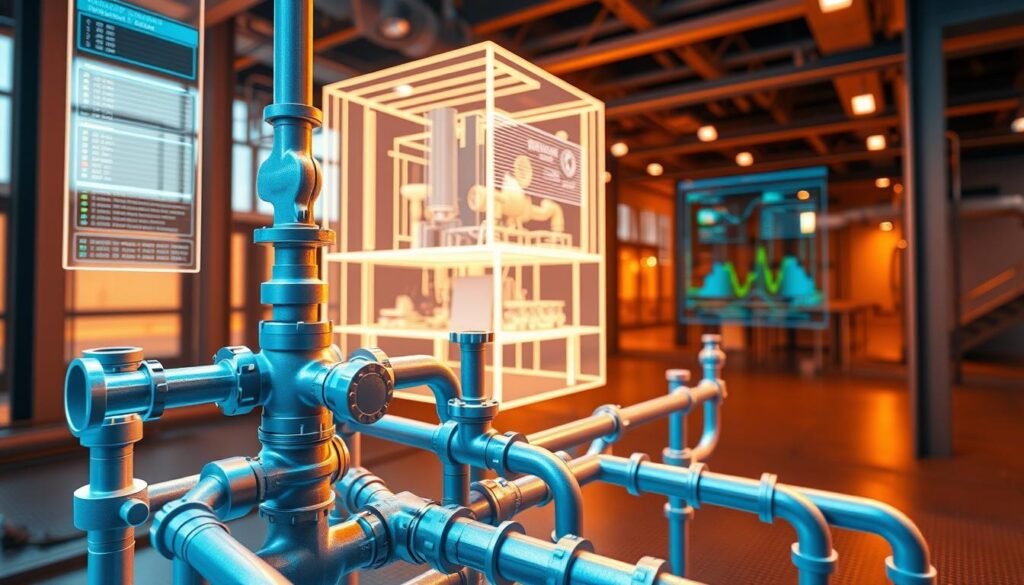
We see Building Information Modeling as key in modern plumbing engineering. BIM holds geometry, metadata, and connections in one digital model. This model is a single source of truth, making coordination faster and reducing errors on big projects in India.
Here, we explain how to link BIM to advanced analysis and operations. Our goal is to move from basic clash detection and quantity takeoff to more complex hydraulic optimization and live monitoring.
Integration with AI and Fluid Mechanics
BIM stores network graphs for quick hydraulic predictions using machine learning. Graph neural networks and operator-learning methods can learn maps from boundary conditions to pressure and flow states. This allows teams to run fast what-if scenarios without the need for expensive CFD each time.
We suggest combining reduced-order hydraulic models or ML surrogates with BIM geometry. Adding sensor streams to the digital twin can validate model outputs and trigger automated responses when anomalies occur. This integration with AI and Fluid Mechanics makes static models dynamic for design and operations.
Advantages of BIM in Plumbing Design
Clash detection and coordinated MEP layouts reduce construction delays. Quantity takeoff and better documentation speed up procurement and handover. Lifecycle asset management links design intent to maintenance schedules and warranties.
With AI, BIM enables automated routing optimization and predictive maintenance scheduling. Digital-twin capabilities support real-time performance monitoring and energy efficiency measures. These benefits make Smart Plumbing Design more reliable and cost-effective throughout a building’s life.
Practical deployment requires attention to data standards and validation. Use IFC and open exchange formats for interoperability. Keep geometry fidelity high where hydraulic accuracy matters. Validate AI predictions against CFD or field measurements before making operational decisions.
We recommend phased pilots: start with coordination and clash detection, expand to routing and hydraulic optimization, then add sensors for digital-twin monitoring. This staged approach reduces risk while proving value to stakeholders and facilities teams.
Smart Plumbing Technologies
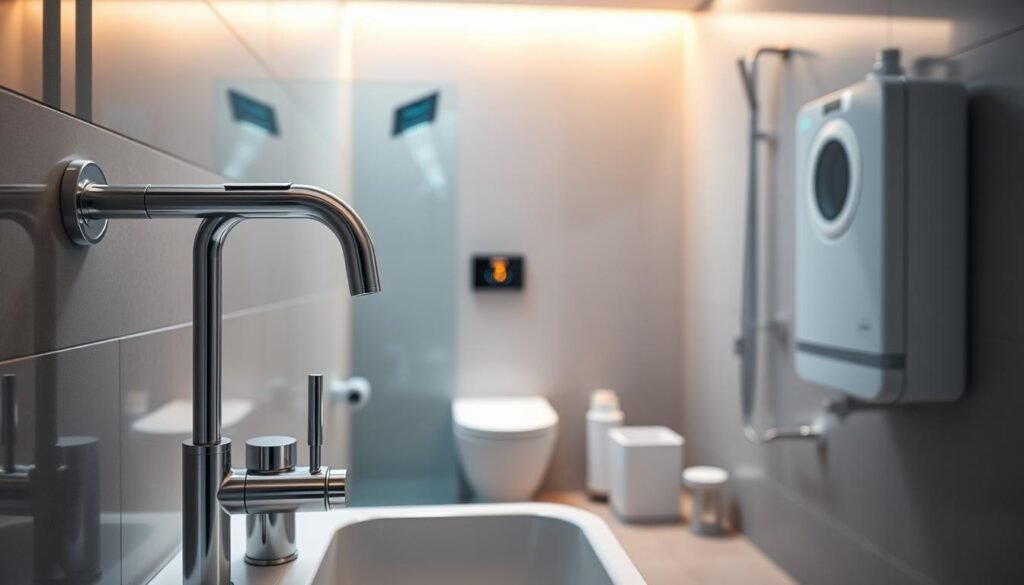
Modern plumbing technology is changing how systems work and how we experience them. Smart Plumbing Design uses sensors, controls, and analytics. It aims to cut down on losses and make systems more reliable in India.
It combines edge compute with cloud services. This ensures fast responses and keeps data private.
IoT Devices in Plumbing Systems
IoT devices are key in connected plumbing systems. Flow meters and pressure transducers provide constant updates. Acoustic leak sensors and vibration sensors on pumps catch problems early.
Valve actuators and smart meters allow for remote control and tracking. Water quality probes check for health standards.
Edge devices quickly process data to cut down response time. Gateways ensure safe connections to SCADA and BMS systems. It’s important to calibrate sensors and plan for redundancy to keep data flowing smoothly.
Real-Time Data Analysis
Streaming analytics helps with quick maintenance and controlling demand. On-device models quickly spot anomalies and control pumps. Cloud services handle deeper analysis and training.
Compact ML models run well in tight spaces. They help predict behavior and find leaks fast without sending lots of data.
Security and power are big concerns in Indian projects. We focus on secure protocols and edge-compute to keep data safe and reliable.
Looking at the big picture, we aim to reduce water loss, lower energy use, and make users happier. We follow best practices like using physics-aware ML and testing everything from start to finish. Keeping sensors calibrated is also key to maintaining data quality.
Challenges in Adopting AI for Plumbing Design
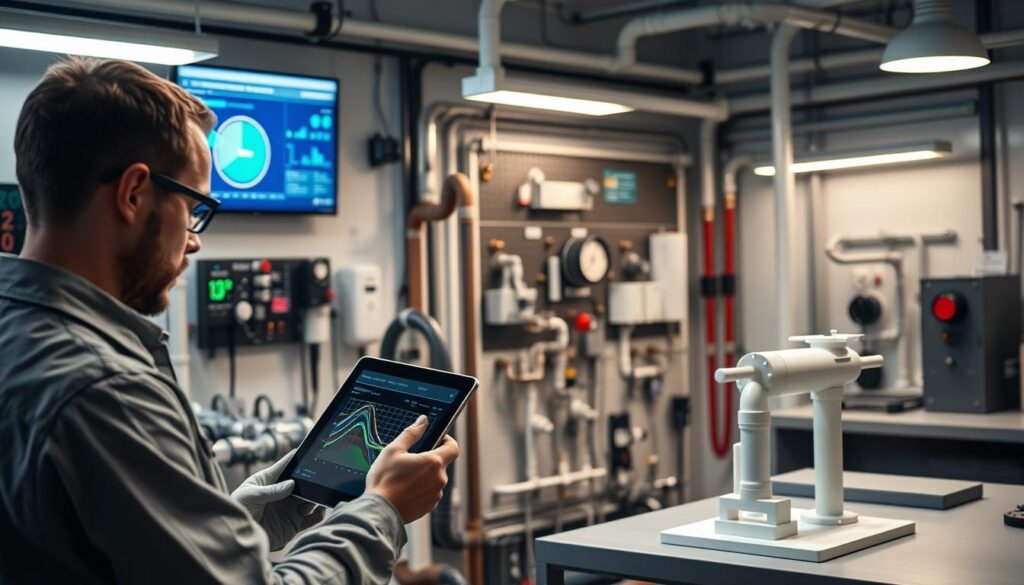
Adopting AI in plumbing design comes with many challenges. These include a lack of quality data and cultural barriers within companies. We will discuss these obstacles and how to overcome them.
Technical Barriers
Data quality is a big issue. Plumbing systems often lack detailed data. We can use computer simulations and machine learning to improve this.
Models trained on one building may not work on another. We can make them more adaptable by using specific techniques. This ensures they work well in different settings.
Building models that work fast and cheap is a challenge. We can use special algorithms to make models run faster without losing too much accuracy.
It’s vital to check if AI models are safe and reliable. We can use special methods to ensure they follow the laws of physics. This makes them more trustworthy.
Resistance to Change in the Industry
Many in the plumbing industry don’t know much about AI. We need to provide training and workshops to help them understand and use AI.
Changing how things are done is hard. Companies are slow to adopt new ideas, and they often stick to what they know. We need to find ways to make it easier for them to try new things.
People need to trust AI and understand how it works. We can use special AI methods that explain their decisions. This helps build trust with clients and regulators.
We can tackle these challenges by taking small steps. Starting with small projects that show the benefits of AI can help. Using a mix of old and new methods can also build confidence.
Training and sharing knowledge are key. We should start small, test thoroughly, and then scale up. This approach helps overcome the hurdles of adopting AI in plumbing design.
Future Trends in Plumbing Engineering
Digital tools and smart thinking are changing plumbing. This change affects how systems are designed, built, and managed. It’s a big shift for practitioners and researchers in India and worldwide.
Predictions for AI and Fluid Mechanics
We’re seeing AI help with plumbing design. Tools like PINNs and operator learners make simulations faster and more accurate. This means quicker designs and better control in buildings.
AI will also help with fluid mechanics. It will work across different systems, making it easier to solve complex problems. This includes designing systems that save money and energy.
AI will also make designing plumbing systems easier. It will suggest the best routes for pipes and where to place pumps and valves. This lets engineers focus on bigger decisions.
Emerging Technologies in Plumbing Systems
Digital twins will combine BIM, IoT, and AI. They will manage plumbing systems over their entire life. This is great for cities with water problems.
Edge AI will bring AI closer to sensors. It will find problems like leaks and blockages without needing the cloud. This makes plumbing systems more reliable.
New sensors will improve monitoring. Tools like acoustic sensors and fiber-optic sensing will catch issues early. This data will help improve plumbing systems for everyone.
We need to share data and tools. Open datasets and APIs will speed up innovation. Working together will help make new plumbing solutions a reality.
| Trend | What it Enables | Practical Benefit | Relevant Technology |
|---|---|---|---|
| Physics-informed ML | Fast, accurate surrogates for CFD | Faster design cycles and real-time control | PINNs, DeepONet, FNO |
| Digital Twins | Integrated lifecycle simulation | Better maintenance and demand management | BIM + IoT + ML |
| Edge AI | Local anomaly detection and control | Lower latency and reduced cloud costs | Microcontrollers, compact C++ models |
| Advanced Sensors | High-fidelity monitoring | Early fault detection and reduced water loss | Acoustic, fiber-optic, nonintrusive flow |
| Open-source CFD & Data | Democratized research and benchmarking | Faster innovation and cross-project validation | Community datasets, open solvers |
We invite everyone to share data and tools. This will make AI and fluid mechanics work better in plumbing. Together, we can create new solutions for plumbing systems.
Training and Skill Development for Engineers
We’re seeing a big change in how engineers learn. Now, they need to know both old-school hydraulics and new tech. This mix gets them ready for the Digital Transformation in Plumbing Engineering.
Here are steps to help engineers grow and add real value to projects. It’s all about practical skills: learning theory, using tools, and working as a team.
Key Skills for the Modern Plumbing Engineer
- Core theory: fluid mechanics, hydraulics, and CFD basics for accurate modeling.
- Machine learning literacy: knowing supervised and unsupervised methods, neural networks, and PINNs.
- Programming: using Python for quick ML prototypes and C++ for speed.
- BIM and data skills: knowing IFC workflows and sensor data.
- Soft skills: teamwork, clear communication, and data governance.
Importance of Continuous Education
Continuous Education is key because the field changes fast. We suggest learning paths with short courses, workshops, and hands-on projects.
Events like ASME Fluids Engineering offer deep technical knowledge. Community resources and GitHub surveys on ML-for-CFD keep skills sharp.
Here’s what we recommend:
- Take blended courses on ML for engineers and domain workshops.
- Run BIM+AI pilot projects with help from experts or universities.
- Get certificates and work on open-source projects for real-world experience.
- Support internships and mentorships to bridge theory and practice.
Training that follows these steps builds strong teams. These teams have the skills needed for big projects.
We must keep learning to make the Digital Transformation in Plumbing Engineering work for the long term.
Conclusion: Embracing the Future of Plumbing Engineering
We’ve seen how fluid mechanics and modern machine learning work together. They make design faster, improve how things work, and cut down on waste. New methods like data-driven surrogates and physics-informed models are making a big difference in Plumbing Engineering Design and AI.
These advancements are moving from just ideas to real-world use. Active research and open-source projects are helping make this happen.
Innovation is key: pilot programs that use BIM with AI are showing great results. They’ve tested ML surrogates against CFD and real-world tests, and they’re making a big impact. We suggest starting small, testing well, and growing while keeping physics in mind.
This approach builds trust with engineers, regulators, and asset owners. It also helps make Sustainable Plumbing Design better.
For those in India, now is the time to lead in water-saving solutions and strong infrastructure. Get involved in internships, academic projects, and professional partnerships. This will help turn ideas into real Innovative Plumbing Solutions.
We encourage teams to try out new ideas, get advice from experts, and join the research community. Together, we can shape the future of Plumbing Engineering.