



Every year, AI helps cut down detection-to-alarm times by up to 60% in tests. This is as big a leap as moving from candlelight to electric bulbs for safety.
We are at a key point where fire science meets AI in India and globally. This mix of sensors, cloud computing, and advanced analytics is turning theory into action. It’s making fire protection smarter and saving lives.
Recent studies and tests, like Ruchit Parekh’s 2024 review and NASA JPL / DHS S&T tests, show AI’s power. It supports real-time risk scores, Digital Twins for buildings, and systems like AUDREY.
This article is for engineers, teachers, and students. It shares practical ideas. It explains how AI and fire models work together, which tech is key for cities, and how to make buildings safer in India.
Understanding Fire Protection Engineering
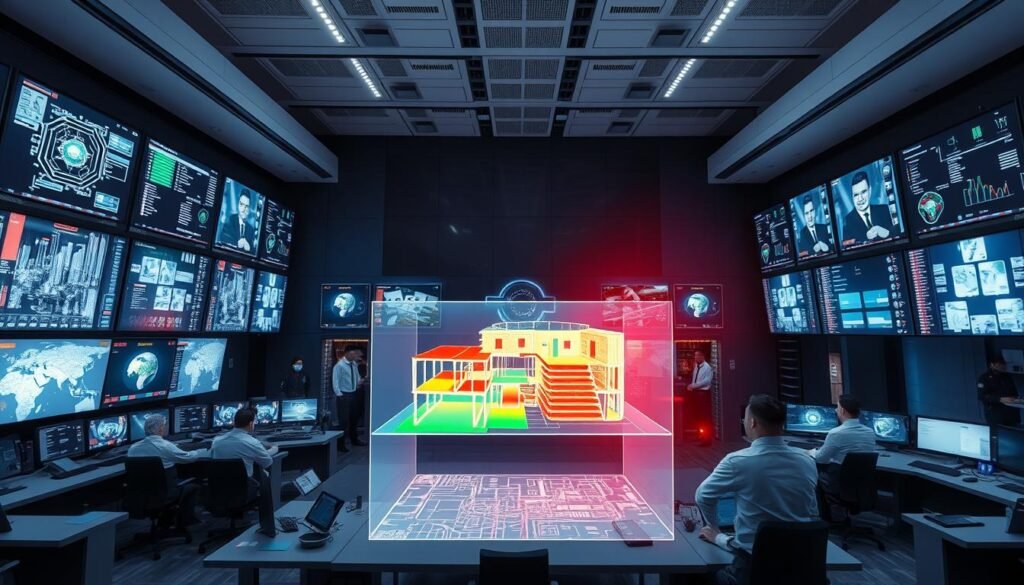
We see fire protection as a mix of science, design, and rules. Our goal is to make it easy to understand. This includes everything from how fires start to following specific codes.
The Role of Fire Protection Engineers
Fire protection engineers turn fire science into real designs. They use tools like NIST’s Fire Dynamics Simulator (FDS) and FireFOAM to test scenarios. They should lead in using AI, knowing its limits is key for reliable results.
These engineers do risk checks, design based on performance, and integrate systems. Companies like CONSAC offer advice within code rules. They also promote smart firefighting and design.
Key Principles of Fire Dynamics
Fire dynamics basics start with how fast heat is released. They also look at smoke and toxicity. How a fire spreads and moves is shaped by plume behavior, compartmentation, and ventilation.
Tunnel fires need special attention, like back-layering and plug-holing. It’s important to place sensors for temperature, CO/CO2, and heat flux. CFD gives detailed heat maps but is too heavy for real-time use.
The Importance of Building Codes
Building codes and performance-based design (PBD) set safety standards. AI and CFD help prove these standards for unique projects. This includes tall buildings, long tunnels, and connected structures.
We need to match AI results with India’s fire codes for approval. Using simulations, experiments, and Springer guidance helps. It supports new fire safety solutions while keeping people safe.
The Intersection of AI and Fire Safety
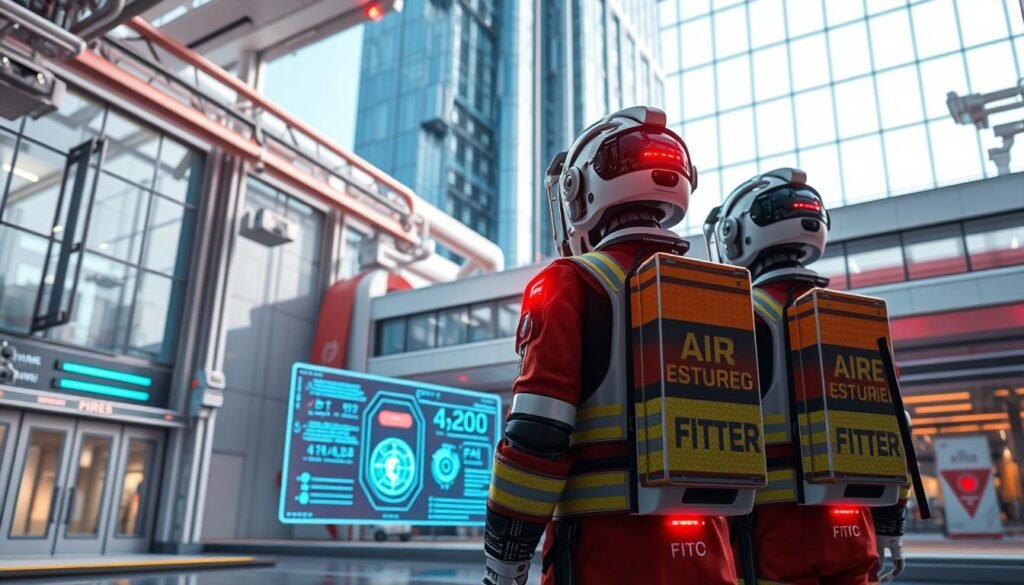
We are at a turning point in fire safety. New algorithms meet traditional engineering. This change brings rapid, data-driven forecasts to fire protection. It blends fire science with computing power, creating useful tools for designers and emergency planners.
How AI Transforms Fire Protection Engineering
Manual CFD studies have evolved into surrogate models. These models mimic complex simulations. They reduce the need for repeated, costly FDS runs, allowing engineers to test many design options quickly.
Pattern recognition from large datasets speeds up detection and forecasting. When AI in fire protection links to IoT and Digital Twins, real-time awareness becomes possible. This lets teams predict temperature spreads, fire growth, and likely failure points during an incident.
Fire experts will drive adoption, while IT and computing specialists supply infrastructure. This mirrors how CFD became standard practice. Practitioners adopt tools that fit into engineering workflows and yield measurable savings.
Benefits of AI in Fire Risk Assessment
AI for fire risk assessment reduces false alarms by combining visual analytics with sensor streams. Convolutional neural networks detect flames and smoke in CCTV, IR, and drone footage. Deep learning models learn flashover precursors and predict temperature trajectories.
A robust database is essential for training. Time-series from thermocouples, gas detectors, and heat-flux sensors pair with visual datasets. Validated numerical simulations and experimental runs augment sparse field data; initiatives like IAFSS MaCFP support standardized, shareable repositories.
The NASA/DHS AUDREY work shows how fused video and sensor inputs can forecast fire growth. This capability supports smarter infrastructure design and prioritizes prevention over reactive firefighting. This is an important shift for rapidly urbanizing Indian cities.
| Area | AI Capability | Practical Outcome |
|---|---|---|
| Design Optimization | Surrogate modeling from FDS and CFD | Faster iteration; lower lifecycle safety costs |
| Detection | CNNs on CCTV, IR, and drone feeds | Reduced false alarms; earlier response |
| Forecasting | Real-time fusion of sensor and video data | Predictive alerts for flashover and structural risk |
| Data & Validation | Shared experimental and numerical databases | Improved model confidence; regulatory acceptance |
| Urban Resilience | AI-enabled planning and resource allocation | Cost-effective prevention for fast-growing cities |
AI Technologies Revolutionizing Fire Protection
We look at new tools changing how we find, predict, and fight fires. These tools mix old fire science with new computer tech. They make buildings and open areas safer.
Machine Learning in Fire Prediction
Machine learning helps predict fires by using special computer models. These models can tell what kind of fire it is and how hot it is. They can even guess when a fire might get worse.
Researchers use these models to make 2D and 3D pictures of fire heat. They also use simple math to make predictions when they have less data.
Fast models help reduce false alarms by using pictures and heat sensors. Mixing real sensor data with computer simulations makes these models better.
Real-Time Data Analysis for Fire Safety
Now, predictions happen in seconds, not hours. This lets us watch fires in real time and make quick decisions. A system called SuRF uses live data and computer models to predict fire spread.
The AUDREY project shows how to use different data sources together. It uses heat sensors, cameras, and gas detectors to make predictions. Soon, these systems will be on fire trucks, making them more useful.
Smart Sensors and IoT Applications
Smart sensors and IoT systems give us constant updates on fires. They use thermocouples, heat flux meters, and cameras. This lets us keep an eye on fires in big places.
Books talk about using sensors to predict fires and linking them to digital models. Tests with real fires help train these models. Keeping the data safe is very important.
By mixing computer simulations with real data, we make our predictions better. This helps keep cities and factories safe from fires in India.
Predictive Analytics in Fire Management

We look at how predictive analytics changes fire management decisions. It gives quick, data-based forecasts. This helps commanders and engineers make faster decisions. We focus on tools, projects, and lessons for Indian cities.
Predictive analytics mixes sensor data, simulation results, and video. It creates fast risk maps. Teams use thermocouple data and infrared images to predict temperature and smoke.
This makes predictions much quicker. It improves how teams understand the situation on the ground.
Forecasting Fire Behavior with AI
AI forecasts fire behavior by learning from experiments and simulations. It uses models like temporal convolutional neural networks. These models learn how temperatures change in different areas.
Building digital twins allows for continuous fire growth forecasts. They also let teams test different scenarios for real fires.
Field systems combine heat meters, 360° video, and edge analytics. They predict when fires might spread too fast. Using AI with image detectors lowers false alarms. This helps commanders plan better.
Case Studies of Successful Implementations
NASA JPL and DHS S&T did AUDREY field burns in Elk Grove. They trained AI with various data to predict fire growth. The AI helped create augmented reality displays for firefighter training.
Academic studies support these uses. Hodges et al. used AI to estimate temperatures in fires. Wang et al. forecasted flashover with machine learning. Lee et al. showed AI can cut down on false alarms in image detection.
Flaim Systems turned 360° burn footage into virtual reality drills. Trainees learn about fire behavior safely. These tools work with cloud and edge analytics for better training.
| Project | Data Sources | Primary Outcome | Metric Improvements |
|---|---|---|---|
| AUDREY (NASA JPL / DHS S&T) | Thermocouples, IR imagery, 360° video | Real-time situational awareness; AR support for firefighters | Prediction latency reduced to seconds–minutes; better heat-flux mapping |
| Hodges et al. (Academic) | FDS simulation data | Temperature estimation using TCNNs | Improved accuracy of compartment temperature forecasts |
| Wang et al. (Academic) | Large simulation databases | Flashover forecasting with ML | Earlier flashover warnings; enhanced pre-incident planning |
| Lee et al. (Academic) | Image datasets from detectors | Reduced false alarms using faster R-CNN | Lower false-positive rate; more reliable alerts |
| Flaim Systems | High-res 360° burn video | Virtual reality training from real burns | Safer trainee exposure; realistic fuel-behavior learning |
For India, we learn to start with sensor networks and analytics. Working with groups like CONSAC is key. AI in fire protection can make cities safer.
Enhancing Evacuation Strategies with AI
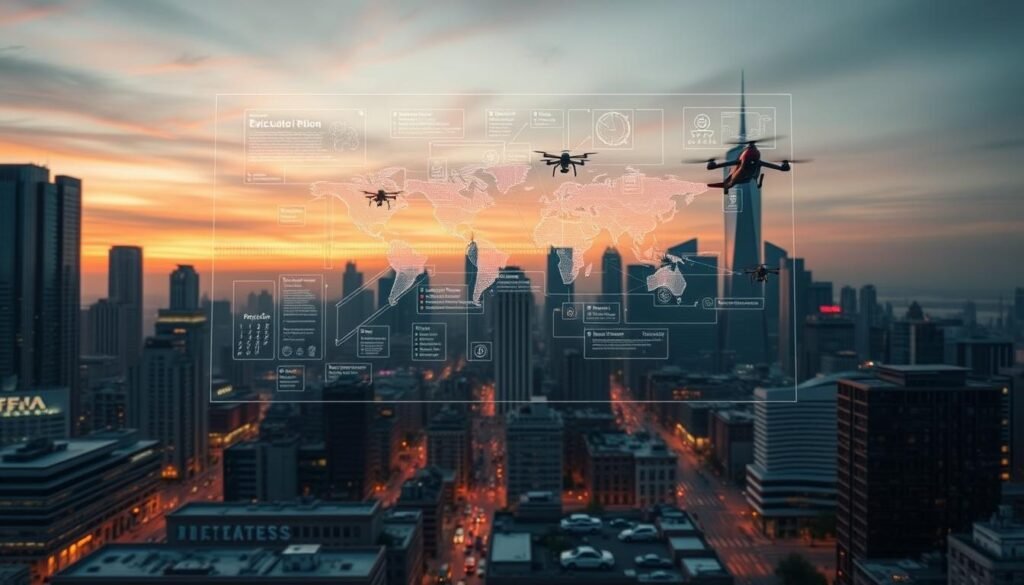
We look at tools and methods that make evacuations smarter, faster, and safer. AI connects sensors, building shapes, people models, and fire behavior. This way, plans change as conditions do, moving from fixed maps to dynamic strategies.
AI-Driven Evacuation Planning Tools
Digital twins and CFD models give AI real smoke and heat data. These systems show safe areas in real time.
Reinforcement learning creates flexible escape plans by trying many scenarios. Edge devices keep these models working even when internet is down. This meets Indian fire codes and protects privacy.
Optimizing Routes and Emergency Resources
AI finds the best paths for people and firefighters, avoiding smoke and crowds. It updates these paths with sensor data.
Machine learning helps use emergency resources wisely. It focuses on the most needed teams based on fire growth and building risk. Augmented reality guides crews with clear instructions, making their work easier.
To use AI well, we need strong wireless, durable edge devices, and accurate data. We suggest using privacy-friendly location tracking and checking models with drills. This keeps them reliable in real situations.
Designing Safer Buildings through Simulations
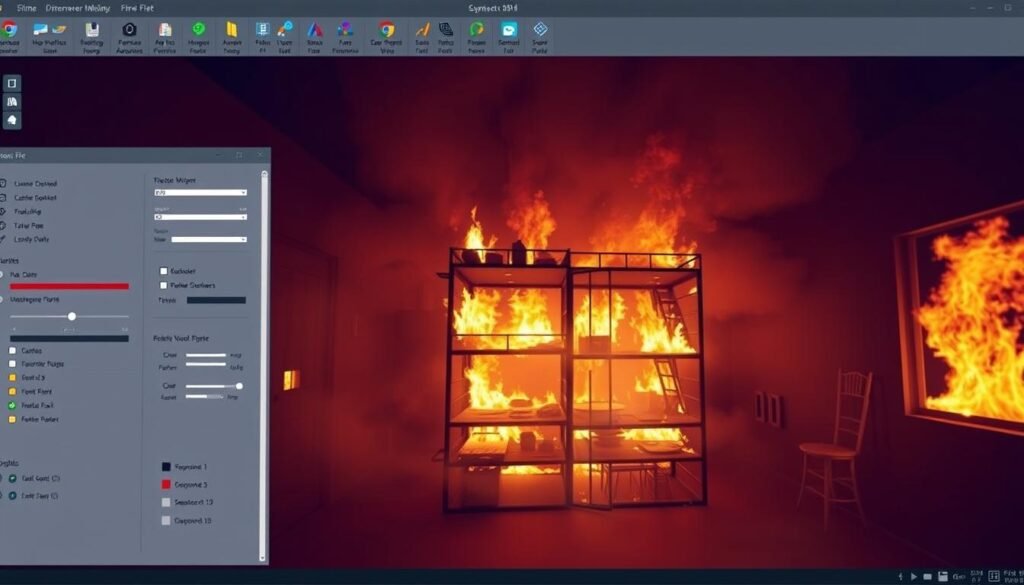
Simulation tools are changing how we design buildings for safety. They help predict how fires spread and how smoke moves. This is key for places like malls and tunnels.
Fire Dynamics Simulation Software
FDS and FireFOAM are top tools for designing safer buildings. They create detailed pictures of fire and smoke in big spaces. This is very useful for complex areas.
Using CFD needs experts. They set up the simulation, create the mesh, and understand the results. It can be expensive to do many tests.
The Synergy of AI in Design Optimization
AI helps by quickly testing many designs. It uses machine learning to make fast predictions. This is great for finding the best ways to fight fires and protect buildings.
AI makes it easier to find designs that need more testing. This way, we can focus on the most important ones. Experts say using both data and simulations is the best way to design.
Practical Workflow Recommendations
- Build hybrid datasets: combine sensor logs, lab tests, and FDS numerical outputs.
- Use AI to identify candidate designs and reduce the number of full CFD runs.
- Validate critical configurations with detailed CFD and expert review before submission for approval.
- Adopt CONSAC-style consultancy practices to align AI-informed design with code compliance for performance-based design documentation.
Education and Research
Universities should teach both CFD and AI in fire engineering. Hands-on labs are important. They help students learn to use simulations and data together.
| Aspect | Role | Typical Tools |
|---|---|---|
| Detailed flow prediction | Capture smoke layers, temperature contours, vents interaction | FDS, FireFOAM |
| Rapid screening | Pre-select configurations for detailed study | ML surrogates trained on CFD data |
| Design optimization | Explore ventilation, sprinkler placement, structural resistance | AI in design optimization tools plus CFD validation |
| Regulatory support | Produce PBD reports and compliance evidence | Hybrid datasets, CONSAC-style documentation |
| Workforce development | Train next generation of engineers in hybrid methods | University courses, Springer texts, industry workshops |
Regulatory Implications of AI in Fire Safety

We look at how AI fits into current laws and what regulators need to think about. This includes sensor networks, Digital Twins, and machine learning models in fire safety. Our goal is to make AI outputs clear, testable, and useful for engineers and AHJs in India.
Compliance with national fire codes starts with clear validation. Engineers should show AI analyses alongside CFD benchmarks and experimental data. This keeps safety cases strong. We also support clear data sources, model versions, and human checks to avoid AI being a mystery.
Regulatory guidance should explain how AI fits into performance-based design. AI will first be used as a decision-support tool in research and pilots. Once AI tools show consistent accuracy against standards, they can be used in performance-based demonstrations.
Compliance with National Fire Codes
We suggest templates for documenting how AI outputs meet Indian codes and performance-based frameworks. This helps AHJs check safety claims and ensures new fire protection solutions follow the law.
Consultancies like CONSAC and research projects like AUDREY show a phased acceptance. Tools are first tested in controlled studies, then in pilot projects, and later in formal submissions. This makes it easier for engineers and regulators.
The Future of Fire Safety Regulations
Regulators will likely create standards for data quality, model validation, and cybersecurity for sensor systems. International and local groups, like IAFSS, offer examples for standardized datasets and validation protocols for India.
Policies should cover risk governance: data sharing, occupant privacy, and liability for AI recommendations. Standards should include hardware and edge devices as well as software validation. This ensures sensors and models meet minimum performance.
We see a need for accredited third-party validation to certify AI tools against CFD and experimental benchmarks. Such certification would help AHJs accept AI-assisted assessments. It would also speed up the use of new fire protection solutions while keeping public safety in mind.
Challenges and Limitations of AI in Fire Protection

We look at the practical limits when AI meets fire protection engineering. Fast sensor setup and complex models show promise. But, trust, supply chains, and on-site performance are real hurdles. These challenges shape how we design, test, and use systems in India and worldwide.
Data pipelines and sensor networks collect sensitive info about people and buildings. This raises big data privacy and security concerns. Who gets to see the data, how long it’s kept, and how models are trained are key questions. Springer and Parekh say secure data handling and strict access controls are essential for responsible use.
Operational limits are critical in emergencies. Edge-compute issues and latency can slow down real-time actions. Sensor accuracy and durability under heat are also big concerns. NASA JPL has studied low-cost IR devices to address these issues.
AI needs large, well-labeled datasets. But, many datasets are private, and simulations must be carefully checked. Parekh warns about overfitting and brittleness when models face new situations. We believe AI should enhance CFD, not replace it, to boost system reliability.
Cultural and ecosystem barriers slow down AI adoption. People often distrust AI’s black box nature. Working together across disciplines is key to overcome these barriers and share benefits.
Practical solutions exist: standardized datasets, open model documentation, and hybrid AI–CFD validation. Rigorous field trials and supply-chain scrutiny for sensor hardware also help. These steps reduce long-term risks in fire safety technology.
We provide a quick guide for engineering teams and policymakers on deploying AI in fire protection. It covers common issues and how to address them.
| Issue | Impact | Mitigation |
|---|---|---|
| Data privacy and security concerns | Unauthorized access, legal risk, loss of public trust | End-to-end encryption, role-based access, data minimization |
| Sensor durability under heat | False negatives, hardware failure during incidents | High-temp testing, redundant sensing, supply-chain vetting |
| Edge compute and latency | Delayed responses, degraded situational awareness | Local inference, prioritized data channels, QoS for comms |
| Model brittleness and overfitting | Poor generalization to new fire scenarios | Hybrid AI–CFD pipelines, diverse datasets, adversarial testing |
| Cultural resistance and resource gaps | Slow adoption, inequitable access in smaller jurisdictions | Transparent models, training programs, shared open resources |
Future Trends in Fire Protection Engineering and AI
Engineering and AI are coming together to make buildings safer and greener in India. New methods like digital twins and real-time forecasting are being used. These tools help in designing, responding to fires, and training people.
These trends are leading to better fire protection strategies. They work well in crowded cities and different weather conditions.
Innovations on the Horizon
AI in fire protection is getting better fast. Digital Twins let us test buildings virtually before they’re built. Super Real-time Forecast systems use sensors and weather data for better predictions.
Robots and AR displays make firefighting safer. VR and 360° simulators offer more training. A 2024 survey by Springer shows these tools will change how we fight fires in the next 20 years.
The Role of AI in Sustainable Building Practices
AI helps make buildings more sustainable. It controls fire suppression and ventilation to save materials and energy. Machine learning suggests designs that reduce waste and improve performance.
In India, we need to start small. We should work with research groups, fire services, and companies like CONSAC. Field trials will help us create better training and solutions.
We must work together to make these solutions safe, resilient, and sustainable. Standardizing data and validating models is key. This way, we can create innovative fire protection solutions.