



We started this project under a neem tree in Himachal Pradesh. A schoolteacher recited a village ballad and asked: who will tell our story? That moment led to Voices of Rural India, a platform to share Rural India Stories and preserve Indian countryside tales.
Shivya Nath, Malika Virdi, and Osama Manzar lead the project. We use travel writing, community-based tourism, and digital empowerment. Our goal is to publish real village stories, teach rural storytellers digital skills, and connect readers with responsible travel and heritage.
These Rural India Stories are like case studies. They include folk ballads, community practices, reports on resilience, and grassroots innovations. We share them with engineers, students, and educators to learn from low-resource settings.
We pay storytellers Rs 1,000 for each accepted story. We’re also looking into sustainable models to increase compensation. If you want to help, volunteer, or partner, email us at info@indiavibes.today.
The Essence of Rural India: An Overview

We explore the core features that shape rural life across India. These pages draw on field notes, oral archives, and technical insights. Our aim is to present cultural texture and practical context for better solutions.
Understanding the Cultural Landscape
Rural India is not a single story. It hosts thousands of distinct traditions. Ladakhi postmen note Bronze Age petroglyphs, and there are ritual practices in Himachal Pradesh’s Tirthan Valley. Tiger-worship customs are found in parts of Maharashtra.
Oral traditions and folk songs do more than entertain. Ballads like the Kinnauri Yumdasi carry history and record social memory. They shape how communities recall trauma and resilience.
Social structure matters for technology design. Patterns like early marriage and son-preference influence health, schooling, and access to information. Understanding gendered divisions helps us build tools that match real workloads.
Importance of Agriculture in Rural Life
Agriculture remains the backbone of Villages of India. Smallholder farms, seasonal transhumance, and livestock grazing define livelihoods. Farming systems are diverse and highly place-based.
Tasks are often gendered: women manage household farm work, while men handle field ploughing or market sales. This split shapes income flows and time availability. Engineering low-bandwidth digital tools and vernacular UX proves essential for adoption in such contexts.
Digital storytelling has begun to reshape Indian village narratives. Projects use WhatsApp, local-language materials, and smartphone photography. These forms of documentation feed design briefs and curricula that respect local forms of knowledge.
| Aspect | Characteristic | Design Implication |
|---|---|---|
| Oral Archives | Ballads, songs, ritual speech preserve memory | Create low-bandwidth audio capture and transcription tools in local languages |
| Agricultural Practice | Smallholder plots, seasonal grazing, gendered labor | Design mobile tools for off-grid use and shared family access |
| Social Norms | Early marriage, son-preference, constrained female agency | Embed gender-sensitive metrics and community consent mechanisms |
| Digital Opportunity | WhatsApp groups, local-language content, smartphone imagery | Leverage familiar platforms for training and income generation |
| Cultural Diversity | Region-specific rituals and beliefs across Villages of India | Adopt participatory design: local co-creation and iterative testing |
Stories of Resilience and Community Strength

We start with real-life stories from rural India. These tales show how people and groups face challenges: surviving crop failures, overcoming social taboos, and rebuilding after shocks. Each story helps us design better and make better policies.
Yumdasi from Kinnaur is a remarkable example. She was married young and sent to Jisti Pabang. Despite the challenges, she raised her children with little. Her story is part of a larger collection that challenges us to face tough topics with care.
Community leaders play a big role. They are the ones who record local stories and economies. These efforts turn oral traditions into jobs and highlight the achievements of Local heroes in rural India.
We look at how groups work together to make a difference. Organizations like Global Himalayan Expedition and Grassroutes Journeys help find storytellers and support community tourism. They turn local tales into jobs while keeping culture alive.
Field research teaches us about data quality. Using methods like focus groups can reveal important topics like reproductive health. But, it’s important to listen to everyone and get consent. This ensures our data is accurate and respectful.
For engineers working in rural areas, there are key lessons. Work with locals, get their consent, and use their languages. Fair compensation is also important. These steps help build strong, true knowledge systems based on real Rural India experiences.
Key roles and outcomes
| Role | Action | Outcome |
|---|---|---|
| Local storyteller (homestay host) | Document oral histories and guide visitors | New income sources; preserved Indian countryside tales |
| Youth volunteers | Train in digital publishing and mapping | Enhanced local capacity; broader reach for Stories from rural India |
| NGO incubators | Provide seed funding and mentorship | Scaled community tourism; sustained Local heroes rural India |
| Field research teams | Use participatory methods with ethical consent | Richer, trustworthy Rural India experiences for planners |
Economic Challenges Facing Rural India

We look at how life in rural areas is tough due to many reasons. These include little land, seasonal jobs, and gaps in the market. Weather changes also play a big role. People living in these areas face many challenges but also show great strength.
Agriculture: The Backbone and Its Struggles
Most families in rural India rely on small farms for their income. But, these farms face big challenges. In the Himalayas and on plateaus, land is scarce. Families must travel far for water and food for their animals.
Women do a lot of work, like getting water and taking care of animals. This limits their chance to earn money in other ways. New ways to make money, like telling stories, are starting to help. But, they need more people to listen and pay fairly.
The Impact of Climate Change on Livelihoods
Changes in the weather are affecting how people live. For example, it’s harder to find good places for animals to graze. This means less food and money for families.
After COVID, some people learned new skills online. This helped them find jobs in digital media. A project called Voices of Rural India pays for stories, showing a new way to make money.
Engineers need to think about how to help rural areas. They should plan for the weather, improve supply chains, and find new ways for people to make money. Ideas like tourism and selling crafts can help. Stories from rural India show us how to overcome challenges.
Innovations in Rural Development

We look at new ideas changing village life in India. These ideas mix old wisdom with new tools. They help people make a living, keep traditions alive, and find new markets. The goal is to make these ideas work for more people, build local skills, and find solutions that help communities.
Sustainable Practices Among Farmers
Farmers in different areas are using old methods again. They are using transhumance grazing, making organic manure, and changing what they grow. These steps save money and reduce harm to the environment.
In places like Uttarakhand and Kerala, farmers are sharing their knowledge. They are looking for ways to farm that are better for the planet. This helps farmers in other places to farm in a way that is good for the earth.
Small steps help farmers get better at farming. They learn about choosing the right seeds, testing the soil, and making compost. These steps help farmers grow food that is healthy and make money for their families.
Grassroots Movements for Change
Groups like Himalayan Ark and Digital Empowerment Foundation are teaching people new skills. They are teaching how to use smartphones, tell stories, and use social media in local languages.
These skills help people make money in new ways. They can start tourism projects, offer homestays, and sell crafts. This shows how local culture and business can work together.
People learn practical skills like typing in Hindi, making videos, and writing stories. They get feedback to make their work better. This helps them share their stories with more people.
Engineering opportunities come up to make tools for telling stories. They make devices that don’t need much power and apps that work offline. They also make tools that can understand local languages and turn spoken stories into written ones.
| Innovation | Local Benefit | Engineering Role |
|---|---|---|
| Traditional forage systems | Reduced feed costs; improved soil cover | Design low-cost sensors for pasture monitoring |
| WhatsApp storytelling modules | New tourism promotion; increased bookings | Create offline-capable content editors and compression tools |
| Organic manure networks | Healthier soils; lower chemical use | Standardize composting units and simple analytics |
| Community incubation (tourism + crafts) | Market access; heritage conservation | Build vernacular marketplaces and payment solutions |
| Vernacular NLP for stories | Preserves oral history; creates shareable content | Train language models on regional dialects and scripts |
We believe in growing ideas slowly. Start by teaching people new skills, then see how it works, and keep improving with help from the community. This way, we can make sure that the ideas we start will last and grow.
Women Empowerment in Rural Areas
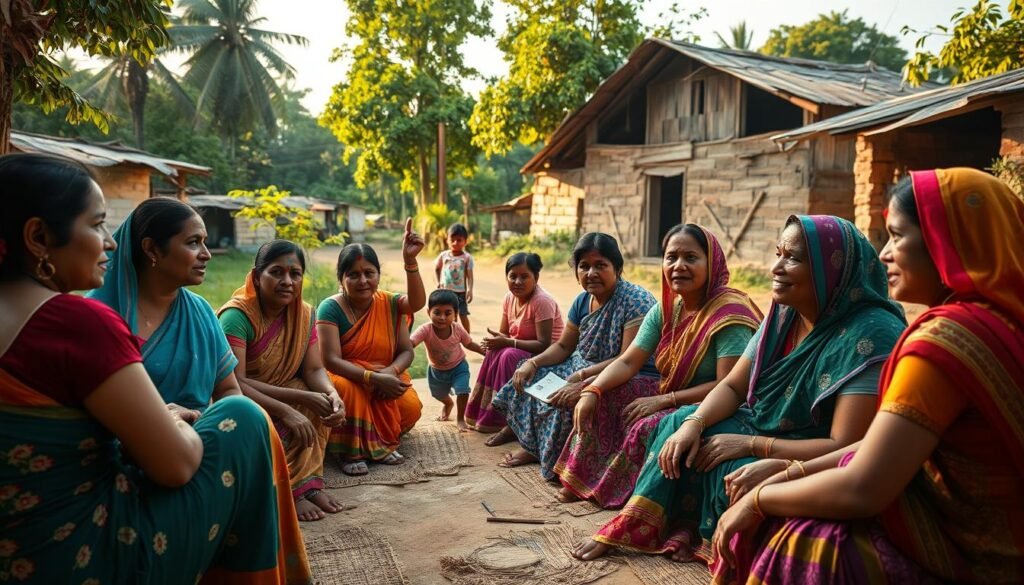
We look at how women in rural India go from limited roles to leading positions. Fieldwork reveals young married women often don’t have a say in decisions. Early marriage, limited control over their bodies, and a preference for sons shape their lives.
Cultural tools like folk songs show these pressures and question gender norms.
To break barriers, women need practical skills and safe places. Digital storytelling programs help women and youth become leaders. They learn to use smartphones, type in Hindi, and edit content.
This turns their stories into published works. Paid stories help them earn money and build reputations. This opens doors to community tourism and local governance roles.
We focus on making programs accessible. Women-only groups, easy-to-use interfaces, and lessons via WhatsApp are key. These steps respect their schedules and reduce dropout.
Choosing the right curriculum is also important. It helps engineers and educators create models that reach remote villages.
Breaking Barriers: Women in Leadership
Local leadership grows when women have a voice and income. Women who share village life gain trust. Community tourism partnerships help them earn steady income.
Over time, they become committee members, cooperative leaders, and mentors.
Success Stories of Rural Female Entrepreneurs
Rural female entrepreneurs turn tradition into market value. Artisans sell handloom textiles and crafts. Homestay operators offer authentic local experiences.
Digital publication of their stories increases demand and brings repeat customers.
Practical support helps them grow. Microloans, training in digital payments, and mentorship in pricing and packaging are key. Small, consistent earnings lead to wider influence and investment in children’s education.
Indian village narratives women need to be told with care and technical support. When cultural heritage becomes an asset, it strengthens identity and income. These stories remind us that empowerment is both personal and structural.
Education: Bridging the Urban-Rural Divide

We see education as a key to change in rural India. Many girls drop out early for marriage, missing out on health and rights knowledge. This keeps communities stuck in a cycle of powerlessness. We aim to connect learning to real-life jobs, making education useful.
Access to Quality Learning in Villages
Rural schools struggle with technology and resources: only 18% have internet, compared to 62% in cities (UDISE+, 2023). Few have devices or basic digital skills. We create mobile, low-data learning that works offline and with limited power.
We use practical solutions: blended learning, local-language content, and hands-on projects. Community mentors teach typing and photography. We also assess learning through publishable work. This approach makes education visible and useful.
Role of NGOs in Education Reform
Nonprofits play a vital role. Groups like Digital Empowerment Foundation and Himalayan Ark teach digital skills over WhatsApp. Urban volunteers help learners improve their writing and digital skills.
Our programs show that teaching storytelling and technical skills can lead to jobs. NGOs create local learning materials, train teachers, and connect villages to mentors. This shows their importance in bridging the gap.
We suggest educators create modules that support local content and measure success through stories and videos. For more on the digital divide and how to bridge it, see this analysis.
Education in rural India succeeds when it connects to real jobs. By combining technical skills with cultural knowledge, we open up more career paths and give communities a stronger voice.
Healthcare Struggles and Solutions

We look at the gaps in Rural healthcare India and how to fill them with respect for local culture. Getting to clinics is hard due to remote locations and limited transport. Women face even more challenges, like not having enough info on reproductive health and facing cultural taboos.
Access to Basic Healthcare Services
Healthcare in villages relies on a few under-staffed health centers. ASHAs and mobile clinics help, but there’s a shortage of supplies. Young married women are often hesitant to talk about birth control because their elders or husbands make the decisions.
Simple solutions can help: solar-powered vaccine storage, apps for teletriage in local languages, and battery-powered diagnostic tools. Training local health workers builds trust and ensures consistent care.
Traditional Medicine and Modern Approaches
Traditional medicine is the first choice for many in rural India. Herbal remedies and folk rituals are part of everyday health. These practices hold cultural value and offer a wealth of local knowledge.
We recommend documenting traditional knowledge while also evaluating it clinically. Programs that combine telemedicine with workshops can help. This approach validates traditional practices while guiding patients to modern care when necessary.
NGOs and partners can train local storytellers to promote health. Using stories can reduce stigma around reproductive health. Mobile health camps with demonstrations and counseling can increase service use.
Designing solutions with local needs in mind is key. This means interfaces in local languages, offline use, and minimal data. Such approaches improve adoption and maintain impact in areas facing health challenges every day.
Preserving Traditions: Art and Craft

In villages across India, we see craft heritage come to life. Handloom textiles and Folk art carry stories and histories. These traditions are not just skills but also economic and cultural anchors.
We use photography, audio, and stories to showcase artisan practices. This helps connect makers with buyers. It turns Indian village narratives into a unique selling point.
We partner with community tourism groups and digital platforms. This creates direct sales channels for artisans. Training in photography and storytelling boosts their income.
We also offer engineering solutions for rural areas. Systems track the origin of crafts and ensure fair credit. This way, artisans can share their stories with the world.
Our plan includes editorial support and paid story publications. This approach ensures artisans earn a steady income. It’s a mix of market access, digital skills, and cultural documentation.
Hope for the Future: Youth and Aspirations
A new energy is rising in India’s villages. Young people are combining local knowledge with digital skills. They are turning storytelling, photography, and content production into jobs.
They are shaping community tourism, social enterprise, and local governance. They also work to preserve heritage.
Groups like Global Himalayan Expedition and Spiti Ecosphere are leading the way. They use heritage trails, homestays, and local skills to create sustainable businesses. Rural India Stories youth use mobile tools and local training to reach more people.
They are even exploring drone deliveries for better logistics and healthcare in remote areas. This is detailed in a report.
Despite their dreams, challenges remain. Limited education, early marriage for girls, and climate risks are big hurdles. Mentorship, fair pay, and training are key.
We suggest expanding local curricula and creating digital job opportunities. Linking urban mentors with rural creators is also important. We can measure success by published stories, income growth, and community projects.
We call on engineers, educators, and students to join us. Volunteer your skills, donate, or help design tools for local businesses. Contact info@indiavibes.today to support storytellers or join networks that uplift rural India’s youth. When technical skills meet cultural understanding, rural youth become strong partners in education, health, and jobs for the future.