



We stood on the concrete steps of the Ganga in Prayagraj one humid morning. We watched fishermen pull in nets clouded with silt and plastic. Nearby, a child filled a steel tumbler from a handpump that sputtered.
An elder warned about low wells in the coming months. This scene shows the urgent problems of Indian Rivers & Water Issues.
The Ganga and Brahmaputra are not just rivers. They are living systems that sustain tens of millions. Yet, they face stress from glacier retreat, damming, and groundwater extraction.
The Gangotri glacier’s retreat and thousands of dams have changed flow seasonality and ecology. Groundwater declines and Water scarcity in India threaten agricultural and urban lifelines.
The Brahmaputra basin presents a governance puzzle. China controls a large share of the basin area and has built infrastructure. This changes flood timing more than bulk flow.
Debates over upstream contributions and dam projects complicate regional diplomacy. These transboundary realities demand integrated approaches beyond simple volumetric accounting.
Ganga River pollution is a public-health and ecological emergency. Polluted tributaries, untreated sewage, and industrial effluents have harmed habitats and livelihoods. The scale calls for a shift to Integrated Water Resource Management.
Our aim is practical and technical. We aim to map physical realities, assess governance options, and highlight river conservation efforts. For a concise overview of the national water challenge, see this briefing from SIWI: water crisis in India explained. For collaboration or technical queries, please contact info@indiavibes.today.
Overview of Indian Rivers and Their Importance

We look at the major rivers in South Asia. They shape the region’s hydrology and human life. Cities and farms fight over the water, affecting everyone.
The Ganga supports over 650 million people in India and Bangladesh. It’s vital for cities, farms, and forests. But, its flow is changing due to climate change.
The Gangotri Glacier has retreated by over a kilometer in 20 years. This reduces the water available during dry seasons. Over 1,000 dams and barrages have changed the river’s flow, affecting Bangladesh and the Sundarbans.
The Brahmaputra basin is vast, covering China, India, Bhutan, and Bangladesh. It receives heavy rainfall, with some areas getting over 98 inches a year. China controls most of the basin, but its contribution to the river’s flow is debated.
Upstream projects like the Zangmu dam have raised tensions. They can alter the river’s flow, affecting downstream areas. This highlights the need for international cooperation.
The Indus River is key to early civilizations and modern diplomacy. It has shaped agriculture and settlements in Pakistan and India. The 1960 Indus Waters Treaty is a landmark for managing shared rivers.
The Ganga–Brahmaputra–Meghna system has a huge flow of water. The Ganges sub-basin has plenty of water, but it’s not evenly distributed. The basins are home to millions of people, making water management a big challenge.
Urban water needs are tied to these rivers. Cities rely on both river water and groundwater. But, upstream projects and fragmented governance make planning difficult.
Groundwater levels are falling in many areas. This is due to cities using more wells to meet their needs. It’s a complex issue involving hydrology, engineering, and politics.
We end by highlighting the importance of Indian Rivers & Water Issues. For more information, contact info@indiavibes.today.
Current Water Issues Facing India

India faces a mix of water scarcity, pollution, and climate change. These issues affect rivers and people’s lives. They cause local problems and big national challenges.
Water Scarcity: A Growing Concern
As the population grows, water for each person gets less. Tools used to manage water can make things worse. They hide the real problem of not enough water at times.
Groundwater in some areas is being used up fast. This is happening in the Ganges-Brahmaputra basin. It’s losing water at a rate of 15–20 mm per year in some places.
Many areas have a lot of water but are very poor. This seems strange. But, the water is not always available when needed. We need to plan better for water use.
Pollution Crisis: Causes and Effects
Waste from cities and factories pollutes many rivers. The Ganga River is a big example. It gets dirty from sewage, industrial waste, and other sources.
The Yamuna River in Delhi is also very polluted. Sewage and factory waste are the main culprits. Dams and barrages make things worse by blocking the river’s flow.
Pollution harms the river’s ecosystem. It affects fish, the balance of microorganisms, and the soil. Farmers and fishermen suffer because of these changes.
Climate Change Impact on Rivers
Glaciers in the Gangotri area are melting faster. This changes how much water rivers get. It makes the flow less predictable.
Monsoon rains are becoming more unpredictable. This leads to both floods and droughts. The Ganges basin has seen droughts on a scale never seen before.
Rising sea levels and changes in sediment transport are making coastal areas saltier. Dams and barrages have changed how sediment moves. This is affecting the Sundarbans.
There are gaps in how we manage water. Different states and countries don’t share data well. This makes it hard to prepare for changes in rivers.
Government Initiatives for Water Conservation
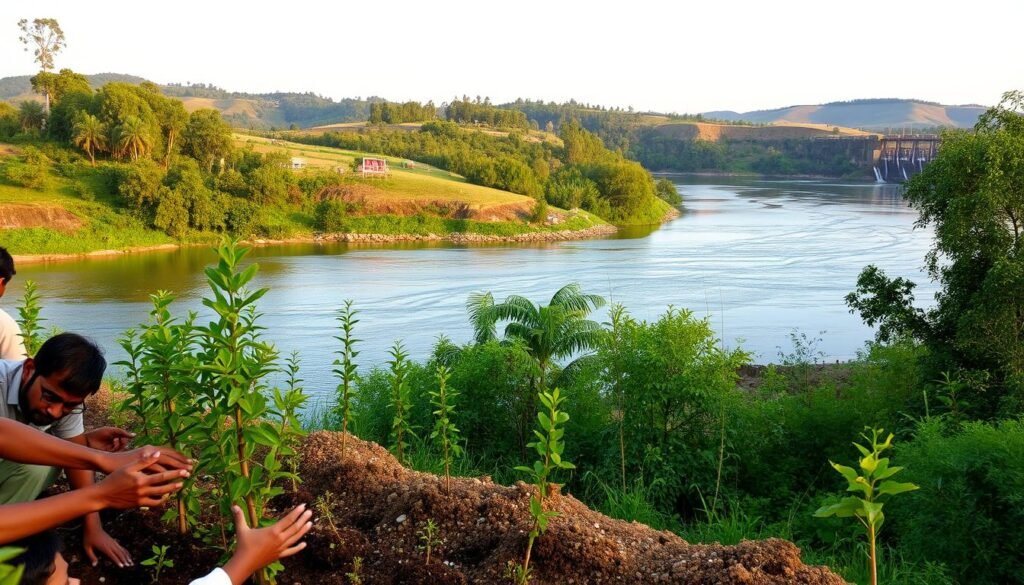
We explore the main national programs and policy tools for river conservation. These efforts include infrastructure upgrades, legal frameworks, and basin-scale planning. They aim to improve water quality, protect biodiversity, and ensure access to clean water across key river systems.
Namami Gange Programme: Restoration Efforts
Namami Gange is India’s key river revival project. It focuses on reducing pollution, improving sewage treatment, and developing riverfronts. It also aims to protect biodiversity in key stretches.
The program funds upgrades to sewage systems and modernizes crematoria to reduce pollution. It also tightens controls on industrial waste. Community groups play a big role by monitoring water quality and spreading awareness.
National Water Policy: A Framework for Action
The National Water Policy is a key policy that emphasizes managing demand and using water efficiently. It encourages integrated approaches to meet urban, agricultural, and industrial needs.
Despite the policy’s goals, supply augmentation and large dams often dominate plans. To bridge this gap, we need stronger incentives for efficiency, transparent data, and successful pilot programs.
River Basin Management Strategies
We suggest adopting Integrated Water Resource Management and Integrated River Basin Management. These strategies address Water, Energy, Biodiversity, and Sediments (WEBS) together.
India’s governance across states and borders is fragmented. Effective basin planning requires benefit-sharing, sediment science, and basin-scale institutions.
| Initiative | Primary Focus | Key Actions | Main Challenges |
|---|---|---|---|
| Namami Gange Programme | River water quality and biodiversity | Sewage treatment plants, crematoria modernization, industrial effluent control, riverfront works | Urban sewage load, long-term operation and maintenance, scaling community participation |
| National Water Policy | Policy and governance framework | Demand management, water-use efficiency, integrated planning | Policy-to-practice gap, preference for supply augmentation, weak enforcement |
| River Basin Management Strategies | Integrated basin-scale governance | IWRM/IRBM adoption, sediment and ecosystem planning, benefit-sharing mechanisms | Inter-state friction, transboundary impacts, data gaps on sediments and flows |
| Infrastructure Planning (Hydropower/ILR) | Energy, storage, inter-basin transfers | Hydropower projects, storage reservoirs, proposed interlinking such as Jogighopa-Teesta-Farakka | Ecological risk, high sediment loads, social displacement, cross-border downstream effects |
We conclude by stressing the need for coordinated action. Scaling up clean water initiatives requires bridging policy and practice. It also involves investing in sediment science and data-sharing. And designing River Basin Management Strategies that reflect social and ecological realities.
Role of Local Communities in Water Management
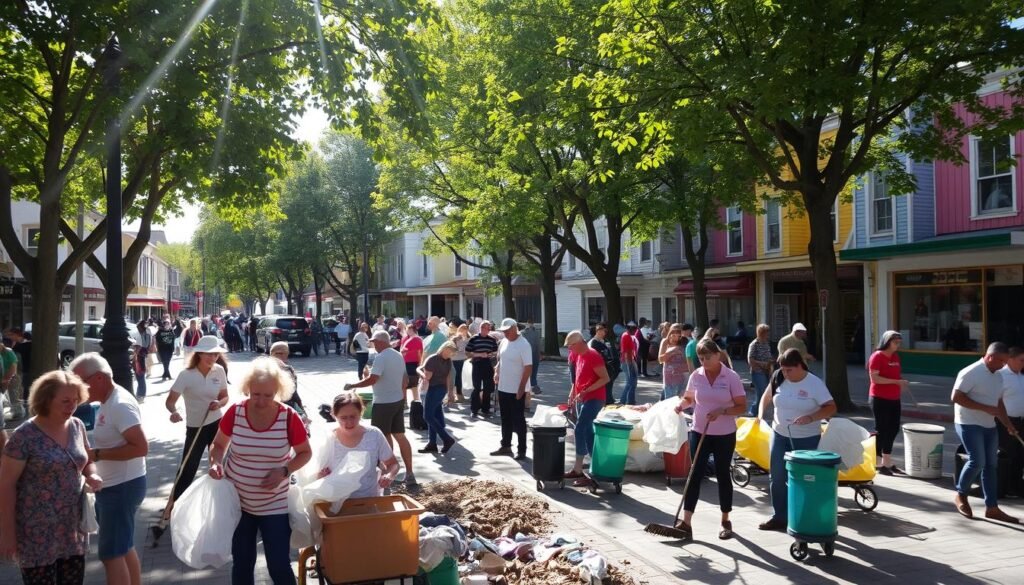
We team up with village councils, schools, and youth groups to boost local care for rivers and aquifers. Grassroots efforts combine knowledge, tradition, and simple tech to safeguard water quality. These actions complement bigger plans and fill in the gaps they might overlook.
Traditional Practices in Water Conservation
In India, communities have used rainwater harvesting, step-wells, and tank systems for ages. These methods help during dry seasons. It’s important to match these practices with local water needs, not just impose solutions.
We document ways to recharge groundwater, slow down runoff, and improve soil health. These traditional methods often work well with modern tools and low-cost techniques.
Community-Led Cleanliness Drives
Groups along the Ganga and its tributaries have launched cleanliness drives. These efforts reduce litter, cut down on pollution, and raise awareness. Village teams check for illegal dumping and use simple systems to clean wastewater.
These local efforts help protect rivers by focusing on pollution sources. They also strengthen local leadership and make clean water efforts more lasting.
Success Stories from Rural India
In Maharashtra and Karnataka, rural projects have improved aquifers and restored river flows. Village sewage plants and wetlands have cut down on pollutants. These projects show how to combine social inclusion, ecosystem services, and practical solutions.
They serve as examples for clean water and river conservation efforts. Capacity building is key. We support training, give out low-cost sensors, and promote mobile reporting tools. This helps communities get involved in basin planning.
For partnership inquiries and technical support, contact info@indiavibes.today.
Technological Innovations in Water Management

We look at new technologies that can change how we manage rivers and urban water supplies. These tools are for engineers, planners, and educators to quickly improve water security and river health in India.
Smart water networks and digital control
Smart Water Management Systems use digital tools like meters and SCADA platforms. They help reduce water loss by finding leaks and controlling pressure. They also help predict water demand.
These systems help manage reservoirs better by releasing water for rivers. Cities like Pune and Chennai use smart meters to manage water better. They get real-time data to make fair decisions and fix problems.
Satellite tools for river observation
Remote Sensing for River Monitoring uses satellites to map rivers. It shows sediment, dams, and glacier changes. Data from Planet Labs, Sentinel, and Landsat helps understand river health.
Sharing data helps prepare for floods. Satellites and ground gauges show trends in water flow. This helps plan better.
Reuse, recycling, and decentralized treatment
Reusing and recycling water helps rivers and aquifers. Small-scale solutions like wetlands and bioreactors clean water. They reduce pollution in rivers like the Ganga and Yamuna.
We suggest more small-scale treatment to ease big plants. Recycled water helps industries and farms. This leaves cleaner water for people and nature.
Modeling, climate signals, and human impacts
Hydrological models mix climate changes with human actions. They consider dams, irrigation, and land use. Models must show recent changes in monsoon patterns.
Models should also predict sediment changes and habitat impacts. This helps planners plan better.
Scaling innovation through open standards
Adoption needs training and open tools. We support open-source platforms and data standards. This helps engineers in cities and towns improve water management.
This approach makes technology available to all. It ensures fair service delivery.
Call for collaboration
Teams looking to work together can contact info@indiavibes.today. We offer help with pilots, data sharing, and teaching. We welcome partnerships for learning and action.
The Economic Impact of Water Issues

We look at how water stress changes lives, business plans, and local economies in India. The numbers show a big problem: too much groundwater use, falling water levels, and droughts. These issues make people rethink their investments and daily choices.
Small farmers, business owners, and city planners now face tough decisions. They must balance short-term gains with long-term survival.
Agriculture and irrigation challenges
More irrigation has helped grow food, but growth is slowing down. People are using more groundwater, which is depleting fast. This makes farming more expensive and raises questions about what crops to grow.
Many farmers in irrigated areas are poor, despite using a lot of water. We need to change how we share water to value the environment more. This could include growing different crops, using less water to irrigate, and changing how we buy crops.
Tourism affected by water quality
Rivers that attract pilgrims and tourists are losing appeal due to low water and pollution. The Yamuna River in cities is not inviting, and the Ganga River’s poor state hurts businesses. Coastal areas like the Sundarbans are also suffering, affecting fishing and tourism.
Cleaning up rivers can boost tourism, save jobs, and protect traditional ways of life. We can link river restoration with local businesses to support both nature and people. For more ideas, see tackling India’s water crisis.
Industries facing water shortages
Factories and power plants are struggling with water scarcity. They need water for cooling, processing, and cleaning. But, they also compete with homes and farms for this resource.
When industries run out of water, they lose production, spend more money, and face supply chain problems. They need to find ways to use water better and plan for the whole basin. The government should make sure economic plans consider the cost of protecting ecosystems.
Pollution in rivers adds to economic risks: more floods and droughts, saltwater in deltas, and climate change. We need to value nature more and use water wisely. This can help make better investments and share benefits fairly.
International Cooperation on Transboundary Rivers

We see managing water across borders as a big challenge. It needs both technical skill and trust among nations. Rivers like those in India connect communities from the mountains to the sea. Working together can lead to better systems that protect both people and nature.
The Indus Waters Treaty is a good example. It set clear rules for water use between India and Pakistan. It also created a special commission to handle disputes and keep communication open.
This treaty is not perfect for today’s river science. It doesn’t focus much on sediment, biodiversity, or managing the whole basin. We need to add more ecological monitoring and flexible rules to deal with climate and land use changes.
Looking at other agreements, the 1996 deal with Bangladesh on the Ganges shows the value of planning for seasonal water needs. But, it lacks on sediment, ecological health, and sharing benefits. To improve, we need to talk about rivers as living systems, not just water.
India and China also have agreements on the Brahmaputra. They share data and work on flood warnings. But, there are issues with data formats, frequency, and access. Making data exchange routine is key for better cooperation.
We suggest steps for better work with neighbors. We should monitor sediments and ecosystems together with water data. Basin-wide management can help with floods, sharing water, and protecting habitats. Rules for shared infrastructure can help with risks and renewable energy.
We propose shared goals that go beyond just splitting water. We need early warning systems with common standards and backup plans. Monitoring should include sediments and biodiversity. Funding across borders can help with river restoration and adaptation.
We suggest ways to share benefits from working together. This could be through better hydropower planning, joint fisheries, and restoring landscapes. These steps can make us more resilient and address India’s water issues in a bigger way.
Future Projections for Indian Rivers

We look at the future of Indian rivers by mixing climate science, urban trends, policy goals, and infrastructure plans. These forecasts are not set in stone. They show how water access and ecosystem health will change across basins.
Anticipated climate scenarios
Climate models suggest more extreme weather: heavy rain in short bursts and longer dry spells. The melting of Himalayan glaciers will also affect river flows.
Adding socioeconomic factors and land-use changes to climate models makes predictions harder. Long-term plans need to update as new data comes in.
Urbanization and Its Effects on Water Resources
Fast urban growth increases water demand, sewage, and groundwater use. Cities like Delhi and Bengaluru are already facing water stress.
To ease river pressure, we need to use less water, treat wastewater locally, and add green spaces. Keeping an eye on urban pollution is key to cleaning rivers like the Yamuna and Ganga.
Sustainable Development Goals in India
Reaching SDG 6 means big changes: better basin management, more wastewater treatment, and fair water sharing. Coastal areas link water goals to SDG 13 and SDG 15 through adaptation and protecting ecosystems.
Policies should focus on flexible management and thorough environmental and social checks for big projects. Involving everyone in decision-making makes plans more acceptable.
Research should focus on longer streamflow records, more gauges, and open data. Models that include human actions will give better future water flow estimates.
Short-term efforts in monitoring and simple urban fixes help now. But, long-term plans tackle sediment, transboundary issues, and the mixed results of big projects. This balanced approach meets climate, urban, and SDG challenges.
How Americans Can Support Indian Water Issues
We can help by spreading the word and teaching others about water issues. We can link U.S. schools, NGOs, and groups with Indian ones. This way, we can teach about managing water resources and protecting rivers.
By supporting water projects, we can make a big difference. We should focus on projects that involve local people and show real results. This way, we can help clean water and restore rivers.
Working together is key. We need to team up with Indian institutions and local groups. This way, we can share knowledge and technology to solve water problems.
Here’s what we can do: support groups working on the Ganga and Brahmaputra rivers. Fund exchanges for students and professionals. Push for climate money that helps rivers. And use open-data platforms for monitoring.
To get involved, email info@indiavibes.today. We should work together in a way that is open and respects local needs. This way, we can make a real difference without causing problems.