



India has enough thorium and uranium to power its electricity for centuries. The Prototype Fast Breeder Reactor (PFBR) criticality marks the start of this era.
The PFBR criticality is a major milestone for India’s nuclear program. It moves from theory to practical reality, following Homi J. Bhabha’s three-stage plan.
This Prototype Fast Breeder Reactor shows India can make plutonium from uranium-238. This is a big step from traditional reactors. It means more fuel, less imports, and better energy security for India.
This achievement opens up new topics for engineers, students, and teachers. We’ll explore the science behind PFBR, its design, and its impact on nuclear energy and innovation in India.
Key Takeaways
- PFBR criticality is the operational realization of Stage II in India’s three-stage nuclear program.
- The Prototype Fast Breeder Reactor breeds plutonium from uranium-238 using fast neutrons.
- This India nuclear milestone improves domestic fuel availability and reduces import dependence.
- PFBR advances national goals for energy security and long-term decarbonization.
- Engineers and educators will find technical and policy threads to explore in subsequent sections.
Prototype Fast Breeder Reactor, India nuclear milestone
The Prototype Fast Breeder Reactor marks a key moment in India’s nuclear journey. It shows how technology meets strategy: it’s a 500 MWe breeder reactor that makes more fuel than it uses. This achievement is part of recent nuclear energy breakthroughs that change how we plan for the future.
What the PFBR means for our nuclear program
The PFBR is a big step for our nuclear program. It shows India can use fuel much longer than before. The reactor was designed by Bhabha Atomic Research Centre and Indira Gandhi Centre for Atomic Research. It was built by Indian companies, showing our ability to work together.
Technical overview of the criticality event
Criticality is when the reactor’s core keeps a controlled chain reaction. To reach this point, we followed a careful plan. We added fuel bit by bit, watched the neutron flow, and checked how the reactor reacted.
We used special detectors and systems to keep everything safe. The operators checked the data against what the models said. This made sure the reactor was working as planned.
Why this marks an India nuclear milestone
This event is a big deal for three reasons. First, it shows India’s sodium-cooled fast reactor technology works. Second, it helps us reach our goal of using less imported fuel. Third, it proves we can work together to build advanced reactors.
Historical context of India’s three-stage nuclear program
The Prototype Fast Breeder Reactor is part of a long plan started by Homi Bhabha. His vision was to use natural uranium first, then plutonium, and lastly thorium. This plan has guided India’s nuclear goals for many years.
Origins and objectives of the three-stage strategy
Bhabha wanted a plan that fit India’s resources and industrial power. Stage I used natural uranium in special reactors. Stage II aimed to breed more fuel using plutonium. Stage III focused on using thorium, a key resource in India.
Progress through stage one and transition to stage two
India built many reactors based on CANDU designs. It also made facilities to produce heavy water. The goal was to make enough plutonium for fast breeders.
How PFBR advances long-term strategic goals
The PFBR is a key step in making Bhabha’s plan real. It shows the success of breeder technology. This success helps India move towards using thorium in Stage III.
| Stage | Main Fuel and Technology | Primary Objective | Progress Indicators |
|---|---|---|---|
| Stage I | Natural uranium – PHWR (CANDU-derived) | Create power base and produce plutonium | Indigenous PHWR fleet, heavy-water plants, operational research reactors |
| Stage II | Plutonium-fueled fast breeder reactors | Breed plutonium and close the fuel cycle | PFBR commissioning, fuel-fabrication facilities, sodium-handling expertise |
| Stage III | Thorium-based advanced reactors | Utilize thorium to ensure long-term energy independence | Ongoing R&D, pilot thorium fuel tests, roadmap for scale-up |
Our story of India’s nuclear progress shows steady growth and careful planning. Each step brings India closer to a strong energy future, relying on its own resources and engineering skills.
Technical features of the Prototype Fast Breeder Reactor
We give a quick look at the Prototype Fast Breeder Reactor. It’s for engineers and students to grasp the key choices and trade-offs. This overview connects reactor design with breeder technology, fuel cycle, and safety systems.
Reactor architecture and core elements
The PFBR has a pool-type layout with a MOX core for about 500 MWe. It includes the core, sodium circuits, heat exchangers, and steam generators. The pool setup simplifies piping and reduces leak risks.
Fast-spectrum operation and breeder fundamentals
Fast-neutron operation means no moderator. Neutrons stay energetic, converting uranium-238 into plutonium-239. The goal is to produce more fissile material than used, depending on core composition and fuel management.
MOX fuel and fuel cycle mechanics
MOX fuel mixes plutonium and uranium oxides for reactivity and burnup. Fuel making and in-reactor behavior are closely monitored. After use, reprocessing recovers bred plutonium, improving resource use.
Sodium coolant properties and engineering responses
Liquid sodium is great for fast spectrum due to its thermal conductivity and low moderation. Design choices use sodium’s heat transfer for high power density. But, sodium’s reactivity with air and water poses challenges.
Steam generator and material considerations
Steam generators keep water/steam separate from sodium with intermediate loops. Materials must be compatible with sodium and resist corrosion. Collaboration between manufacturers and labs validates materials under expected conditions.
Active safety systems and controls
Active safety includes a reactor protection system, redundant pumps, and automated scram. Monitoring systems watch neutron flux, temperatures, and sodium flow. Redundancy and separation lower failure risk.
Passive features and inherent response
Passive safety uses natural phenomena like negative reactivity coefficients and natural circulation. Containment and thermal inertia give time for operators to act. Passive features add to the defense-in-depth approach.
Leak detection, monitoring, and emergency planning
Special sensors detect sodium leaks through sound, light, and chemical signs. Real-time data helps control rooms act fast. Emergency plans work with local authorities for site protection and public communication.
Ongoing updates and operational learning
Tracking updates and feedback refines reactor design and maintenance. Field data improves instrumentation, materials, and fuel management. This cycle boosts system reliability and future breeder economics.
PFBR project progress and timeline
We follow the PFBR project’s progress through key milestones and workstreams. The Prototype Fast Breeder Reactor at Kalpakkam has gone from drawings to concrete. It then moved to detailed assembly and system integration.
Key milestones leading up to criticality
Design finalization and regulatory clearance started the project. The site was chosen on the Indira Gandhi Centre for Atomic Research campus at Kalpakkam. This choice followed safety and logistics rules.
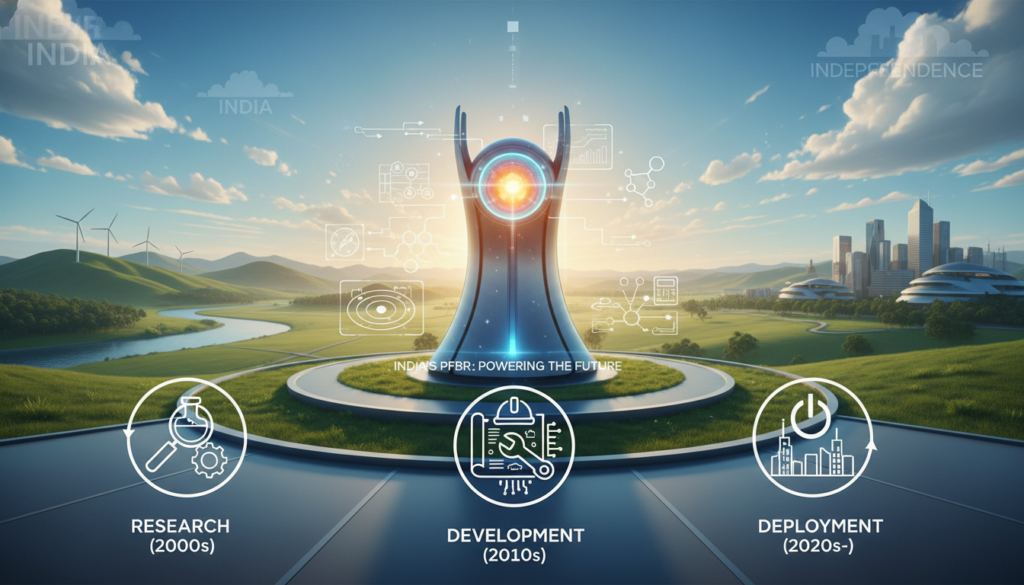
Major steps included foundation and civil works, and installing the primary vessel and heat exchangers. The sodium circuit was assembled, and mechanical completion was done in phases. Fuel loading and physics tests came before the reactor’s start-up.
Construction, testing, and commissioning phases
Construction focused on containment and reactor island assembly. Heavy equipment was placed, and primary system assembly was done. This included pumps, intermediate heat exchangers, and sodium loop insulation.
Testing moved from component checks to system tests. Leak tests, pump and valve validation, and instrumentation calibration were done. Electrical and control system verification followed, along with ambient-temperature sodium tests.
The hot commissioning phase used sodium circuits at operating temperature. Dynamic behavior was assessed. Troubleshooting and corrective actions were taken at each stage.
Recent updates and operational readiness steps
Pre-criticality actions included fuel loading and control rod drive mechanism verification. Reactor physics models were validated with in-core and ex-core detectors. Training programs prepared operating crews for standard and abnormal procedures.
Regulatory inspections by the Atomic Energy Regulatory Board checked compliance. Coordination among NPCIL, IGCAR, BARC, and equipment manufacturers ensured quality and documentation. We keep track of the prototype fast breeder reactor timeline and document each phase.
Impact on India’s energy security and power mix
The PFBR milestone is a key step for India’s energy security. Breeder reactors make uranium last longer by turning uranium-238 into plutonium. This means India uses less uranium from other countries.

How breeder reactors contribute to long-term fuel availability
Breeders make the most of available resources. One tonne of natural uranium can produce much more energy with fast reactors. This helps plan for the future and supports growing industries.
Role of PFBR in decarbonization and meeting demand
Fast reactors have low CO2 emissions and provide constant power. This is great for using more solar and wind energy. It helps India meet its clean energy goals and meet growing electricity needs.
Integration with renewables and grid planning
We need to plan how to mix steady nuclear power with changing wind and solar. Using batteries, pumped hydro, and smart grids helps. This makes the energy system more stable and efficient.
Operational and policy implications
For successful integration, we need better transmission and market rules. These should value clean, reliable power. This helps India’s economy grow and supports local industries.
Strategic resilience and benefits
Breeders also make India’s energy system more secure. They reduce the need for imported uranium and provide steady power for factories. Overall, they make India’s energy future cleaner and more reliable.
Indigenous nuclear reactor technology and domestic capability
India moved from relying on imports to a strong domestic base for advanced reactors. The Prototype Fast Breeder Reactor (PFBR) brought together manufacturers, research labs, and universities. This showed how indigenous nuclear reactor technology works.
Public sector units like Bharat Heavy Electricals Limited and Larsen & Toubro worked with specialized vendors. They delivered reactor vessels, steam generators, and more. Small and medium enterprises provided precision-machined parts and testing services that met nuclear standards.
Fabrication for sodium-compatible materials needed metallurgy skills and tight tolerances. Manufacturers followed ISO and ASME practices with nuclear extensions. This ensured quality and consistency across the supply chain.
Knowledge transfer and workforce development
Training programs at Bhabha Atomic Research Centre and others created skilled workers. Apprenticeships, certification courses, and mentorship prepared technicians. They learned about reactor operations, materials science, and safety engineering.
Academic partnerships linked institutes like the Indian Institutes of Technology with national labs. This updated curricula and funded research. It helped prepare personnel for complex plant operations and maintenance.
Significance for Make in India and technology self-reliance
PFBR is a success story for Make in India. It reduced import dependence, grew domestic manufacturing, and opened up export opportunities. The project showed Indian nuclear innovations from design to testing.
The growth of vendors and skilled teams means future projects can grow faster. This strengthens India’s technology self-reliance and supports its energy strategy goals.
| Area | Indian Capability | Key Institutions and Players |
|---|---|---|
| Reactor components | In-country fabrication of vessels, internals, heat exchangers | BHEL, Larsen & Toubro, Walchandnagar Industries |
| Specialized materials | Sodium-compatible alloys, cryogenic welding, surface treatments | DRDO labs, IIT metallurgy departments, private foundries |
| Quality and testing | Non-destructive testing, radiography, QA to ASME/Nuclear codes | National Test Laboratories, TCS-embedded QA teams |
| Workforce development | Operator training, apprenticeships, certification pathways | BARC, IGCAR, NPCIL, IITs |
| R&D and innovation | Materials research, safety validation, component optimization | National labs, university consortia, industry R&D centers |
Nuclear technology development and research ecosystem in India
We explore the research network that supports India’s fast-spectrum reactor plans. This system connects national labs, universities, and industry R&D. It helps move from basic materials science to real reactor operations.
Research institutions and national laboratories involved
Bhabha Atomic Research Centre (BARC) and Indira Gandhi Centre for Atomic Research (IGCAR) lead in research. NPCIL handles plant engineering and operations. The Department of Atomic Energy (DAE) funds big projects. The Atomic Energy Regulatory Board (AERB) oversees and licenses.
Each group has its own role: from design checks to safety reviews.
Collaborations with universities and industry R&D
Indian Institutes of Technology, Indian Institute of Science, and local universities team up. They focus on materials, reactor physics, and thermal-hydraulics. Industry partners bring in tools and know-how.
This teamwork speeds up the move from prototype to production. It also strengthens local supply chains.
Ongoing research areas prompted by PFBR success
Research now focuses on materials that can handle high sodium temperatures. There’s also work on better MOX and metallic fuel making. Plus, new ways to reprocess fuel are being explored.
Studies on sodium-water interaction and advanced reactor models are also ongoing. Labs and hot cells are used for these tests.
Advances in metallurgy, sensors, and control software benefit other fields too. This sharing boosts the research ecosystem. It helps grow nuclear technology in India.
Environmental and safety considerations of breeder reactors
We look into how fast breeder reactors change the game for nuclear power. The Prototype Fast Breeder Reactor (PFBR) changes waste and needs new safety systems. It also brings new advances in nuclear energy.

PFBR operations create different waste types. There’s high-level waste in spent fuel, intermediate-level waste from reprocessing, and low-level waste like contaminated tools. The breeder cycle shifts isotopic composition toward plutonium-bearing streams. This change requires careful waste management planning and engineered storage before any reuse or treatment.
Reprocessing and closed fuel cycle
Mechanical and chemical routes separate usable plutonium and uranium from fission products. Reprocessing reduces long-lived waste volume and recovers fissile material. It needs hot cells, shielded facilities, and strict safeguards.
Process controls and accounting systems reduce proliferation risks. This enables a closed fuel cycle.
Radiological protection and monitoring
Occupational protection focuses on time, distance, and shielding. Reactor designs add containment barriers and redundant monitoring. Fast reactors with liquid sodium use acoustic sensors and sodium-reactive detectors for leak detection.
Routine fuel integrity checks and environmental sampling maintain radiological safety around the site.
Emergency preparedness and community plans
Emergency planning zones, community alert systems, and evacuation or sheltering protocols are coordinated with local authorities. Regular drills test communications, transport routes, and hospital response. Public information and clear signage build trust and help communities respond effectively if an incident occurs.
Comparative environmental footprint
Nuclear power has low lifecycle CO2 emissions and a small land footprint. Concerns include long-lived radioactive wastes, water use for cooling, and sodium-related environmental risks. Engineering controls, regulated waste management, and advances in reprocessing help reduce these impacts.
| Aspect | PFBR / Fast Breeder | Thermal Nuclear (Pressurized Water) | Coal |
|---|---|---|---|
| Primary waste types | High-level spent fuel, plutonium-rich reprocessing streams, ILW, LLW | High-level spent fuel, ILW, LLW | Fly ash, bottom ash, SOx/NOx residues |
| Waste volume & toxicity | Smaller volume after reprocessing; higher plutonium fraction | Moderate volume; long-lived actinides remain | Large volume; chemically toxic but not radiological |
| Radiological safety measures | Shielded handling, sodium-specific leak detection, extensive monitoring | Containment, filtration, routine monitoring | Air quality controls, particulate capture |
| Water use | Moderate to high; depends on cooling design and sodium systems | High; large cooling requirements | High; water for steam and cooling |
| Lifecycle CO2 emissions | Low | Low | Very high |
| Need for reprocessing infrastructure | Essential for fuel reuse and reduced long-lived waste | Optional; spent fuel storage often used | Not applicable |
| Regulatory and community readiness | High requirements for safeguards, emergency planning, and waste management | Well-established frameworks | Air and water permits; public health measures |
Economic implications of PFBR and fast breeder deployment
We look at the economic side of the Prototype Fast Breeder Reactor. We see how costs, markets, and local economies change as the project moves forward. This includes upfront costs, ongoing expenses, and how it affects the area.
Capital costs for a PFBR are high because of complex materials and special systems. The cost of making and testing these systems is also high. Running the reactor also has ongoing costs for fuel, maintenance, and skilled workers.
The cost of electricity from breeder reactors depends on several factors. These include how long the plant lasts, how often it runs, and the fuel cycle. If the plant uses recycled fuel, the cost can go down over time.
There are ways to make breeder reactors cheaper. Building more plants can save money on parts and construction. Making parts in India can also lower costs. Improving design and learning from the first plant can make future plants cheaper and faster to build.
Getting money for breeder reactors is a big challenge. Governments and private companies need to work together to share risks. Stable rules and clear plans help attract investors and lower costs over time.
Building breeder reactors creates jobs and boosts local economies. It also helps small businesses and trains skilled workers. As the project grows, more jobs and opportunities will appear.
To make the most of this investment, policymakers need to offer the right incentives. They should help make the project pay off faster and support facilities for reprocessing fuel. As the project advances, it’s important to be open about costs and plan carefully to achieve economic benefits.
International perspective and strategic implications
The PFBR’s criticality marks a significant turning point globally. It shows India’s growth in nuclear technology and opens up new talks. This milestone boosts India’s role in energy and fuel-cycle discussions.

The success of PFBR shows the power of international collaboration. It makes research partnerships, joint projects, and component sharing more real. Countries like Japan, France, and Russia might want to learn from India’s fast-reactor technology.
Non-proliferation is a big deal. The International Atomic Energy Agency sets rules for civilian nuclear sites. India needs to update its agreements to keep up with breeder technology and global standards.
Having breeder technology means better fuel security and less need for foreign uranium. This boosts national energy independence. But, it also raises questions about managing plutonium and keeping materials safe.
Now, there’s talk about exporting Indian nuclear technology. Indian companies could sell components, offer engineering services, and train others. But, they must follow international rules and agreements to do so.
We see a way to balance sharing technology, keeping it safe, and making money. Being open, following safety rules, and talking together can help. This approach will help India use its nuclear milestone wisely and lead responsibly.
Public perception and communication about nuclear advancements
Public opinion greatly influences how communities view complex projects. Open and honest talks about risks and benefits can help. Trust grows when we share facts clearly and listen to local voices.
Addressing safety concerns and misinformation
We focus on using data to address safety concerns. Explain protective measures in simple terms. Share information on containment, redundancy, and passive systems to show real safeguards.
Use comparisons to make risks clear, like medical imaging or air travel. Quick responses to false claims can stop their spread. Prepare fact sheets in Hindi, Tamil, Bengali, and English. Host town halls and Q&A sessions with experts from Bhabha Atomic Research Centre and safety regulators.
Engaging communities near nuclear sites
We suggest ongoing local engagement, not just one-time events. Offer regular public hearings, school visits, and vocational training. Seeing real benefits like jobs and improved infrastructure can build trust.
Work with district administrations and local hospitals on emergency drills. Create community advisory boards with teachers, farmers, and health professionals. These boards help guide site activities and review communication plans.
Media coverage and narratives around the PFBR milestone
We encourage balanced media coverage. Mix technical details with personal stories. Provide journalists with clear explainer packets, visuals, and access to experts from the Indian Institute of Science and the Tata Institute of Fundamental Research.
Good reporting explains the PFBR’s importance for nuclear tech while addressing safety concerns. Frame stories that demystify breeder reactors and show steps to protect people and the environment.
Fast breeder reactor updates and future deployment plans
We look at the near future after PFBR’s start-up. India aims to move from testing to a steady program. We focus on key steps: scaling designs, learning from regulations, aligning fuel cycles, and preparing the workforce.
Future breeder reactors will learn from PFBR’s experience. The Atomic Energy Commission and the Department of Atomic Energy are planning. They want to make designs and build reactors faster as plutonium needs grow.
Getting commercial reactors ready takes time. It involves collecting data, refining designs, getting licenses, and building and starting up reactors. This process can take a decade. PFBR’s data will help speed up or slow down these plans.
Next-generation fast reactors aim for better performance. Indian labs and universities are working on new fuels and coolants. They want to make reactors more efficient and cost-effective.
To grow a breeder fleet, we need to expand fuel processing and fabrication. We must invest in new technologies and increase capacity. This ensures we can supply fuel for more reactors.
Each reactor will help improve design, rules, and training. We plan to upgrade based on real-world data. This will help us deploy more reactors safely and efficiently.
We also watch global progress in fast reactors. International cooperation can help us improve reactors without losing our own skills. We aim to deploy reactors at a pace that matches our readiness.
Nuclear power achievements India and comparative milestones
The Prototype Fast Breeder Reactor (PFBR) is a key part of India’s nuclear journey. It follows Apsara, India’s first research reactor, and the Tarapur and Rajasthan power units. These steps have built the foundation of India’s nuclear power achievements.
The PFBR is a step towards fast-spectrum technology and closed fuel cycles. This marks a significant shift in India’s nuclear ambitions.
Apsara showed India’s early experimental skills in the 1950s. Tarapur’s boiling water reactors demonstrated industrial power delivery. The focus on pressurized heavy water reactors (PHWRs) brought reliable power.
India also made progress in fuel fabrication and reprocessing. Companies like Larsen & Toubro and Bharat Heavy Electricals helped build a strong supply chain.
How PFBR compares with global breeder efforts
Worldwide, breeder reactors like Russia’s BN series, France’s Phénix and Superphénix, and Japan’s Monju have been developed. Each has its own approach, such as sodium cooling and different fuel types. India’s PFBR is unique because it’s designed to work with India’s three-stage strategy and use plutonium from thermal reactors.
| Program | Coolant | Design focus | Operational note |
|---|---|---|---|
| India – PFBR | Liquid sodium | Indigenous breeder for closed fuel cycle | Prototype stage; data-driven scale-up planned |
| Russia – BN series | Liquid sodium | Commercial serial deployment | Operational reactors with commercial ambitions |
| France – Phénix / Superphénix | Liquid sodium | Large-scale breeder demonstration | Operational and policy challenges curtailed expansion |
| Japan – Monju | Liquid sodium | Prototype testing and safety research | Limited operational record due to technical setbacks |
Milestone mapping and next steps
PFBR is seen as a key step towards a future with more fast reactors. Short-term goals include increasing power output and proving the breeding ratio. The next steps will depend on how well the PFBR performs.
Looking ahead, India aims to use breeder outputs in thorium-based reactors. This will require careful planning and international cooperation. By comparing milestones, India can set realistic goals and learn from others.
Policy framework and regulatory readiness for stage two
We explore the policy and regulatory landscape for Stage Two deployment. Clear rules, predictable funding, and strong oversight are key. These elements create a safe and responsible environment for breeder technology to grow.
The Atomic Energy Regulatory Board is the main safety regulator. It handles licensing, inspection, and safety reviews. We expect a phased approval process, including design approval, construction permit, and operating license.
Inspection regimes will include routine site checks and milestone assessments. The Atomic Energy Regulatory Board will also coordinate technical committees and independent reviews. This ensures compliance before each licensing decision.
Oversight mechanisms and continuous review
Regulatory readiness relies on strong oversight. This includes periodic safety reviews, regulatory audits, and performance monitoring. Clear reporting channels for incidents and lessons learned are also recommended.
Policy incentives and funding models
The Department of Atomic Energy provides capital allocations and R&D funding. Policy incentives include grants for domestic manufacture and tax benefits for nuclear supply-chain firms. These measures support industrial capacity and reduce import dependence.
Public–private partnership models can accelerate deployment. State support for early-stage risk and private investment in manufacturing can help. Grants for demonstration projects and competitive research grants will strengthen the talent pipeline.
Alignment with national energy and climate goals
Breeder deployment supports India’s energy security and low-carbon growth. Nuclear policy in India aims for a diversified energy mix. This reduces fossil fuel exposure and meets emissions targets.
Policy signals should match planning horizons for grid integration and capacity addition. Incentives for grid studies and hybrid plant concepts help integrate breeders into power planning.
International obligations and standards
Stage Two progress must respect non-proliferation norms and international safety standards. We endorse coordination with the International Atomic Energy Agency guidance. Transparent adherence to safeguards strengthens global confidence in India’s program.
| Aspect | Key Elements | Implication for Deployment |
|---|---|---|
| Regulatory oversight | Atomic Energy Regulatory Board; staged licensing; periodic safety review | Ensures safety milestones are met before each advancement |
| Licensing stages | Design approval; construction permit; commissioning license; operating license | Provides predictable checkpoints and reduces project risk |
| Technical requirements | Deterministic cases; probabilistic safety assessment; emergency preparedness | Builds resilient reactor designs and operational protocols |
| Funding and incentives | Department of Atomic Energy budgets; grants; PPP models; manufacturing incentives | Mobilizes capital and strengthens domestic supply chains |
| Policy alignment | Energy security goals; low-carbon targets; Make in India; nuclear policy india | Ensures breeders support national priorities and industrial strategy |
| International compliance | IAEA standards; safeguards; non-proliferation commitments | Maintains global trust and access to best practices |
Conclusion
The PFBR criticality marks a big win for India’s nuclear program. It shows India has reached a key point in its three-stage nuclear plan. This achievement proves India’s skill in building fast-reactor technology.
This milestone is just the start. It opens the door for more learning and testing. It’s a chance to improve and make the technology better.
The PFBR criticality is a big step forward. It means India can use more fuel and follow a long-term plan with thorium. It also boosts the economy by creating jobs and growing industries.
But, it also comes with big responsibilities. India must handle waste safely, be ready for emergencies, and follow strict rules. This is key to keeping the public’s trust and making sure the energy is sustainable.
Now, it’s time for everyone to get involved. Engineers, teachers, students, and leaders need to work together. They should focus on training, improving education, and making policies that support this technology.
This collaboration will help India move forward faster. It will also help manage any risks. By working together, India can make the most of this achievement.
The PFBR criticality is a big step, but it’s just the beginning. How well India does next will depend on the data it collects, the improvements it makes, and the policies it follows. With teamwork, India can achieve its goals and move towards a cleaner, more secure energy future.