



Did you know Canada has a program like PMMY? The Canada Small Business Financing Program gave out over $11 billion in 10 years. It shows how a good government loan program can change entrepreneurship finance.
Pradhan Mantri Mudra Yojana, or PMMY, is India’s main program for small businesses. It offers loans without collateral to micro and small businesses. The goal is to help startups and growing businesses in both cities and rural areas.
In this article, we help engineering students, teachers, and entrepreneurs understand PMMY. We cover the Shishu, Kishore, and Tarun loan types, who can get them, and how to apply. We also talk about interest rates, repayment plans, and the roles of banks and NBFCs. We share common challenges and success stories to help you feel confident in entrepreneurship finance.
We aim to explain PMMY clearly and provide useful steps and motivation. Our goal is to make the Mudra Loan Scheme easy to use, effective, and in line with improving technical education and small business growth in India.
Understanding Pradhan Mantri Mudra Yojana
We offer a clear guide to the Pradhan Mantri Mudra Yojana. It helps readers understand its purpose and reach. This introduction is for engineers, students, and small business owners looking for Entrepreneurship Finance or seed capital.
The program connects public policy to supporting small businesses. It provides practical ways for people to access these funds.
Overview of the Initiative
Pradhan Mantri Mudra Yojana is a Government Loan Program. It gives small, collateral-free loans to non-corporate, non-farm micro and small enterprises. The scheme has features similar to other public credit facilities.
It relies on banks, NBFCs, and microfinance institutions for delivery. This PMMY overview focuses on simplified processes and tiered loan categories. It aims to include more people in its outreach.
Objectives of the Program
The main goals are to boost small businesses and support self-employment in both urban and rural India. It aims to provide Entrepreneurship Finance to sectors often ignored by traditional banking.
Another goal is Financial Inclusion. It wants to lower barriers for micro entrepreneurs, artisans, traders, and service providers. The scheme makes credit accessible for first-time borrowers and those with proven track records.
Target Audience
PMMY targets micro enterprises, small manufacturers, shopkeepers, artisans, and service providers. It helps those needing small-ticket loans for startup, expansion, or working capital. It’s relevant for engineering professionals and technical students who want to commercialize prototypes or launch product-focused startups.
| Audience Segment | Typical Need | How PMMY Helps |
|---|---|---|
| Micro Enterprises | Working capital and basic equipment | Collateral-free loans through banks and NBFCs |
| Artisans and Traders | Inventory, tools, market access | Small-ticket finance with simplified documentation |
| Shopkeepers and Service Providers | Shop setup, repairs, short-term cash flow | Tiered loans matching business stage |
| Engineering Students & Professionals | Prototype funding, small-scale manufacturing | Access to Entrepreneurship Finance for product launches |
Types of Loans Offered

We explain the main types of loans under the Mudra Loan Scheme. This helps you find the right loan for your business needs. Loans are for different business stages: starting, growing, and expanding.
Shishu Loans: For New Startups
Shishu loans are for new businesses. They offer small amounts, usually up to INR 50,000. This makes it easy to get the money quickly for basic needs.
Kishore Loans: For Expanding Businesses
Kishore loans are for growing businesses. They offer more money, from INR 50,001 to INR 5,00,000. This helps with buying new equipment, growing inventory, and hiring more staff.
Tarun Loans: For Mature Businesses
Tarun loans are for established businesses. They offer up to INR 10,00,000. This money helps with expanding, buying machinery, and improving facilities.
These loans also overlap with Microfinance and Small Business Loans. They can be used for buying equipment, working capital, and improving facilities. Each lender has its own terms, but they follow PMMY guidelines.
| Category | Historical Amount (INR) | Typical Uses | Ideal Business Stage |
|---|---|---|---|
| Shishu loan | Up to 50,000 | Raw materials, handheld tools, initial working capital | Startups, first-stage ventures |
| Kishore loan | 50,001 – 5,00,000 | Equipment upgrades, inventory, incremental hiring | Growing enterprises |
| Tarun loan | 5,00,001 – 10,00,000 | Machinery, leasehold improvements, capacity scaling | Mature micro and small businesses |
| Delivery channels | Public and private banks, NBFCs, Microfinance institutions providing Small Business Loans under the Mudra Loan Scheme | ||
Eligibility Criteria for Borrowers
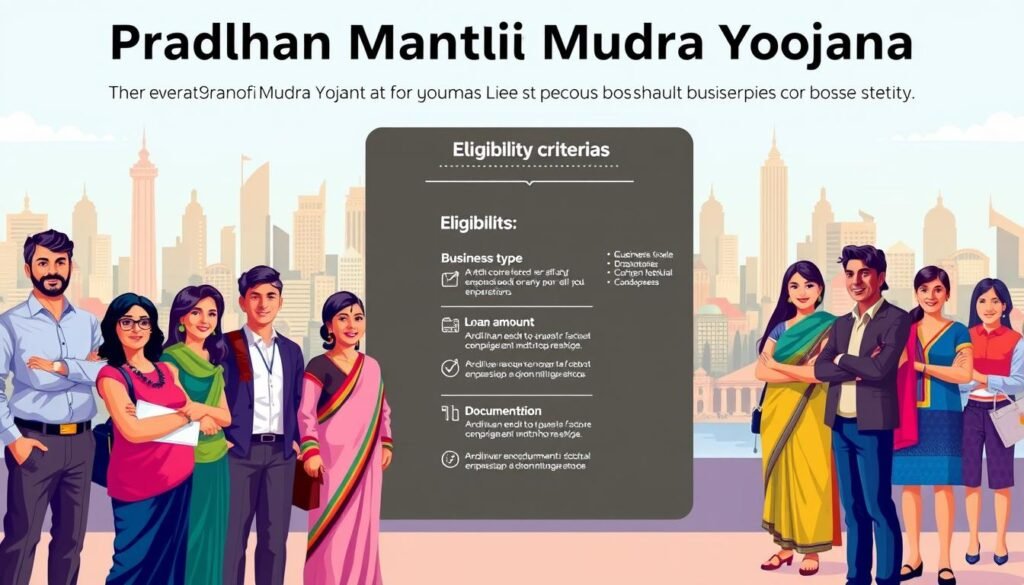
We explain who can apply and what’s needed for Small Business Loans under the Pradhan Mantri Mudra Yojana. Knowing the eligibility and required documents helps applicants. This makes the process faster and increases the chance of quick approval.
General Requirements
Eligible applicants include businesses like proprietorships, partnerships, and private companies. They must run non-farm micro and small business activities. The program focuses on businesses with small turnover and micro-scale.
Loan rules vary by lender. Some accept personal guarantees for smaller loans, while others need collateral for bigger ones. This flexibility is seen in other government-backed programs too.
Documentation Needed
Common documents needed include proof of business existence like registration and trade license. You also need a government-issued photo ID and address proof.
For companies, lenders ask for partnership deeds and financial records. They also want bank statements and basic financial documents.
For bigger loans, lenders might ask for project reports and cash-flow projections. But for smaller loans, the paperwork is less and the process is quicker.
Practical tip: prepare your business registry extracts and current documents before applying. Having your PMMY documents ready can speed up the approval process. This helps entrepreneurs across India get the financial support they need.
Application Process Explained

We help entrepreneurs navigate the PMMY application process. It’s designed to be straightforward and quick. We focus on simple steps and careful checks to help you grow your business.
Step-by-step application guide
First, check if Shishu, Kishore, or Tarun fits your needs. This helps you choose the right loan for your business.
Next, find a lender. You can choose from public banks like State Bank of India or private banks like HDFC Bank. You can also consider NBFCs or microfinance institutions. Talk to a financial officer to see if their product is a good fit for you.
Then, gather your documents. You’ll need your ID, business registration, recent bank statements, and estimates or quotes for your project.
After that, fill out the loan form. Many banks let you apply online and save your progress for later.
The lender will then review your application. They’ll do their due diligence and make a decision. If approved, they’ll disburse the funds according to the program’s rules.
Lastly, the lender will register the loan. This step is important to complete the process.
Common pitfalls to avoid
One common mistake is not having all the necessary documents. Missing important documents can delay your application.
It’s also important to clearly explain how you plan to use the loan. Be specific about how you’ll use the funds for working capital, equipment, or marketing.
Don’t overlook the differences between lenders. Compare their interest rates, loan terms, and security requirements before making a decision.
Remember, underestimating your working capital needs can cause problems. Be conservative with your cash flow projections and include buffers for any seasonal changes.
Smaller loans often get approved faster because they require less documentation.
| Step | Action | Practical Tip |
|---|---|---|
| 1 | Assess capital need | Match to Shishu, Kishore, or Tarun to avoid over- or under-borrowing |
| 2 | Choose lender | Speak with officers at SBI or ICICI Bank and an NBFC to compare terms |
| 3 | Gather documents | Use a checklist: ID, business proof, bank statements, quotes |
| 4 | Apply | Prefer online forms that let you save progress during the PMMY application |
| 5 | Appraisal & decision | Prepare a concise business plan to speed lender review |
| 6 | Register loan | Confirm the lender records the loan under the Mudra scheme per rules |
Wondering how to apply for a Mudra Loan? Start with accurate financial information. Choose the right lender and follow the checklist above. We support you in finding accessible Entrepreneurship Finance. Prepare your documents early and compare offers before making a decision.
Interest Rates and Repayment Terms
We explain how borrowing costs and repayment plans work under government-backed small credit schemes. This helps entrepreneurs plan their cash flow. They can compare offers from SBI, ICICI, HDFC, and nonbank lenders. This way, they can pick the best Small Business Loans terms for their business.
Competitive Interest Rates
PMMY interest rates vary by lender and borrower profile. Lenders offer fixed or floating rates. Floating rates are based on a base rate plus a margin based on creditworthiness.
State Bank of India uses clear slabs, while smaller NBFCs set margins based on risk and sector. Borrowers with strong records often get lower spreads. Asset-backed loans have modest rates, while unsecured micro loans have slightly higher rates.
We suggest checking the annual percentage cost and processing fees before signing.
Flexible Repayment Plans
Repayment terms match the loan category and working-capital needs. Shishu, Kishore, and Tarun-style financings offer monthly or quarterly instalments. Term loans have a fixed schedule, while credit lines charge interest on amounts drawn.
Lenders often adjust schedules to fit seasonal cash flow. For example, a shop with peak festival sales can ask for holiday moratoriums or step-up repayments. Equipment financing usually has longer tenors with asset security.
Fees, Security and Guarantees
Some schemes include registration or processing charges that lenders may add to principal. For example, a small registration levy can be financed into the loan amount. Clarify whether such fees are payable upfront.
Lenders accept unsecured personal guarantees for low-value advances. Asset finance requires a charge over machinery or property. For intangible investments, lenders may secure business assets or require stronger credit history.
Managing Mudra Loan repayment
We recommend mapping projected cash inflows to instalment dates. Build a modest reserve for delays. Discuss restructuring options early if stress appears. Timely payments protect credit lines and preserve access to future Entrepreneurship Finance.
Small Business Loans terms include prepayment clauses, penalty charges, and conditions on additional borrowing. Read loan agreements thoroughly and negotiate terms where possible.
To compare offers, list effective interest rates, total fees, expected instalment amounts, security needs, and flexibility options. This checklist helps choose a plan that supports growth without straining working capital.
Benefits of Pradhan Mantri Mudra Yojana
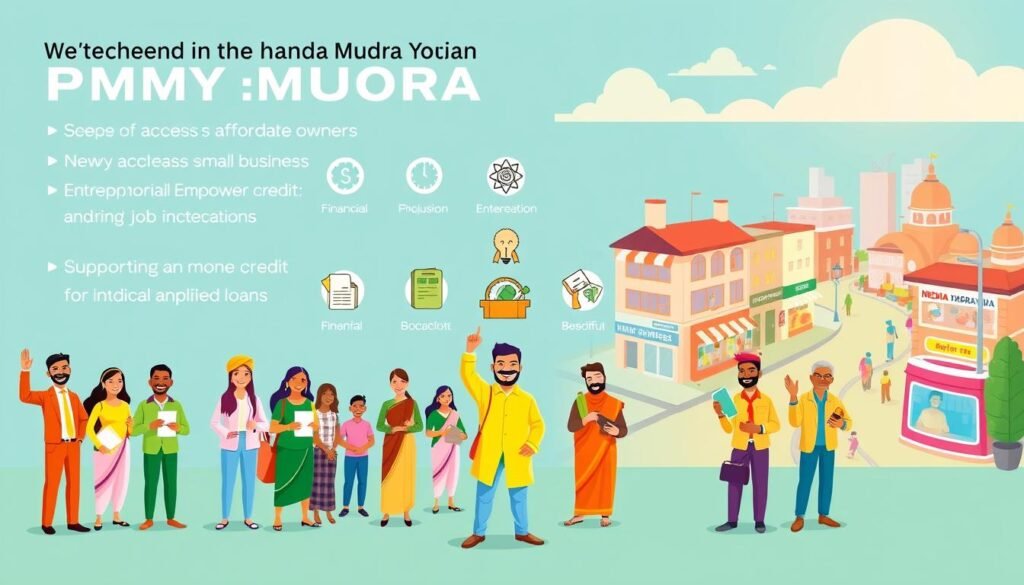
The Pradhan Mantri Mudra Yojana is a bridge for engineers, shopkeepers, and service providers. It helps them access small loans for starting or growing their businesses. This makes it easier for them to get the funds they need.
The scheme has many advantages. It offers quick loans with little need for collateral. The loan amounts are perfect for small businesses. This makes it easier to turn ideas into real products or services.
Financial Inclusion is a big win. PMMY gives credit to those who need it most. It helps entrepreneurs join the formal economy. This opens doors for more finance and growth.
There are also jobs, stronger local businesses, and a more vibrant entrepreneurial scene. Engineering graduates and teachers can now turn their lab projects into businesses. This program helps them get the funding they need.
We summarize the main benefits in a table for easy reference.
| Benefit | What It Means | Who Gains |
|---|---|---|
| Accessible Credit | Small Business Loans without heavy collateral and faster processing | Micro-entrepreneurs, artisans, small manufacturers |
| Support for Scaling | Funds for equipment, working capital, and market entry | Startups, expanding workshops, service providers |
| Financial Inclusion | Formal banking linkages for underserved segments | Rural entrepreneurs, women-led businesses, street vendors |
| Entrepreneurship Finance | Targeted loans that complement incubators and technical mentoring | Engineering teams, incubators, student founders |
| Local Economic Impact | Job creation and growth of local manufacturing/services | Communities and regional industries |
Role of Banks and Financial Institutions

We explain how public and private banks team up with non-bank lenders. Together, they help small businesses get loans under the Government Loan Program. This partnership makes loans more accessible and tailored to local needs.
Partnerships with NBFCs
Non-banking financial companies (NBFCs) help reach more areas. They use field agents and simple loan processes. This way, they help artisans, food vendors, and small manufacturers.
Banks work with these partners to try new loan types and share data. This helps them offer better loans while following rules.
Support Provided by Banks
Banks play a key role in evaluating and approving loans. Bank officers check business plans and decide on loan amounts. They also register loans with the authority.
We suggest talking to bank managers about special loans and advice. Some banks have online apps for easier applications. This saves time and effort.
Each lender has its own rules. Smaller loans need less paperwork and are quicker. Larger loans require more checks. Knowing these rules helps businesses choose the best lenders for them.
Challenges Faced by Borrowers

Entrepreneurs face many hurdles when they apply for PMMY loans. These problems slow down the approval process and make it hard for small businesses. By tackling these issues, we can improve Financial Inclusion in both cities and rural areas.
Common Obstacles
One big problem is missing documents. This includes things like KYC, GST records, and bank statements. Banks like State Bank of India and ICICI need these to make quick decisions.
For businesses with ups and downs, like a vegetable vendor or a textile unit, cash flow can be a big issue. Even if they make good money, they might struggle to pay back loans on time.
Not knowing about finance can also hold you back. Without a solid plan, lenders might see your loan request as too risky.
Different rules from each lender can confuse things. Interest rates, what you need to put up as collateral, and fees can vary a lot. This makes it hard for new borrowers to know what to expect.
Tips to Overcome Challenges
Start by getting your documents in order. Make sure you have the latest business registration, PAN, Aadhaar, GST, and bank statements for the past year. This can help avoid delays and clear up many issues right from the start.
Make sure your financial plans are clear and realistic. Show how you plan to use the money and your expected cash flow. This helps lenders see if you can pay back the loan.
Shop around for the best loan deal. Talk to managers at different banks and non-bank financial companies to compare rates, terms, and fees. Even small differences can save you money.
Get help from experts like MSME Development Institutes or local accountants. They can help make your loan application stronger and increase your chances of getting approved.
| Challenge | Immediate Action | Expected Benefit |
|---|---|---|
| Documentation gaps | Assemble KYC, GST, bank statements, registration | Faster processing and fewer query cycles |
| Cash-flow mismatch | Prepare monthly cash forecasts; align EMI dates with inflows | Reduced defaults and improved credit history |
| Limited financial literacy | Attend MSME workshops; hire a financial consultant | Stronger loan proposals and higher approval rates |
| Variation in lender terms | Obtain quotes from multiple banks and NBFCs | Lower cost of capital and better-fit loan structure |
| Over-borrowing | Request a loan size tied to immediate, trackable needs | Smoother repayments and faster access to future credit |
Success Stories and Testimonials
We’ve seen many PMMY success stories. Artisans bought modern looms with Mudra loans. Street-food vendors upgraded their equipment to meet demand. Small Business Loans testimonials talk about faster launch times and clearer cash flow.
These real-world accounts show how Entrepreneurship Finance impact turns ideas into steady income and customer growth. Entrepreneurs report gains like more sales, timely vendor payments, and new hires. Metrics like loan numbers, average sizes, and jobs created show the impact of Mudra Loans.
Schools and incubators track the success of these technical solutions. They show how these solutions become market-ready products. PMMY helps Local economic growth by strengthening supply chains and creating demand.
Case examples from small manufacturers and retail chains show how targeted credit fuels regional entrepreneurship. We encourage engineering professionals, students, and educators to see these success stories. They show how combining disciplined business planning with accessible finance can scale technical ideas and uplift neighborhoods.