



Did you know the four Vedas hold about 20,379 mantras and 72,000 metrical feet? This vast collection was passed down orally for thousands of years before being written. It shows the deep commitment of ancient India to record prayers, rituals, and questions.
The Vedas are seen as both historical texts and living scriptures in Hinduism. They were written in Vedic Sanskrit and called śruti—”what is heard.” They are believed to have been revealed to sages and kept alive through oral tradition.
The Vedic texts are divided into four main parts: the Rigveda, Samaveda, Yajurveda, and Atharvaveda. Each part has different sections like Samhitas, Brahmanas, Aranyakas, and Upanishads. These sections cover rituals, music, philosophy, and daily life.
For engineers, students, and teachers, the Vedas are a lesson in building knowledge. They cover phonetics, metrics, ritual science, and early astronomy. This series explores their creation, themes, and lasting impact on Indian thought and practice.
Introduction to the Vedas
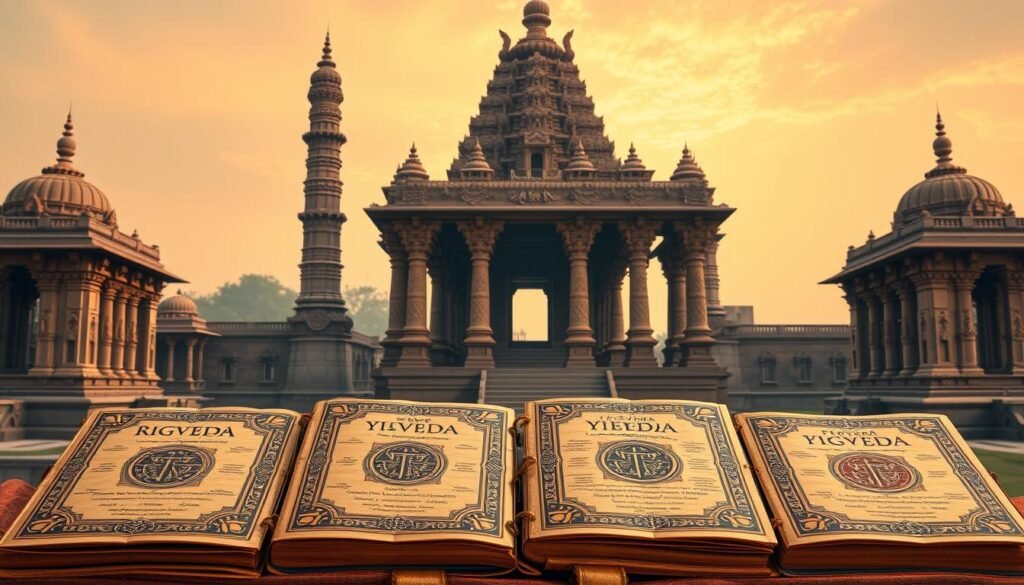
The Vedas are a collection of ancient texts that hold the essence of early Indian thought. They are a treasure trove of rituals, sound theories, and early wisdom. This introduction will guide you through the four Vedas and their significant role in ancient India.
Overview of the Four Vedas
The Rigveda is the oldest part of the Vedas, with 1,028 hymns in ten mandalas. It celebrates gods like Agni, Indra, Soma, and Surya. Scholars believe its core was written between 1500–1200 BCE. It’s the poetic core of Vedic rituals.
The Samaveda has about 1,549 stanzas, mostly from the Rigveda but set to music. Its focus on melody influenced Indian music and liturgy.
The Yajurveda is a guide for sacrificial rituals, known as yajus. It has two versions: Krishna (Black) and Shukla (White). Priests followed its instructions for yajña rites.
The Atharvaveda contains around 730 hymns and 6,000 mantras. It includes spells, medical verses, and household advice. Many of its passages are similar to Ayurvedic practices.
Importance in Ancient Indian Culture
The Vedas were key for rituals and life events. They included recitation guides, procedural explanations, and contemplative texts. The Upanishads explored deeper philosophical questions.
Vedic texts shaped society and politics. They mentioned social classes, royal rituals, and connections between ceremonies and governance. Places like Taxila and Nalanda kept Vedic knowledge alive.
Oral tradition ensured the exact sounds were kept. Teachers used memory aids, multiple recitations, and gestures. This made the power of mantras and rituals central to Vedic practice.
The Rigveda: The Earliest Text
The Rigveda is a treasure trove of Vedic poetry from ancient India. It has shaped rituals and thoughts for centuries. Its language and rhythm have kept knowledge alive through generations.
Structure and Composition
The Rigveda Samhita has 1,028 hymns in ten mandalas. Scholars believe the oldest parts date back to 1500–1200 BCE in Punjab. Later, hymns were added as people moved to the Yamuna and Ganges plains.
The hymns are layered, with mantras at the core. Brahmanas and Upanishads offer interpretations. Oral tradition was key, with written texts coming much later.
Key Themes and Concepts
The hymns often call on gods like Agni, Indra, Soma, and Ushas. These gods are central to rituals and prayers for good fortune.
Themes like cosmic order and dharma are common. Hymns like the Nasadiya Sukta explore the universe’s beginnings. They hint at deeper philosophical questions.
The Rigveda’s verses are used in many rituals. They were adapted into other texts like the Samaveda and Yajurveda. This shows the Rigveda’s importance in ritual practices.
In conclusion, the Rigveda is a rich source of devotion, ritual language, and deep questions. It is crucial for understanding ancient India’s religious and intellectual heritage.
The Samaveda: The Melodic Veda
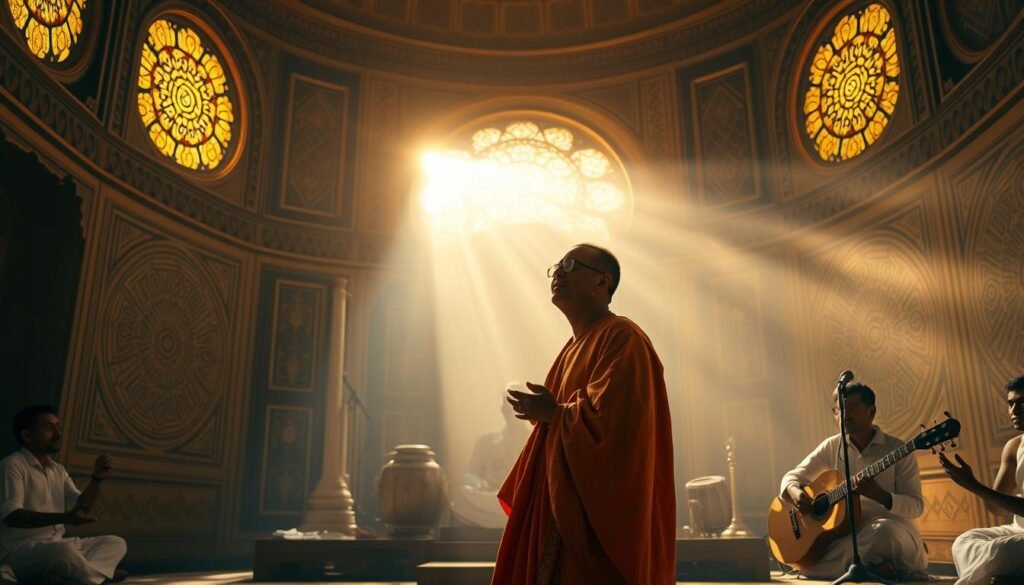
We delve into how melody and ritual merged in ancient India through the Samaveda. This Veda transformed verses from the Rigveda into sung forms called sāman. This change highlights the early importance of sound as both technique and art.
Role of music and chanting
The Samaveda holds about 1,549 stanzas, all set for singing. It’s divided into Purvarchika and Uttararchika, organizing gana collections and arcika verse books. Vedic chanting here was a training ground for priestly specialization.
Udgātṛ priests learned specific melodic shapes. This helped guide ritual timing through rhythm and pitch.
These arrangements laid the groundwork for later raga theory. The musical ordering of text shows music’s role in shaping memory and meaning. Vedic melodies acted as mnemonic devices and tools to focus attention during yajñas.
Ritual significance
Samaveda was key in Soma sacrifices and many yajñas, where melody enhanced efficacy. Chanting created a charged atmosphere, believed to invite deities. Over 75% of its verses come from the Rigveda, but they were repurposed.
Sound took precedence over literal sense. This shows the Vedic belief in Nada Brahma—the world as sound. It also highlights how phonology served as a technology for preservation.
Musical recensions and specialized priest roles ensured accuracy across generations.
We see a clear cultural legacy: Vedic chanting and Samaveda practices influenced Indian classical music and continued ritual singing forms. The connection between ritual purpose and musical form made the Samaveda a cornerstone in ancient India’s melody history.
The Yajurveda: The Veda of Rituals
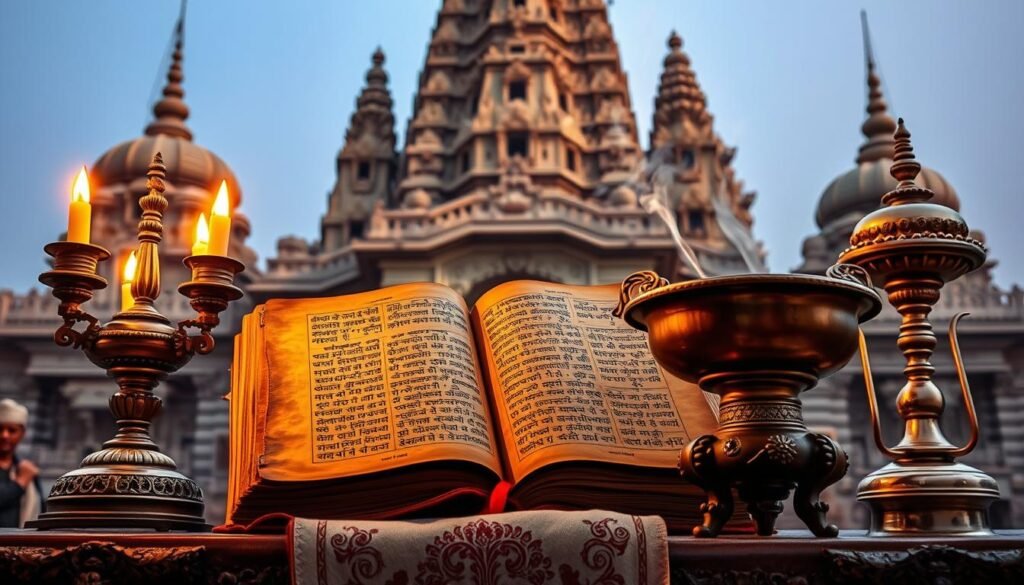
The Yajurveda is the guide for Vedic rituals. It turns poetic hymns into action steps. It shows how to perform rituals, from daily offerings to royal ceremonies.
There are two main traditions in the Yajurveda. One mixes mantras with notes, the other keeps them apart. This affects how priests perform their duties.
Types of Yajurveda: Black and White
The Krishna Yajurveda, or Black Yajurveda, combines mantras and prose. It’s great for rituals where you need to understand the actions as you do them.
The Shukla Yajurveda, or White Yajurveda, separates mantras from commentary. The Shatapatha Brahmana is part of this tradition. It gives detailed explanations for complex rituals.
Its Practical Applications in Sacrifice
The Yajurveda is the priest’s guide for yajñas. It outlines the steps for sacrifices, including what to say and do. This ensures the rituals are done correctly.
Every step in a ritual depends on correct speech and action. Training in Shiksha and other Vedangas helps keep pronunciation and recitation right. The success of the ritual depends on timing and execution.
| Aspect | Black Yajurveda | White Yajurveda |
|---|---|---|
| Textual Structure | Mantras and commentary mixed in single recensions | Mantras presented separately with Brahmana commentary |
| Notable Associated Work | Various regional śākhās with integrated notes | Shatapatha Brahmana with thorough ritual analysis |
| Use in Vedic rituals | Quick reference during rites where interpretation is required | Step-by-step procedural clarity for elaborate ceremonies |
| Typical Applications | Domestic offerings, regional ceremonies, practical guidance | Major sacrifices, royal yajñas, scholarly exegesis |
| Transmission | Oral recitation with embedded commentary traditions | Strict oral paths for mantra and separate Brahmana recensions |
The Atharvaveda: The Veda of Everyday Life
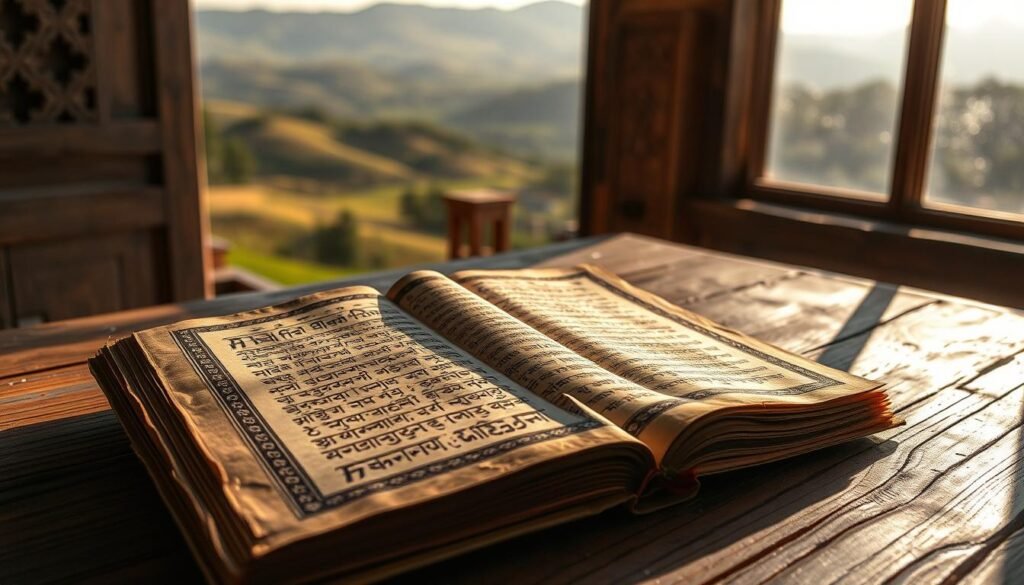
We look at the Atharvaveda as a practical guide from ancient India. It focuses on everyday life, health, and social issues. Its straightforward and folk-like style offers a peek into daily rituals and beliefs.
The Atharvaveda dates back to around 1200–1000 BCE. It has two main recensions: Paippalāda and Śaunakīya. Its inclusion in the Vedic canon shows a shift towards practical texts for homes and villages.
We outline key differences and content areas. This helps readers compare texts and see cultural continuity.
Unique features compared to other Vedas
The Atharvaveda has about 730 hymns and 6,000 mantras. It focuses on domestic rituals, charms, and protection prayers. This contrasts with the other Vedas’ focus on liturgical formulas.
It includes hymns for fertility, crop protection, and household prosperity. It also offers remedies for common ailments. This practical focus explains its preservation and link to healing systems.
Medicinal and magical content
The text is an early source for Ayurveda. It contains treatments, herbal references, and rituals for fever, wounds, and skin issues. These passages connect ritual speech with therapy.
It also preserves Vedic magic through charms and incantations. These spells protect against evil, counter malevolent influence, and secure social harmony or political success.
Its social dimension is evident in hymns for kings, alliances, and justice. This shows how ritual, medicine, and politics intertwined in ancient India.
To summarize, we offer a compact comparison.
| Aspect | Atharvaveda | Rigveda / Yajurveda / Samaveda |
|---|---|---|
| Primary focus | Household rites, healing, protection, folk practices | Sacrificial liturgy, ritual formulas, chants for public rites |
| Content type | Charms, remedies, practical hymns, Atharva spells | Sacred hymns, ritual instructions, musical notations |
| Medical relevance | Early Vedic medicine elements; herbal remedies and diagnoses | Less explicit medical material; ritual purity and offerings |
| Social role | Domestic prosperity, protection of individuals and families | Public ritual, royal consecration, communal obligation |
| Canonical history | Canonicalized later in many traditions; two main recensions | Older core texts with early liturgical primacy |
The Influence of Vedas on Indian Philosophy
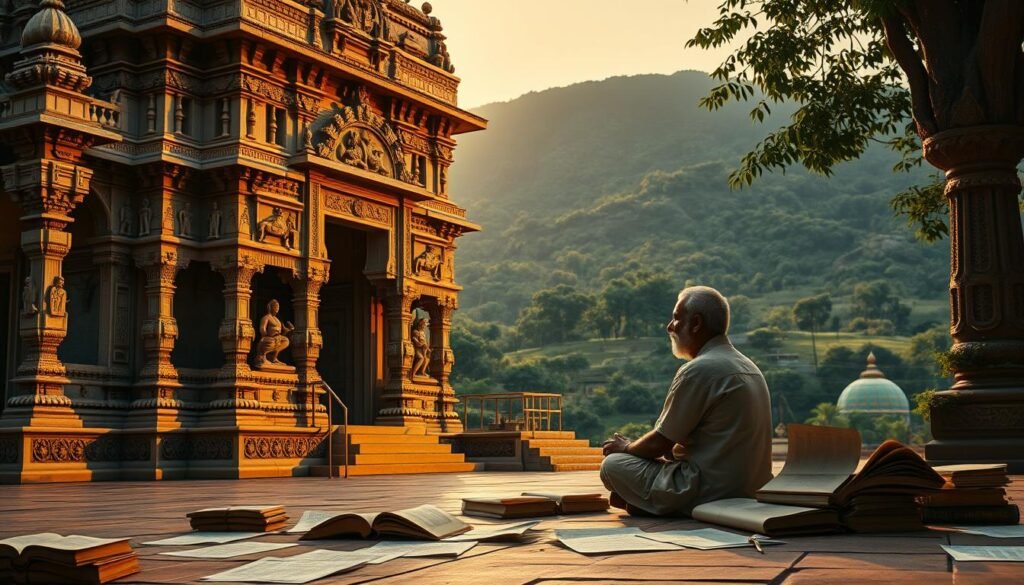
We explore how ancient India’s thought evolved from rituals to deep thinking. The Vedas shaped many debates on existence and ethics. They led to texts that questioned the self, reality, and freedom.
The Upanishads are a key shift to inner reflection. Written around 800 BCE, they use old rituals for meditation. They introduce Brahman and Atman, ideas that shaped later philosophies.
The Upanishads are the heart of Vedanta. Important texts like Brihadaranyaka and Chandogya discuss ultimate reality. Katha and Kena delve into moral and life’s big questions, still debated today.
Here are some key connections and echoes:
- Mimamsa focused on ritual interpretation, creating detailed ways to understand Vedic commands.
- Vedanta, with Advaita, Vishishtadvaita, and Dvaita, expanded Upanishadic ideas into theories of unity and liberation.
- Nyaya and Vaisheshika used Vedic logic and concepts to improve reasoning methods.
- Samkhya and Yoga drew from Vedic views of the universe, with Purusha and Prakriti, and introduced systematic theories and meditation.
It’s important to note that āstika schools saw the Vedas as essential. But śramaṇa movements like Buddhism and Jainism had different views on scriptures and practices. This disagreement shaped many debates in ancient India and influenced later philosophies.
In summary, the Vedas’ impact is more than just ritual texts. They continue to influence through interpretive traditions, Upanishadic metaphysics, and the varied doctrines of classical Indian thought.
The Vedas and Hindu Ritual Practices
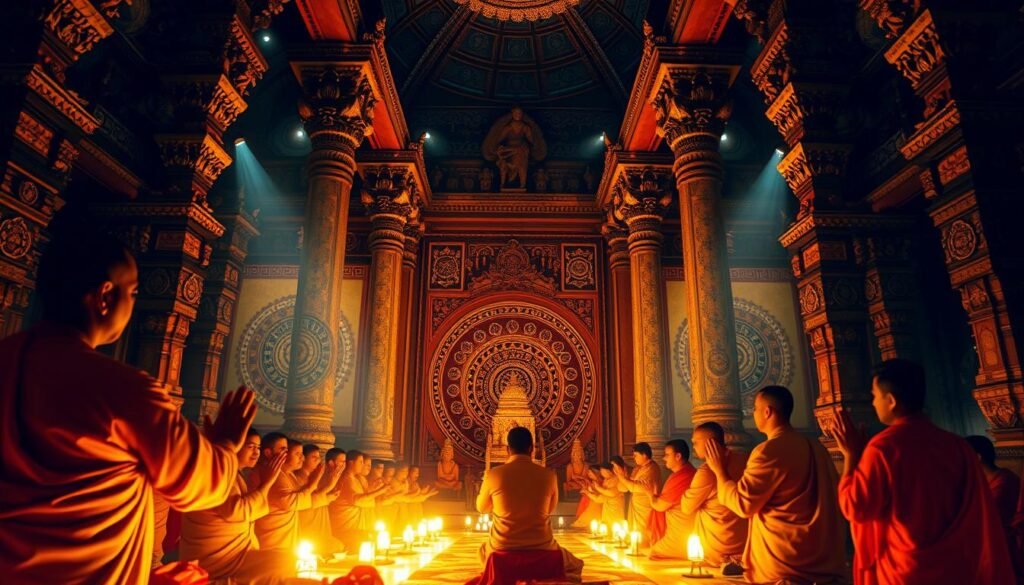
We look at how the Vedas shaped rituals in ancient India. These practices still exist in many Hindu rituals today. We focus on the details of these rituals, the roles of priests, and the social structure that helped pass down these traditions.
Vedic rites were based on yajna, a system of daily offerings. These included Agnihotra and big ceremonies like Soma and Ashvamedha. They needed precise recitation from the Samhitas and Yajurveda.
Ritual guides, like Shrauta and Grihya Sutras, told priests what to do. They explained the tools, timing, and tasks needed for the rituals to work.
Priests had specific jobs. The hotṛ recited Rigvedic hymns, the adhvaryu did the physical actions, and the udgātṛ sang. They used memory aids and strict rules to keep the mantras correct over time. Brahmana commentaries gave deeper meanings, and Aranyakas helped with deeper contemplation.
Rituals did more than just spiritual things. They also helped with social roles and showed who was in charge. They were tied to the varna system and helped kings show they were rightful rulers. Community life was filled with seasonal rites, weddings, and funerals, all connected to Vedic traditions.
Today, many Hindu rituals still use Vedic elements. They include Sanskrit mantras, fire offerings, and specific priest roles. This shows a link to ancient India. Dharma Shastra literature also helped shape these rituals into legal and moral codes for daily life.
Over time, guides and manuals were created to handle the complexity of rituals. Shrauta Sutras covered public ceremonies, and Grihya Sutras focused on home rituals. These texts helped build a framework for yajna and other ceremonies. This framework helped define community identity and cultural memory.
Preservation and Transmission of the Vedas
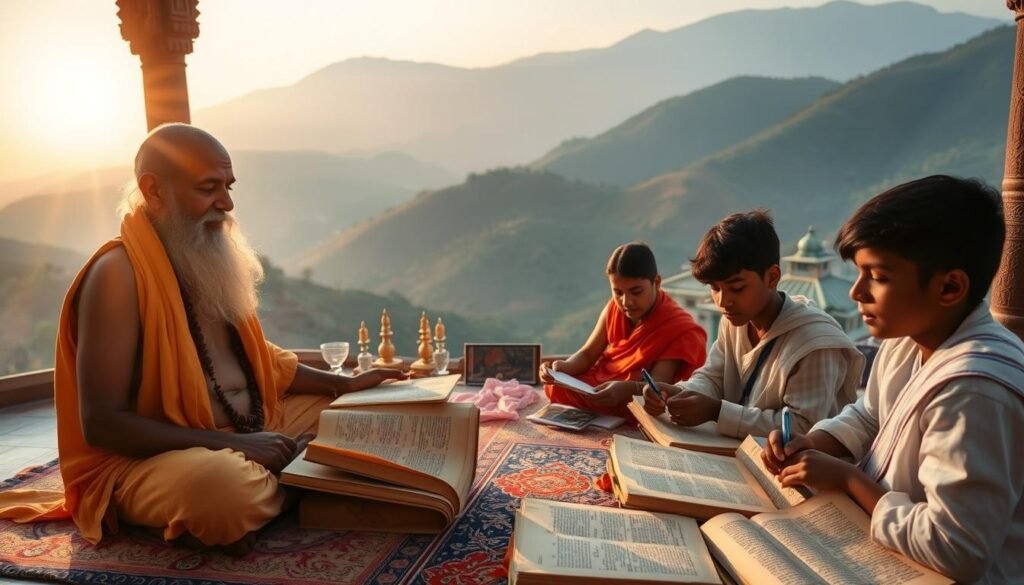
In ancient India, a tradition kept the Vedas alive for centuries. Before writing was common, the Vedas were passed down through oral performance. This history is key for understanding modern Vedic studies and the importance of sound, memory, and ritual.
Oral methods and early manuscripts
The Vedas were mainly shared through teacher-student lines called sampradayas. Reciters used special techniques to remember the texts. They chanted in groups and used eleven ways to recite to keep the sounds right.
These methods focused on the sounds rather than the meaning. This helped protect the phonology over time. The Vedangas, like Shiksha, helped with pronunciation and memorization.
Writing started around 500 BCE, but most Vedic manuscripts are from the medieval times. This is because palm-leaf and birch decay easily. Yet, we have a 14th-century Rigveda copy and 11th-century Nepalese Veda manuscripts. For more on this, see Vedic transmission.
Contemporary preservation efforts
Today, we mix old ways with new methods. Gurukulas and temple schools keep the tradition alive with regular recitation. Universities also offer courses that blend ritual training with language study.
Philologists work on critical editions and concordances. They map thousands of padas across Samhitas. Digital archives have high-quality scans of fragile manuscripts. Audio projects record traditional reciters to preserve their cadence and pronunciation.
| Aspect | Traditional Method | Modern Initiative |
|---|---|---|
| Memory technique | Eleven pathas, padapatha, krama | Audio archives, pedagogical recordings |
| Textual authority | Oral transmission within sampradayas | Critical editions and philology |
| Manuscript survival | Palm-leaf and birch copies, limited longevity | Digitization of Vedic manuscripts and climate-controlled storage |
| Educational venues | Gurukulas and traditional schools | University departments, research centers |
| Research focus | Pronunciation, ritual correctness | Modern Vedic studies combining audio, philology, and history |
Challenges still exist: fragile manuscripts, differences between śākhās, and balancing oral practice with scholarship. We think a mix of supporting recitation, research, and digital preservation is best for the Vedas’ long-term preservation.
The Vedas: Influence on Indian Literature
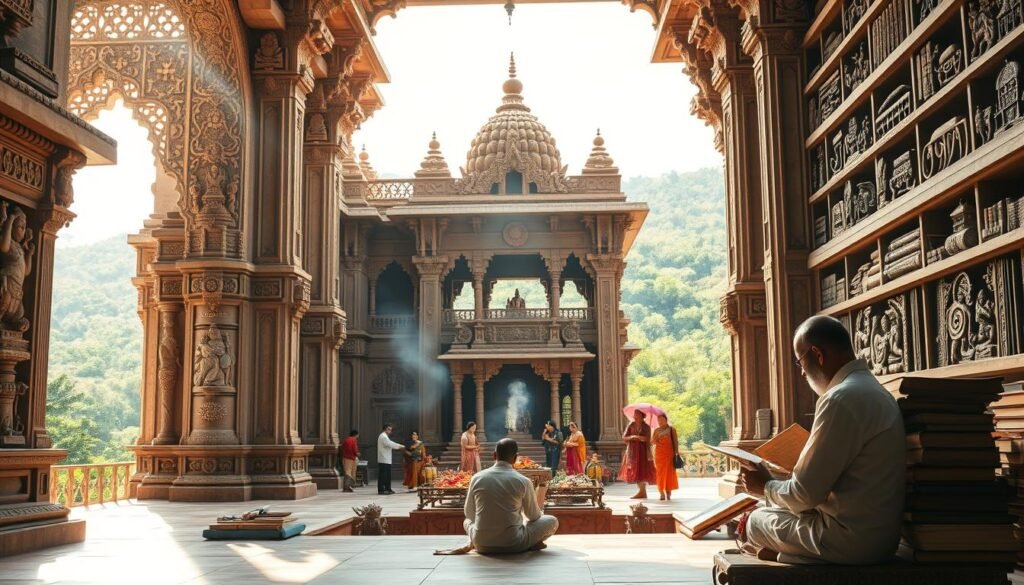
We explore how Vedic words and ideas spread from sacred texts to ancient India’s literature and beyond. This journey leads to two key areas: poetic forms and prose traditions.
Integration into Poetry and Prose
Vedic rhythms and poetic devices influenced later Sanskrit poetry. Poets used imagery from the Samhitas, blending Rigveda’s poetry into their work. This included similes, invocations, and setting scenes for rituals.
Ritual words found their way into drama and epic poetry. The Mahabharata and Ramayana, for example, use Vedic themes. This shows how Vedic influence shaped the rhythm and focus of stories.
Prose took on a concise, formulaic style from Vedic traditions. Commentaries and philosophical writings kept Vedic language alive. They used Vedic terms for clarity and precision.
Impact on Classical and Contemporary Works
Vedanga disciplines, like Pāṇini’s grammar and Chandas on metrics, created tools for writing. These tools helped medieval scholars refine language and rhythm across different genres.
In recent times, thinkers like Swami Vivekananda and Sri Aurobindo reinterpreted Vedic ideas. They aimed to renew spirituality and culture. The Samaveda’s melodies also live on in Indian classical music and rituals.
| Aspect | Vedic Roots | Later Literary Effect |
|---|---|---|
| Meter and Prosody | Hymnic metres from Rigveda and Samhitas | Standardized meters in classical kavya and drama |
| Imagery and Motifs | Nature, sacrifice, cosmic order | Epic scenes, devotional hymns, regional ballads |
| Philosophical Language | Upanishadic reflections embedded in Vedic corpus | Theological treatises, modern philosophical essays |
| Musical Tradition | Samaveda’s melodic chants | Framework for Hindustani and Carnatic forms |
| Scholarly Practice | Commentarial and pedagogic traditions | Grammar, metrics, and hermeneutics in scholarship |
Interpretations of the Vedas
We see the Vedas as a conversation that spans centuries. They offer insights from ritual guides to deep spiritual teachings. This section explores the main ideas and how they evolved in ancient India and beyond.
Traditional commentaries laid the groundwork for early Vedic understanding. Sayana’s 14th-century work is key, clarifying rituals and grammar. Scholars also highlight Mimamsa’s role in resolving doubts and focusing on action.
H3: Scholarly Perspectives and Commentaries
Today, scholars use new tools like philology and archaeology. Experts like Michael Witzel help date texts from 1500–500 BCE. They use detailed analysis to improve our understanding of these ancient texts.
H3: Historical Context and Evolution of Thought
The study of the Vedas has changed over time. It started in northwest India and spread across Aryavarta. The texts evolved from focusing on rituals to exploring deeper ideas.
There’s debate on who wrote the Vedas. Some say they were revealed, while others point to the role of rishis and redactors. The balance between oral and written traditions is also crucial.
Interpretations vary widely. Some focus on literal meanings, while others see deeper allegories. These approaches help us understand ancient India’s culture and history.
Key works have shaped our understanding of the Vedas. Yāska’s Nirukta and Pāṇini’s Aṣṭādhyāyī are foundational. Sayana’s Vedartha Prakasha is a classic commentary. Ongoing research continues to refine our knowledge.
We don’t aim to make definitive statements. Instead, we encourage readers to explore the rich diversity of Vedic interpretations and traditions.
The Vedas in Contemporary India
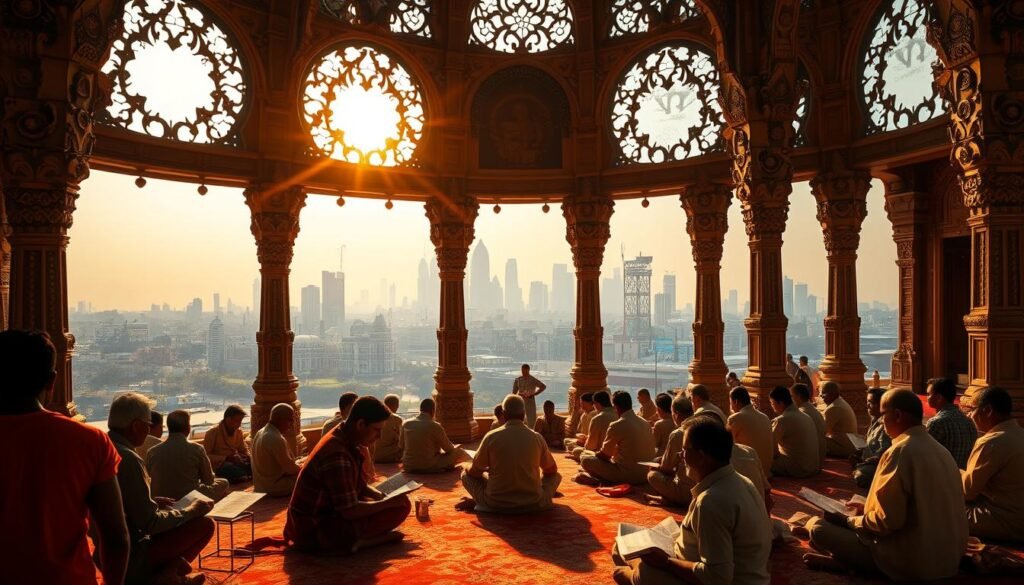
We see a connection from old chants to today’s classrooms. Vedic sounds and teachings are alive in temples, homes, yoga centers, and schools. They shape both spiritual practices and academic studies.
Relevance in Modern Spiritual Practices
Vedic mantras like the Gayatri are key in weddings, funerals, and daily prayers. Priests and laypeople focus on correct pronunciation to keep the Rigveda and Samaveda’s sounds alive. This effort keeps the ancient knowledge alive while fostering devotion.
Upanishadic ideas from the Vedas guide yoga and meditation schools. Swami Vivekananda and Sri Aurobindo made Vedanta popular worldwide. The Atharvaveda also influences Ayurveda and folk healing, offering practical remedies.
Educational Institutions and Vedic Studies
Universities and gurukulas teach Vedic recitation, Sanskrit, and Vedangas. Places like Sampurnanand Sanskrit University and Banaras Hindu University offer courses. They mix traditional training with modern approaches.
Scholarship spans translations, critical editions, and interdisciplinary projects. Teams of archaeologists, philologists, and digital-humanities experts work together. They aim to train young students and make Vedic texts more accessible.
| Aspect | Contemporary Role | Representative Institutions |
|---|---|---|
| Oral Tradition | Daily recitation; temple liturgy; preservation of phonetics | Sampurnanand Sanskrit University; gurukulas in Varanasi and Haridwar |
| Academic Research | Critical editions; translations; interdisciplinary analysis | Banaras Hindu University; University of Delhi; digital humanities labs |
| Applied Traditions | Yoga, meditation, Ayurveda, folk healing | Integral Yoga Institutes; Ayurvedic colleges; classical music academies |
| Preservation Projects | Audio archives; manuscript digitization; student patha programs | National Mission for Manuscripts partners; university archives; private academies |
For collaboration or inquiries about Vedic studies, email info@indiavibes.today. We’re open to partnerships that honor tradition and scholarship.
Criticism and Controversies Surrounding the Vedas
The Vedas have been at the heart of many debates for a long time. Scholars, activists, and religious groups all have their say on Vedas controversies. These discussions shape how we talk about modern India.
One big debate is about when and how the Vedas were written. Most experts say the Rigveda was written between 1500–1200 BCE. But some argue that the texts are so old, they can’t be written by humans.
Another debate is about how the Vedas were passed down. Some say writing is key to social change. Others, like Frits Staal, believe that the priests’ oral tradition is more precise. These views affect how we look at the texts.
Debates on Authenticity and Interpretation
There are also debates about what the Vedas say about rituals and social rules. Some think the Rigveda talks about changing social roles. Others see it as setting up the caste system. Different ways of reading the texts lead to different conclusions.
Good debates need careful research and clear sources. We focus on dating, comparing manuscripts, and looking at oral versions. This helps us understand the Vedas better.
Role in Sociopolitical Contexts
The Vedas play a big role in society, from old debates to today’s identity politics. Movements like Buddhism and Jainism have challenged Vedic authority. This has shaped India’s intellectual landscape.
In today’s world, the Vedas are used in nation-building and cultural claims. Scholars warn against using them in a way that’s not fair. They say we should read them in context to avoid political misuse.
We summarize the main points of the debates and their interpretations:
| Issue | Primary Positions | Evidence or Method |
|---|---|---|
| Dating of core hymns | Traditional early dating vs. philological 2nd millennium BCE dating | Comparative linguistics, stratigraphy of manuscripts, archaeological correlation |
| Oral vs. literate transmission | Orality champions accuracy; literacy advocates highlight codification effects | Performance studies, mnemonic techniques, manuscript collation |
| Social prescriptions | Fluid early social roles vs. foundations for rigid caste | Close readings, historical context, cross-textual comparison |
| Modern political use | Source of cultural identity vs. subject to scholarly critique | Discourse analysis, historiography, ethical scholarship |
By focusing on evidence, we can keep debates grounded. We encourage using clear methods and looking at history over time. This helps us understand the Vedas without oversimplifying their complex past.
Conclusion: The Legacy of the Vedas

The Vedic texts have deeply influenced ancient India and still guide us today. They are seen in rituals, arts, medicine, and key ideas like Rita and Atman. These ideas create a spiritual wisdom that people and scholars still explore.
The Vedas’ oral traditions keep their original sound and meaning alive. This is something written texts can’t match. It helps keep rituals effective and cultural memories alive through generations. For a quick guide on the Vedas, check out Vedic origins and overview.
Lasting Impact on Spiritual Wisdom
The Vedas are the base for many Hindu practices, like mantras and meditation. They also shape philosophical thoughts and devotion. In schools and temples, they help answer big questions about duty and who we are.
Experts, teachers, and followers find in the Vedas a wealth of ideas. These ideas help with moral thinking and creativity. They also help those studying science and spirituality to understand each other better.
Future Prospects for Vedic Studies
Vedic studies are looking bright, with new ways to study like combining different fields. New tech will help keep rare versions of texts safe for study and teaching.
Working together, schools, scholars, and cultural groups can make new translations and lessons. This will make the Vedas more accessible while keeping their traditions alive.
We aim to keep learning from the Vedas in a way that respects their traditions. This approach helps the Vedas continue to inspire education, creativity, and our connection to ancient India’s heritage.
Contact Information
We are open to working together on research, educational programs, and preservation projects. These projects can focus on the Rigveda, Samaveda, Yajurveda, Atharvaveda, and other ancient Indian texts. Our team combines Vedic studies with engineering, music, linguistics, and digital preservation. This way, we make complex knowledge easy to understand and exciting.
For any questions about Vedic studies or Vedas, email us at: info@indiavibes.today. If you’re interested in curriculum partnerships, workshops, manuscript digitization, or guest lectures, use indiavibes contact.
We encourage engineering professionals, students, and educators to suggest projects. These projects should use Vedic insights in teaching and research. If your work involves ancient India research or uses Vedic methods today, email info@indiavibes.today. We’ll get back to you with more information and ways to collaborate.