



More than 3,500 years of continuous use: the Sanskrit language connects modern India to ancient India’s thought. This began around 1500 BCE.
We look at how saṃskṛta, or “refined” or “perfected,” became scholars’ and sages’ precise tongue. From the Vedic texts to Pāṇini’s grammar, Sanskrit evolved. It preserved science, medicine, and philosophy.
Sanskrit’s impact on Indian heritage is huge. It gave us Ayurveda and shaped the Upanishads and Bhagavad Gita. It also enriched English with words like guru, karma, and mantra. Its importance in South and Southeast Asia is clear, and it still matters today.
For enquiries or contributions relating to this article and Sanskrit resources, contact info@indiavibes.today.
The Origins of Sanskrit Language
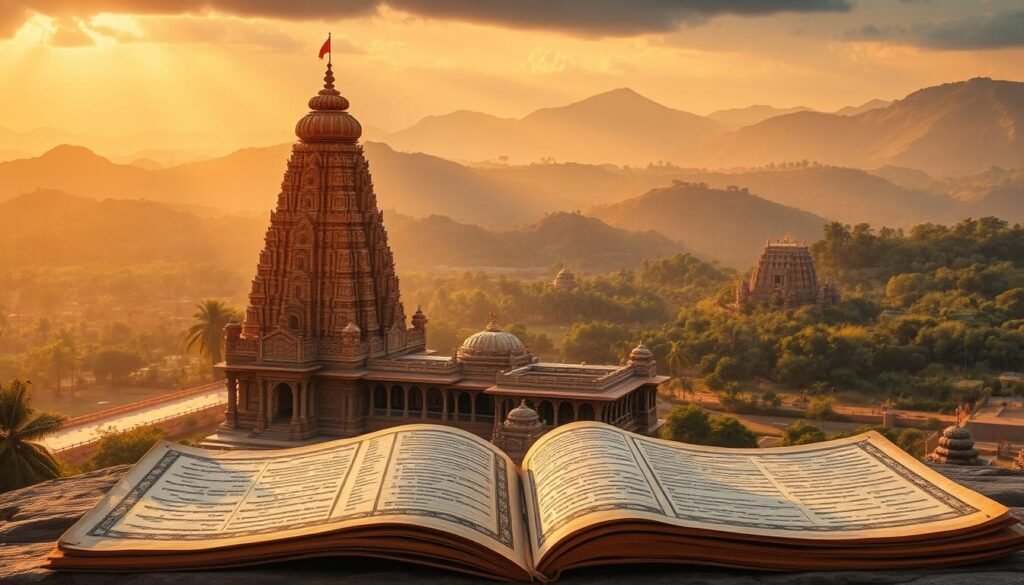
The origins of Sanskrit come from migrations and exchanges in the northwest of the subcontinent in the early second millennium BCE. It shows a link to Proto-Indo-European speech that reached ancient India. This set the stage for a rich oral tradition.
Vedic Sanskrit emerged between c.1500 and 500 BCE. This period produced the Rigveda, shaping ritual, metric, and phonetic norms. For centuries, oral transmission was key, with Brahmi inscriptions appearing later. Devanagari became a common script for written works.
The evolution of Sanskrit is a layered process. Pāṇini’s Aṣṭādhyāyī, around the 4th century BCE, codified Classical Sanskrit and standardized grammar. Epic Sanskrit in the Mahābhārata and Rāmāyaṇa expanded literary reach across regions.
We list key milestones that mark the language’s path:
- Rigveda composition: earliest substantial corpus in Vedic Sanskrit.
- Pāṇini’s Aṣṭādhyāyī: formal grammar and rules for Classical Sanskrit.
- Epic literature: expansion into narrative, moral, and cultural genres.
- Transmission to South and Southeast Asia: scripts, inscriptions, and scholarly exchange.
- Modern revival: educational institutions and technology-driven resources reconnecting learners to their linguistic roots.
The evolution of Sanskrit shows changes in ancient India’s social, religious, and intellectual scenes. Each stage kept core phonology and morphology. But it adapted vocabulary and style for new genres and audiences.
Sanskrit and the Vedas
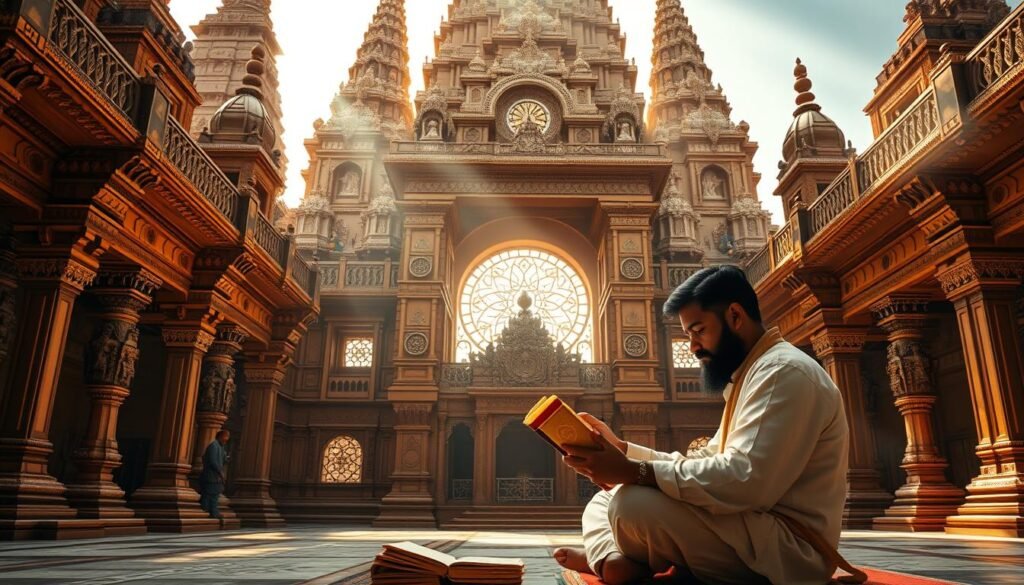
We look into how Vedic Sanskrit created a tradition of knowledge. The Vedas were the foundation of early Indian learning. They covered ritual rules, the universe, and social norms, passed down orally.
This tradition made Sanskrit the language of sacred learning and rituals for generations.
Overview of the Vedic Texts
The Vedas consist of four main collections: Ṛgveda, Yajurveda, Sāmaveda, and Atharvaveda. They are filled with hymns, formulas, and rituals. Brahmanas and Āraṇyakas add more details to the rituals. Early Upanishads introduce deep thoughts that shaped many philosophical schools.
Vedic texts show ancient language and rhythms. They were kept alive through strict memorization, keeping the sounds and rhythms true for centuries.
The Language of Sacred Knowledge
Vedic Sanskrit is a sacred language used for rituals, chants, and passing down knowledge. The way it’s spoken and the rhythm are key to understanding the texts. So, learning to recite them correctly is crucial.
Knowing Sanskrit and the Vedas is vital for scholars. It lets them read the original texts and connect the words to rituals and the universe.
Influence of Vedic Literature on Sanskrit
Vedic literature greatly influenced later Sanskrit. The unique vocabulary and flexible grammar of Vedic Sanskrit shaped the Classical Sanskrit used by Pāṇini and others.
Ritual formulas and terms from the Vedas are still used in rituals and spiritual texts. This keeps Sanskrit important for religious chanting and liturgy in South Asia.
| Aspect | Vedic Period | Later Sanskrit |
|---|---|---|
| Primary works | Ṛgveda, Yajurveda, Sāmaveda, Atharvaveda | Epics, Puranas, classical poetry and dramas |
| Language traits | Archaic forms, flexible syntax, rich oral variants | Standardized grammar, refined phonology, literary registers |
| Function | Ritual, mantra, cosmology | Philosophy, science, poetry, law |
| Transmission | Oral memorization techniques with strict phonetic rules | Manuscripts, commentaries, formal education |
| Role in spiritual literature | Core source for ritual and theology | Source of motifs, terminology, and interpretive traditions |
Sanskrit as a Classical Language

What makes a language a classical one? It has a long history of literature, strict grammar rules, and texts that shaped thought for centuries.
Definition of Classical Language
A classical language has texts that are a treasure of high culture and learning. In Sanskrit, Pāṇini’s grammar made it a precise language. This turned Sanskrit into a key for classical literature and deep thinking.
Recognition by UNESCO
Sanskrit is highly valued in India, being part of the Eighth Schedule of the Constitution. UNESCO also recognizes Sanskrit, focusing on its role in rituals and Ayurvedic texts. This shows Sanskrit’s deep cultural significance in India.
Comparison with Other Classical Languages
Sanskrit is like Latin, Classical Greek, and Classical Chinese in many ways. It has a vast collection of texts, influenced many languages, and played a big role in religion and learning. Unlike many spoken languages, Sanskrit was mainly used for learning, shaping philosophy, law, and science in the region.
The Role of Sanskrit in Indian Heritage

Sanskrit is at the heart of India’s culture and learning. It goes beyond just grammar, touching on rituals, laws, science, and the arts. This makes it a key part of Indian heritage and daily life.
Cultural Significance
Sanskrit is central to Hindu, Buddhist, and Jain traditions. It keeps rituals and festivals alive, linking local customs to a broader tradition. This helps keep community memories alive and protects cultural heritage.
The language also shaped the vocabulary of many regional languages. It introduced words related to kingship, law, and education, creating a shared understanding across South and Southeast Asia.
Influence on Indian Philosophy
Classical thinkers used Sanskrit to discuss complex ideas in philosophy. Works by Panini, Patanjali, and Adi Shankaracharya show its precision. Their writings still influence debates in philosophy today.
Sanskrit was key for texts on logic, ritual law, and medicine. It provided a technical vocabulary that is still used today. This connection allows students and scholars to engage with original ideas.
Sanskrit in Art and Literature
Epic stories and classical dramas have shaped Indian aesthetics and storytelling. Works by Kalidasa, the Mahābhārata, and the Rāmāyaṇa have influenced art and performance. They form the core of Sanskrit literature that guides modern creativity.
Poetry and scientific texts in Sanskrit have created common ground for education. Literary forms, rhetorical devices, and technical terms have been passed down, fostering a shared curriculum in arts and sciences.
| Domain | Sanskrit Role | Enduring Influence |
|---|---|---|
| Religious Practice | Preservation of mantras and liturgy | Continued ritual use; transmission of spiritual literature |
| Philosophy | Precise formulation of doctrines | Frameworks for debate in Indian philosophy still cited |
| Science & Medicine | Technical vocabulary in treatises | Foundations for Ayurveda, astronomy, mathematics |
| Literature & Arts | Epic and classical works | Influence on regional storytelling, theatre, and aesthetics |
Studying Sanskrit helps preserve Indian culture and heritage. It is not just a relic of the past but continues to shape education, art, and spiritual literature in India.
Sanskrit in Modern India
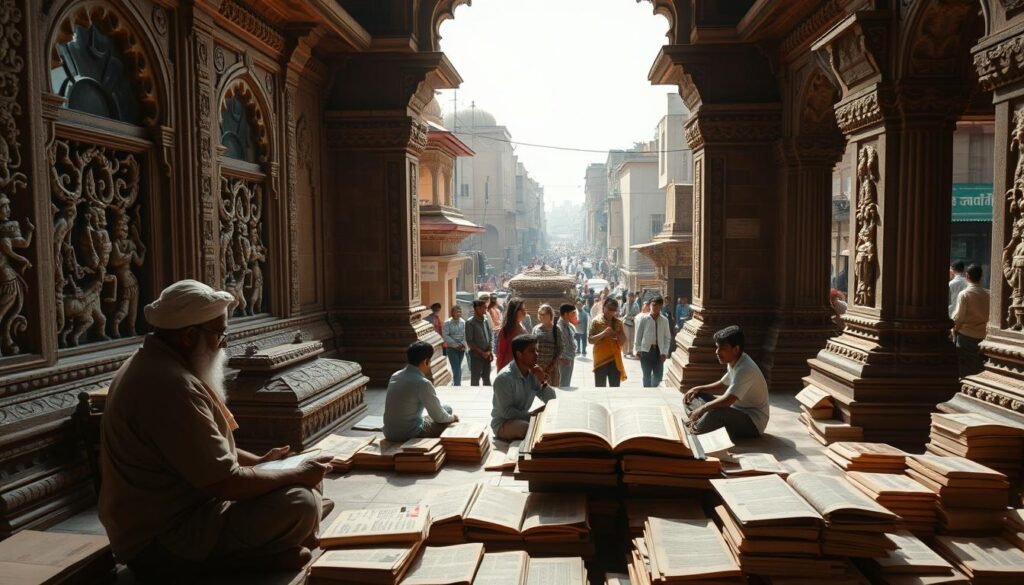
Sanskrit is alive in classrooms, temples, publishing houses, and online. We see it in education, temples, and media. It’s a bridge between ancient wisdom and today’s world.
Current status and public recognition
In modern India, Sanskrit is more than just a language. It’s in state lists and cultural policies. It’s also part of school and temple life.
In places like Uttarakhand and Himachal Pradesh, Sanskrit has official roles. Census data shows it’s valued, even if not everyone speaks it at home.
Educational institutions promoting study
Learning Sanskrit is available in many places. From old gurukulas to modern universities, there’s a path for everyone. Benares Sanskrit College and schools in Kolkata have been teaching for centuries.
Today, many places offer Sanskrit courses. You can learn about ancient texts and also science and law. This mix helps students tackle today’s challenges with ancient wisdom.
Use in contemporary literature and media
Modern Sanskrit literature includes poetry and short stories. It tackles today’s issues. Authors and translators make it accessible to more people.
Technology has made Sanskrit easier to find. Digital archives, apps, and online courses bring ancient texts to life. They help teachers, scholars, and creators.
For a quick history and more details, check out this summary on Sanskrit.
The Grammar and Structure of Sanskrit
Sanskrit’s grammar is a rule-bound system that shapes a living tradition. It offers clarity and precision, appealing to engineers, linguists, and students. Its formal design lets us trace ideas from phonetics to complex compounds with consistent logic.
Unique features include a compact but powerful toolkit. Pāṇini developed a highly formalized descriptive method. His concise rules, meta-rules, and procedural ordering read like a language engine specification.
This tradition supports elaborate samāsa compounds used in Ayurveda and classical literature. The role of Panini is central. His Aṣṭādhyāyī frames morphology and derivation with algorithmic clarity.
For learners and analysts, Panini’s approach models how discrete rules combine. This generates valid forms. We find analogies to programming grammars and formal automata when mapping those rules to modern computational formats.
Syntax and phonetics form the backbone of intelligibility. Sanskrit syntax uses clear case marking and flexible word order. This expresses relations without ambiguity.
The phonetics preserve a finely graded inventory of sounds. Sandhi rules govern transitions between sounds, shaping meter and recitation. These sound laws matter for textual transmission and linguistic reconstruction.
Phonetics allow us to compare cognates across families. Through careful phonetic evidence, scholars perform Indo-European comparison. This links Sanskrit to Latin and Greek, shedding light on how families diverged while keeping shared roots.
For practical learning, we outline contrasts that help engineers and students see patterns fast:
- Rule density: Panini’s compact rules vs. descriptive grammars of modern tongues.
- Morphology: extensive inflectional paradigms that encode syntactic roles.
- Phonetics: systematic sandhi and meter that affect pronunciation and textual form.
- Comparative value: archaic features useful in Indo-European comparison.
We present a compact reference to visualize these contrasts.
| Feature | Sanskrit | Typical Modern Indo-European Language |
|---|---|---|
| Grammar model | Rule-based, generative as in Panini | Descriptive, less algorithmic |
| Morphology | Rich inflectional system | Reduced inflection, more reliance on word order |
| Phonetics | Detailed inventory, sandhi rules | Simpler phonemic contrasts |
| Compound formation | Productive samāsa with semantic precision | Limited compounding; often periphrastic |
| Utility for reconstruction | High: preserves archaic Indo-European features | Lower: many innovations obscure archaic forms |
We aim to make complex ideas accessible through clear examples and tight structure. The intersection of Panini’s legacy, precise phonetics, and robust syntax keeps Sanskrit relevant to both humanities and technical fields.
The Revival of Sanskrit
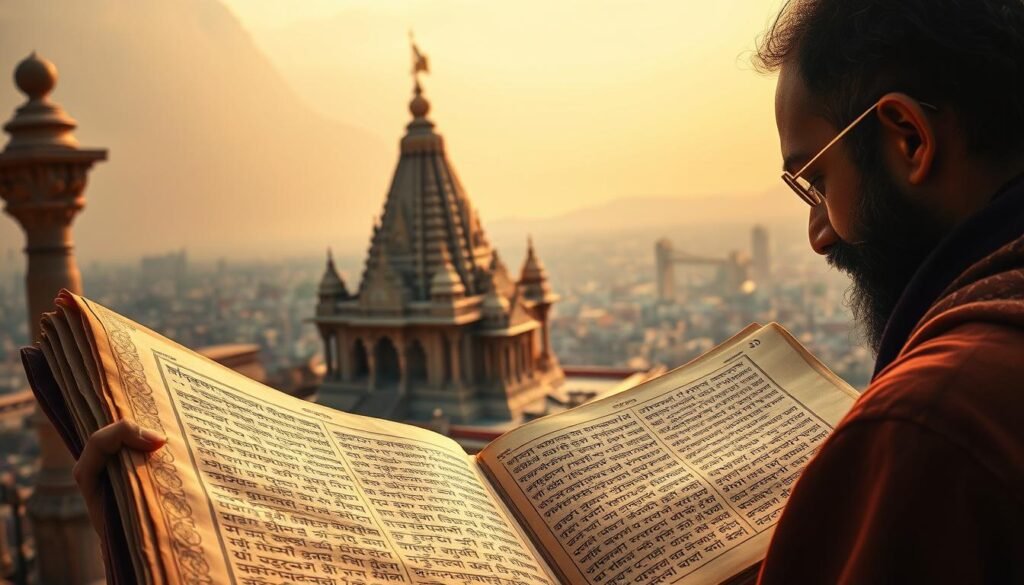
Sanskrit is making a comeback in education, rituals, and research. A mix of old and new methods is being used. This includes new curricula, clear terms, and community teaching. These efforts make Sanskrit relevant in schools and universities.
Since the 18th century, schools and scholars have worked to keep Sanskrit alive. Universities offer degrees and colleges make new glossaries for science and tech. Scholarships and foundations fund research and teacher training.
Grassroots groups run evening classes and summer camps. They teach spoken Sanskrit. This keeps the language alive in focused settings.
Sanskrit-speaking Communities Today
While there are few native speakers, Sanskrit is still used in certain places. Rituals, temple towns, and ashrams are where you’ll find it. Schools and cultural centers also promote speaking it.
Technology in Preservation
Technology has changed how we learn Sanskrit. Digital libraries and databases make texts easily accessible. Mobile apps teach pronunciation and Ayurvedic terms.
AI tools help standardize terms for modern Sanskrit. Cloud platforms allow students to study together from anywhere. This mix of efforts keeps Sanskrit alive and accessible.
Prominent Sanskrit Texts

We look at key works that shaped ancient India’s knowledge. These include epic stories, poetic dramas, grammar guides, and medical texts. They cover ritual, philosophy, and science, making them crucial for studying Sanskrit texts.
Overview of Major Literary Works
The Mahabharata and Ramayana are huge stories. The Mahabharata explores duty and law, while Ramayana shows Rama’s path. Vedic hymns and Upanishads offer deep philosophy.
Classical poets like Kālidāsa set beauty standards with their poetry and plays. In science, texts like Charaka Samhita and Sushruta Samhita guide Ayurveda’s medicine and surgery.
Contributions of Notable Authors
Pāṇini created a grammar that still helps us understand language. Kālidāsa improved writing and drama with Shakuntala and Meghaduta. His work is still admired today.
Charaka and Sushruta wrote about medicine. Charaka Samhita focuses on internal medicine, while Sushruta Samhita deals with surgery. Vagbhata’s Ashtanga Hridaya combined old medical ideas for doctors.
Translations and Interpretations
Modern translations and notes make ancient texts easy to read. Bilingual books keep the original Sanskrit next to translations. This helps us understand technical terms.
Experts use old texts and digital tools to improve translations. This way, Sanskrit works stay relevant for students, doctors, and researchers.
The Linguistic Influence of Sanskrit
We look at how Sanskrit shaped languages across the subcontinent and beyond. This brief overview covers the core roots of language, its impact on Indian tongues, and key borrowings in English and other languages.
Sanskrit was a treasure trove of words for courts, scholars, and poets. It shaped the vocabulary of Hindi, Bengali, Marathi, Tamil, Telugu, and Kannada. This historical influence changed grammar and formal speech, adding loanwords and calquing to Indian languages.
Prakrit and regional languages interacted with Sanskrit over centuries. These interactions left marks in sound and sentence structure. Sanskrit is a key tool for studying Indo-European languages because it shows deep roots of language.
In Asia, Hindu and Buddhist traditions spread Sanskrit script, religious terms, and scholarly phrases. This spread shows the global reach of an ancient language. Religious and technical terms traveled with missionaries, pilgrims, and traders.
Many English words come from Sanskrit. Terms like guru, karma, yoga, avatar, and mantra are known worldwide. These words entered English through colonial ties, translations, and the rise of yoga and Ayurveda.
Here’s a quick comparison of Sanskrit’s influence, typical loanwords, and their effects on languages.
| Region | Channels of Influence | Typical Loanwords | Primary Linguistic Effect |
|---|---|---|---|
| North India | Court literature, education, religious texts | Vidya, dharma, shastra | Formal register enrichment; morphology adoption |
| South India | Religious exchange, Sanskrit schools, inscriptions | Agama, sthala, grantha | Lexical layering in Dravidian vocabularies; technical terms |
| Southeast & East Asia | Buddhist and Hindu transmission, scripts | Deva, bodhi, stupa | Religious terminology; script adaptations |
| Global English | Colonial contact, translations, wellness culture | Yoga, karma, guru | Cultural vocabulary adoption; semantic shifts |
Educational Initiatives for Sanskrit Studies
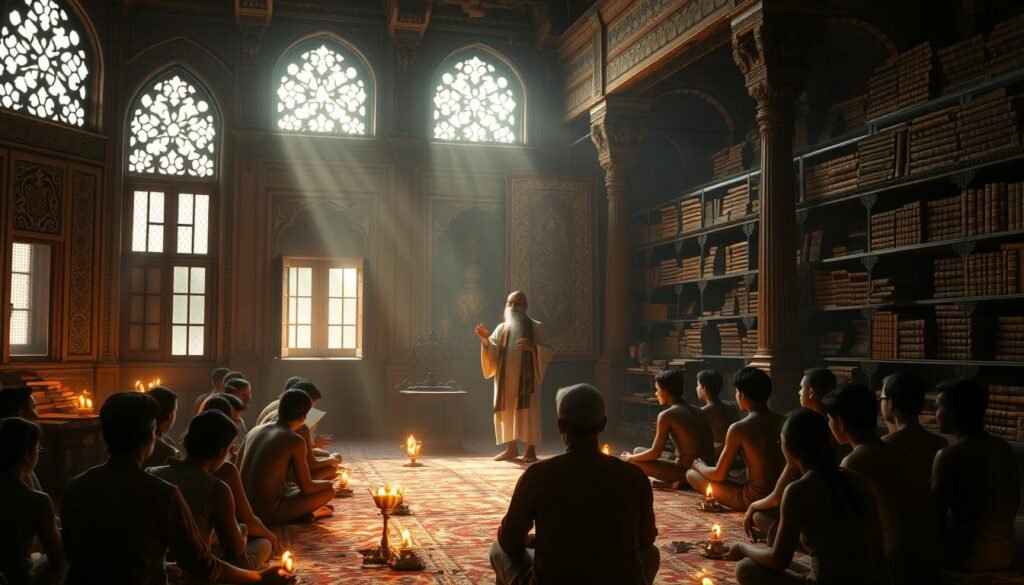
We look at how traditional and modern methods teach Sanskrit in India and worldwide. Gurukula and school classes work together. This mix keeps Sanskrit alive and meets today’s learning needs.
Sanskrit Curriculum in Indian Schools
Secondary schools in India offer Sanskrit as an elective. Textbooks include terms for Ayurveda and Vedic studies. Language labs and practice help with pronunciation and grammar.
Curriculum committees aim for practical skills. Students learn to read classical texts, understand grammar, and apply Sanskrit to cultural studies. This makes Sanskrit relevant for those interested in literature and heritage.
University Programs in Sanskrit
Universities like Sampurnanand Sanskrit University and Benares Hindu University have long-standing Sanskrit programs. They offer degrees from bachelor’s to doctoral research with government grants.
Interdisciplinary courses combine Sanskrit with linguistics, philosophy, and computational studies. These programs prepare students for careers in academia, museums, and cultural institutions.
Online Courses and Resources
Digital platforms offer flexible study options. MOOCs, mobile apps, and cloud libraries provide lessons and archives. There are certification paths for professionals and academics.
AI tools help with translation and pronunciation. Online Sanskrit courses make learning accessible worldwide while connecting learners to Indian heritage.
- Sanskrit curriculum: school syllabi with Vedic and practical modules.
- University Sanskrit programs: degrees from undergraduate to PhD with research support.
- Online Sanskrit courses: flexible, certified, and tech-enabled learning paths.
The Spiritual Dimension of Sanskrit

Sanskrit is more than just a language; it’s a bridge to rituals, meditation, and practices in India and worldwide. It carries a tradition of sound, meter, and precision. This supports the oral sharing of deep philosophical thoughts.
Connection to Indian spiritual practices
Sanskrit is found in Vedic hymns, Upanishadic passages, and temple shlokas. It has helped preserve texts for centuries. Priests, monks, and scholars use it to keep rituals alive.
It’s at the center of ceremonies from Varanasi puja to Tibetan Buddhist recitation.
The role of mantras and chants
Mantras, like the Gayatri Mantra, are key in contemplative practices. They are believed to have vibrational effects. Chants help with breath control, focus, and group unity.
Importance in Yoga and meditation
Yoga teachers and students use Sanskrit terms for asanas and pranayama. This helps keep the practice true to ancient texts like Patanjali’s Yoga Sutras. It connects words to actions, making the spiritual aspect real in classes and personal practice.
We suggest seeing Sanskrit as a tool for engineers and educators. It connects rituals, wellness, and academic study. Its use in chants, mantras, and Yoga vocabulary keeps ancient wisdom alive today.
Challenges Faced by Sanskrit Language

We face many challenges today that affect Sanskrit. These issues include social trends and gaps in institutions. Understanding these helps us find ways to preserve and modernize Sanskrit.
Decline in Common Usage
Sanskrit is no longer a native language for many. People often list Sanskrit as their mother tongue for cultural reasons, not daily use. This decline makes it harder to pass the language down through generations.
Modernization vs. Preservation Debates
There’s a big debate about Sanskrit. Some want to keep it traditional, while others push for modern changes. Scholars argue over adding new words for science and technology, fearing it might lose its cultural richness.
Solutions and Future Perspectives
We can improve Sanskrit by updating school curricula and offering grants. Creating glossaries for fields like Ayurveda and law helps. This way, Sanskrit stays true to its roots while adapting to today’s needs.
Technology is key in saving and advancing Sanskrit. Digital archives, AI, and apps make learning easier. They also help in using Sanskrit in fields like Ayurveda and law.
Community efforts, funded research, and clear goals are crucial. They help Sanskrit stay relevant and balanced between old and new. This ensures Sanskrit’s future is bright.
Conclusion: The Enduring Legacy of Sanskrit
Sanskrit’s journey from ancient Vedic hymns to a refined language is amazing. It shows great precision and depth. Its grammar and sounds are key in fields like Ayurveda, math, and philosophy.
This makes Sanskrit a vital part of Indian culture and a tool for sharing knowledge deeply.
Today, Sanskrit is kept alive by institutions, laws, and scholars. Though not many speak it natively, its impact is wide. It touches South and Southeast Asia and enriches Indo-European studies.
This ensures Sanskrit’s role in global culture and learning.
For Sanskrit’s future, we need to mix old with new. We suggest adding Sanskrit to school programs. Using AI and digital libraries can help.
Linking Sanskrit to fields like engineering and medicine is also key. For help or to learn more, email info@indiavibes.today. Let’s make Sanskrit a key part of education today.