



On-screen digital evaluation for board exams is rapidly reshaping India’s examination system, with CBSE leading the transition from traditional manual checking to technology-driven assessment. This reform aims to enhance transparency, eliminate totalling errors, speed up results, and improve accountability in the board exam process.
As lakhs of students appear for board exams every year, the move toward on-screen digital evaluation for board exams reflects a broader digital transformation in India’s education governance. In India, this trend has taken a giant leap with the Central Board of Secondary Education (CBSE) leading the transition from traditional manual evaluation of board examination answer sheets to a digital on-screen evaluation system — often referred to as On-Screen Marking (OSM). This reform, introduced for Class 12 board exams from 2026, is not just a technological upgrade but a paradigm shift in how large-scale examinations are evaluated in the country. https://www.cbse.gov.in
On-screen evaluation aims to address long-standing challenges in the manual evaluation process, including totalling errors, delays in result declaration, limited evaluator availability, and lack of clear audit trails. As this article explores, not just CBSE but several state boards are considering similar digital implementation to improve examination integrity and efficiency.
Background: Traditional Evaluation Practices
For decades, the evaluation of board examinations in India has followed a manual process:
- Students write answers on physical answer sheets.
- Sheets are transported to centralised evaluation centres.
- Teachers physically mark answers using pens and stamps.
- Marks are manually totalled.
- Results are compiled, vetted, and declared after all answer books are checked.
While this method has worked reasonably well, it has several limitations — travelling logistics, delayed results, human totalling mistakes, mismatches in evaluation standards across regions, and potential bias.
The demand for improved transparency and faster results, especially given the rising number of candidates, prompted educational authorities to rethink this model. https://www.education.gov.in
Digital Evolution: What Is On-Screen Evaluation?
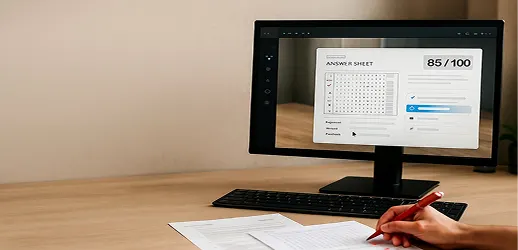
On-Screen Marking (OSM) is a technology-enabled system in which answer sheets are digitally scanned and uploaded to a secure platform, where evaluators score responses on a computer screen instead of with pen and paper.
Key steps in the OSM process:
- Scanning:
After exams conclude, physical answer books are scanned into high-resolution digital images. - Upload & Anonymisation:
Each script is assigned a unique digital identity, masking candidate details to reduce bias during assessment. - Distribution & Assignment:
The digital platform assigns answer scripts to evaluators based on subject and workload. - Evaluation:
Examiners log in to the OSM portal and mark answers digitally using annotation tools, upload comments, and input marks. - Automated Totalling:
The system automatically totals marks, reducing human calculation errors. - Progress Monitoring:
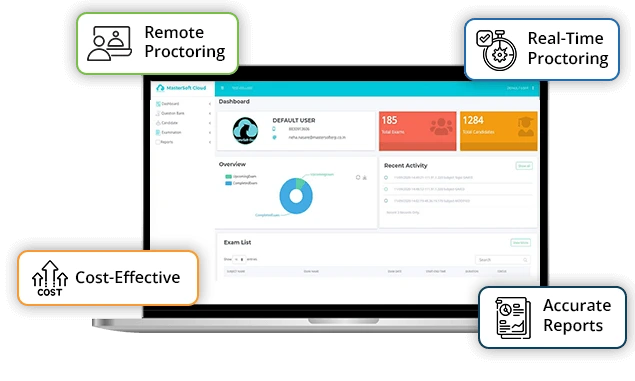
Real-time dashboards track evaluation progress across regions, ensuring timely completion.
Why Move to Digital Evaluation?
The move to digital marking is driven by several core objectives:
1. Accuracy and Transparency
Automated totalling and digitally tracked marking reduce the possibility of human calculation errors and missing markings. Every evaluator’s actions are recorded, making it easier to audit discrepancies — a major improvement in transparency.
2. Faster Evaluation and Result Declaration
Since answer scripts can be evaluated from anywhere with connectivity, reliance on centralised physical evaluation centres diminishes. This accelerates the overall evaluation timeline.
3. Greater Participation from Teachers
Digital evaluation allows a larger pool of qualified teachers to participate without needing travel or prolonged stays at evaluation centres.
4. Cost and Time Savings
Expenses related to transporting bundles of answer sheets, organising evaluation venues, and coordination are significantly lowered.
5. Reduced Errors and Enhanced Consistency
Digital systems automatically flag unusual marking trends, offer embedded marking schemes, and ensure evaluations adhere to predefined rubrics – enhancing fairness.
Teacher Training and Adoption Challenges
Transitioning such a massive evaluation system — affecting tens of millions of answer sheets — is not without challenges.
Some concerns cited by educators include:
- Training Gaps: Many teachers reported limited time for training and familiarisation with the OSM platform.
- Infrastructure Issues: Reliable computers, internet access, and power backup remain challenges, especially in rural areas.
- Screen Fatigue: Teachers evaluating digitally for long hours have pointed to eye strain and setup discomfort.
Despite these concerns, boards are implementing mock drills and support sessions to ensure smooth adoption.
CBSE’s Official Rollout and Key Updates
Starting from the 2026 exam cycle, the CBSE has introduced on-screen marking for Class 12 board exams.
Important points to note:
- The digital evaluation is initially implemented for Class 12 only — Class 10 continues with manual evaluation for 2026.
- Post-result mark verification for Class 12 has been discontinued, as the system’s accuracy is expected to make re-checks unnecessary.
- Training webinars, mock drills, and dashboard tracking systems are being used to prepare evaluators.
- CBSE anticipates wider expansion and possibly future integration of AI tools for enhanced analytics (still under discussion but not yet official).
Impact on Students and Parents
Positive Outcomes
- Faster Results: Students can receive their scores quicker than traditional timelines.
- Reduced Errors: Lower chances of totalling mistakes and missing sections.
- Greater Confidence: Transparent marking increases trust in result outcomes.
Concerns
- Some fear digitisation may overlook the nuances of handwriting interpretation, especially for non-English-medium responses.
Overall, the shift promises a more efficient and more student-friendly examination assessment process.
State Boards Following the Trend
Following CBSE’s landmark reform, several state boards are exploring similar digital evaluation systems.
For example, the Maharashtra State Board is considering an AI-augmented digital evaluation model for SSC and HSC examinations, inspired by CBSE’s OSM rollout.
This suggests a broader national trend toward digital transformation in exams, potentially shaping future board policies countrywide.
The Future: AI and Beyond
While the current implementation focuses on digitisation and automation of marking, discussions are underway at various policy levels about using artificial intelligence (AI) for advanced evaluation support—such as error flagging, standard deviation checks, and pattern analysis.http://CBSE Board Exam Updates
However, at present — including in CBSE’s OSM — AI does not autonomously evaluate answers; human evaluators still score scripts digitally.
Conclusion
The transition of CBSE and other Indian boards toward on-screen digital evaluation is a watershed moment in examination reform. It promises:
- Better accuracy
- Improved transparency
- Faster result turnaround
- Reduced administrative burden
This reform aligns with broader digital transformation goals for the Indian education system and sets a model for other boards and educational bodies across the country.