



In 1975, Aryabhata, India’s first satellite, was launched into space. It changed our view of what’s possible. This small satellite was the beginning of a journey from simple launches to complex missions.
Today, India’s space story is one of steady growth. Each mission teaches us something new. Every success helps us reach for the next goal.
At the center of this journey is ISRO, the Indian Space Research Organization. Their team has achieved great things in space. They’ve worked on Earth observation, communication, and even space exploration.
ISRO has launched 131 spacecraft missions and 101 launch missions. They show us that with hard work and smart planning, big dreams can come true.
We’ll look at key missions that changed the game for India. These include Aryabhata, ASTROSAT, Aditya-L1, the Mars Orbiter Mission, and the Chandrayaan series. We’ll also talk about upcoming projects like Gaganyaan and Chandrayaan-4.
Our goal at India Vibes is to inspire through education and innovation. For more information or to get involved, email us at info@indiavibes.today.
The Beginnings of ISRO
The Indian Space Research Organization started with rocket tests at Thumba in the early 1960s. These tests showed the importance of science for the good of society. This idea helped shape the Indian space agency’s goals and paved the way for bigger missions.
The Department of Space set a clear goal for ISRO. It wanted to use space technology for the country’s growth, explore space, and help private companies. This goal helped choose projects like NavIC navigation and Gaganyaan human spaceflight.
ISRO built a strong base for designing, testing, and running space missions. Key places include the Satish Dhawan Space Centre for launches and the Vikram Sarabhai Space Centre for designing spacecraft. There’s also the Liquid Propulsion Systems Centre for engines and the Indian Deep Space Network for tracking.
Vision and Mission of ISRO
ISRO aims to help the nation and expand scientific knowledge. It focuses on using space for practical purposes and making technology affordable. This approach has made space technology useful for farming, disaster relief, and communication.
Key Pioneers in Indian Space Exploration
Vikram Sarabhai started the space program with a focus on national needs and scientific dreams. Satish Dhawan led the growth and practical engineering during important years. Their work and that of others made them key figures in India’s space journey.
Early projects like the Aryabhata and Rohini satellites showed India’s engineering skills. These successes helped create paths for engineers and students. Today, we see this legacy in universities, research labs, and the private sector supporting ISRO.
Milestones in Satellite Development
We explore key moments in India’s Space Program. From the first orbit to a navigation network, each launch shows progress. These examples highlight technical growth, service impact, and mission variety.
Aryabhata was a turning point. Launched in April 1975, it carried X-ray experiments. It showed India could design scientific payloads. This success inspired a new generation of engineers.
The INSAT series was key for national communications and broadcasting. Early INSAT satellites helped with TV and weather. Later, GSAT satellites brought broadband and disaster warnings. The INSAT series is vital for domestic connectivity.
Earth observation satellites like IRS and Cartosat provide detailed images. These images help with land use, crop monitoring, and emergency response. They support many civil applications that help national development.
Navigation systems like IRNSS, or NavIC, moved from concept to service. The NavIC constellation offers precise positioning and timing for India and nearby waters. Recent updates have improved accuracy and resilience.
Scientific and multi-disciplinary payloads have expanded mission scopes. ASTROSAT opened up multi-wavelength astronomy for Indian researchers. Aditya-L1 focuses on solar physics, providing data on space weather. These missions show the mix of applied services and pure science in Indian satellite development.
We list notable impacts in brief:
- Telecom and broadcasting enabled by INSAT series and GSAT platforms.
- Precision agriculture and disaster management using IRS and Cartosat imagery.
- Regional navigation services from IRNSS/NavIC improving timing and positioning.
- Research advances through ASTROSAT and other scientific satellites.
The cumulative effect is a robust ecosystem. This includes a growing industrial base, a trained workforce, and demand for more sophisticated missions. These elements keep India’s Space Program advancing from demonstration flights to operational constellations and commercial services.
Notable Launch Vehicles and Technologies
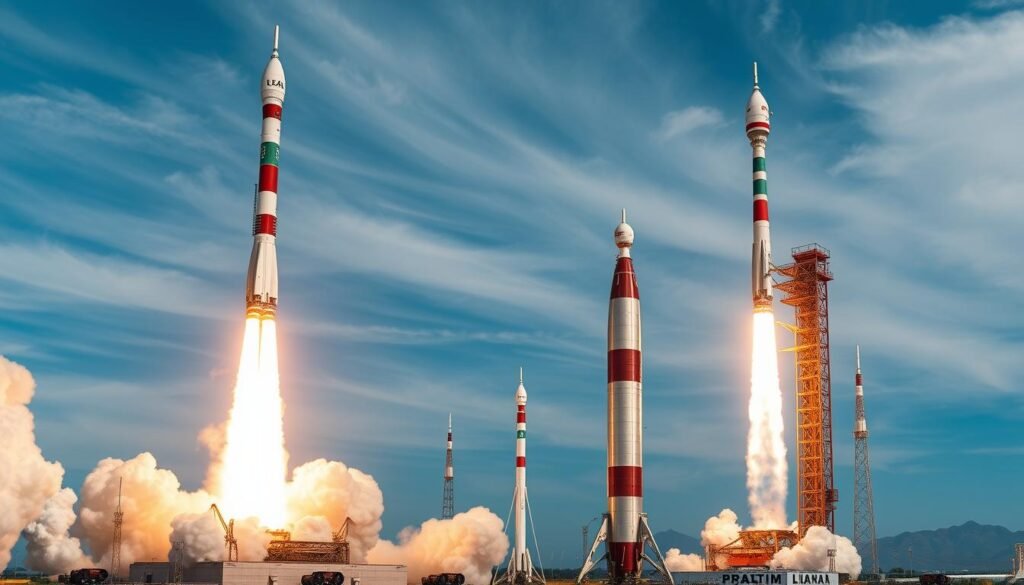
We look at the engines, pads, and designs that make Indian launch vehicles stand out. We focus on reliable workhorses, heavy-lift evolution, and low-cost options. We also explore the propulsion advancements that shape mission choices in India’s space technology.
PSLV is known for its versatility and on-time delivery. It carries Earth-observation satellites, scientific payloads like ASTROSAT, and small satellites from around the world. For low and sun-synchronous orbits, PSLV is the cost-effective choice for many Indian satellite launches.
GSLV brought cryogenic upper-stage technology to India. This allowed for heavier payloads to reach geostationary and interplanetary orbits. The modern version, LVM3, has enabled missions like Chandrayaan and high-mass communications satellites. These advancements have opened up new possibilities for lunar and GTO missions.
SSLV aims to provide fast and affordable access to space for small satellites. It’s designed for quick turnaround and easy integration. SSLV shows how Indian launch vehicles are diversifying to meet different orbital needs.
Choosing the right propulsion is key: Vikas engines provide proven thrust for core stages, while CE-20 and CE-7.5 cryogenic engines offer higher specific impulse for upper stages. Work on SCE-200 and reusable demos like the RLV aims to lower costs and increase mission tempo.
Ground infrastructure is also important: Satish Dhawan Space Centre is our main launch site, with Kulasekharapatnam planned to increase flexibility. Expanding pads and facilities will help scale up satellite launches and improve schedule resilience.
Engine families and vehicle classes match mission needs. PSLV is best for medium-payload, sun-synchronous tasks. LVM3/GSLV handles heavier GEO and crewed test flights. SSLV is for quick small-satellite launches. Understanding these roles shows why vehicle evolution is critical for scientific and commercial goals.
We summarize engineering trade-offs in three points:
- Propulsion: cryogenic stages increase payload mass; hypergolic stages simplify restart and handling.
- Cost: small launchers are cheaper for microsat constellations; heavy-lift vehicles are cheaper for large payloads.
- Reusability: RLV research aims for rapid turnaround and lifecycle savings, changing mission economics.
Operational growth is clear. ISRO has completed over 100 missions, showing steady growth in Indian launch vehicles. This record boosts confidence in future mission diversity and cadence.
| Vehicle | Primary Role | Key Engines | Notable Missions |
|---|---|---|---|
| PSLV | Sun-synchronous / multi-payload | PSLV solid stages, Vikas (strap-on) | ASTROSAT, many commercial rideshare missions |
| GSLV / LVM3 | GTO, lunar, crewed test flights | Vikas, CE-20 cryogenic | Chandrayaan-2, Chandrayaan-3, Gaganyaan tests |
| SSLV | Small-satellite rapid deployment | Solid stages with simplified avionics | Parikshit-class demonstration and commercial launches |
| RLV (demo) | Reusable tech demonstrator | Air-breathing and rocket propulsion tests planned | Atmospheric re-entry trials and glide tests |
| SCE-200 (in development) | Higher-thrust cryogenic core engine | Large kerolox/LOX cryogenic architecture | Planned for next-generation heavy-lift vehicles |
International Collaborations and Partnerships
Space missions by India have grown from national efforts to global teamwork. ISRO works with space agencies, universities, and companies worldwide. This teamwork boosts technology sharing, data exchange, and launch service markets.
The NASA-ISRO collaboration on NISAR is a big example. It uses advanced radar to measure Earth’s surface changes. This mission brings together engineering, technology, and planning, helping scientists everywhere.
Working with NASA and Other Space Agencies
We team up with NASA, ESA, JAXA, and more on projects. Our Mars Orbiter Mission and Chandrayaan have opened doors for joint research. These partnerships help us achieve scientific goals and share data globally.
ISRO also works with private companies through NSIL and IN-SPACe. This allows for international contracts and launches. Our reliable launch services, like PSLV and LVM3, attract customers worldwide.
The Global Impact of Indian Launched Satellites
Indian satellites help in disaster response, agriculture, and climate studies. They provide data for real-time flood mapping and crop monitoring. This data also supports long-term environmental studies.
Projects like the India-EU Space Dialogue and the BRICS Space Exploration Consortium expand global cooperation. India’s role in the Artemis Accords and other initiatives shows our commitment to international space solutions. For more on this, see here.
| Area | Type of Collaboration | Key Benefit |
|---|---|---|
| Earth Observation | NASA-ISRO (NISAR), ESA data sharing | Improved monitoring of earthquakes, glaciers, deforestation |
| Launch Services | Commercial contracts via NSIL | Cost-effective access to orbit for international payloads |
| Scientific Missions | Joint instruments with JAXA, ESA | Enhanced science return and shared expertise |
| Capacity Building | ITEC training, SIDS partnerships | Skill development and regional satellite programs |
| Policy & Commerce | IN-SPACe, bilateral agreements | Streamlined approvals and private sector growth |
Mars Orbiter Mission: A Historic Achievement
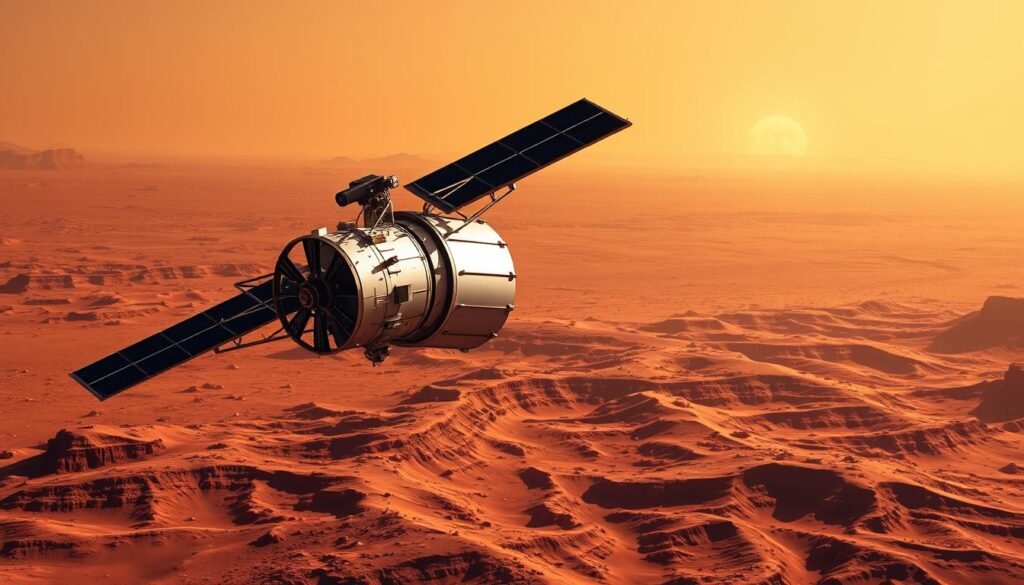
The Mars Orbiter Mission marked a significant milestone for India’s Space Program. It was launched on November 5, 2013, and entered Martian orbit on September 24, 2014. This mission showed that with careful planning and budgeting, space missions can be achieved at a lower cost.
The mission proved the value of smart planning and efficient design. It used a cost-effective approach, focusing on a small, strong spacecraft and precise navigation. This approach helped balance risks, performance, and costs for deep-space missions.
Key Objectives and Successes
The main goal was to show India’s capability in space exploration. The mission aimed to image Mars, map minerals, and study the atmosphere. The Mars Color Camera provided valuable data on the planet’s surface.
India became the first Asian nation to orbit Mars on its first try. The mission operated smoothly until October 2, 2022, providing ongoing data for scientists.
Global Recognition and Impact on Science
Mangalyaan’s impact went beyond just images. It made important atmospheric measurements and provided data for global research. This sparked international cooperation and inspired new space missions.
The mission boosted ISRO’s reputation worldwide. It inspired new space projects and taught valuable lessons in engineering and mission planning. These lessons are now part of educational programs and professional training.
| Aspect | Detail |
|---|---|
| Launch and Arrival | Launched 5 Nov 2013; Mars orbit insertion 24 Sep 2014 |
| Main Goals | Demonstrate interplanetary mission capability; conduct imaging and atmospheric studies |
| Key Instruments | Mars Color Camera, methane detection experiments, other payloads for mineralogy and atmosphere |
| Technical Approach | Cost‑efficient design, small spacecraft, efficient Earth‑escape via elliptical orbits |
| Operational Legacy | Nominal operations through 2 Oct 2022; datasets used in international research |
| Broader Impact | Boosted India’s Space Program reputation; model for low‑cost interplanetary mission planning |
| Future Influence | Informed Mangalyaan 2 planning; lessons for technology reuse and international collaboration |
The Future of Lunar Exploration
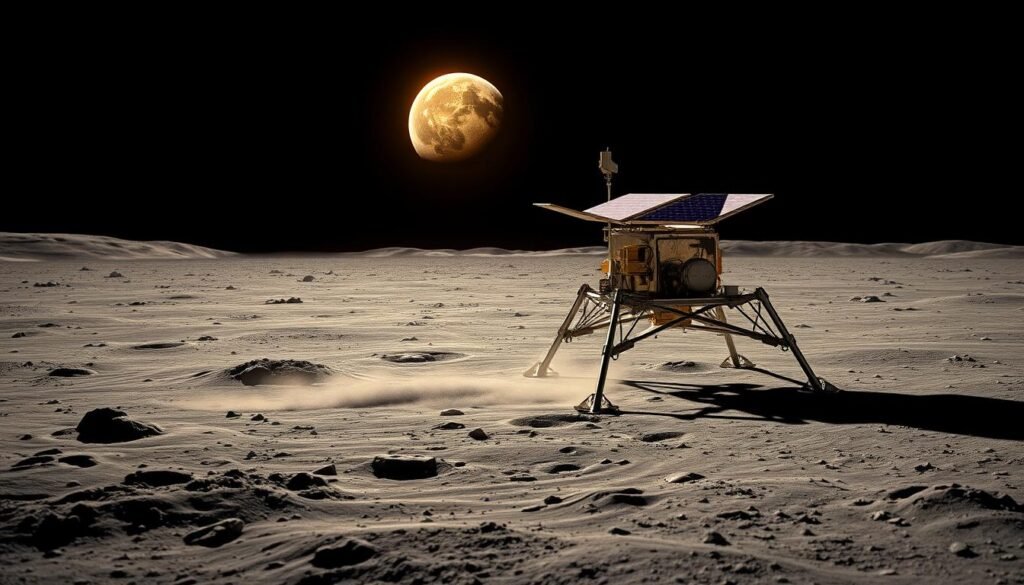
India’s Space Program is growing fast. First, orbiters showed us what’s possible. Then, landers perfected soft landings. Now, we’re working on missions to bring back lunar samples.
Let’s look at the progress so far. Chandrayaan-1 found water in 2008. Chandrayaan-2’s orbiter is doing science even after a rough landing in 2019. And Chandrayaan-3 successfully landed in 2023, proving the rover works.
Next up, Chandrayaan-4 aims to return samples by 2027. It will have a complex setup. The Lunar Polar Exploration Mission, planned with JAXA for 2028-29, will explore the moon’s south pole.
Our goals are clear: find water and volatile compounds, improve maps, and test new technologies. Each mission helps us get ready for more complex missions, including those with humans.
Building skills is key. Students and engineers are learning about robotics, landing, and handling samples. Working with other countries also helps us share knowledge and instruments.
Here’s a quick look at recent and upcoming lunar missions:
| Mission | Primary Objective | Key Technologies | Target Timeline |
|---|---|---|---|
| Chandrayaan-1 | Orbital mapping; detection of water/hydroxyl | Orbiter payload suites; impactor experiment | 2008 |
| Chandrayaan-2 | Orbiter science; attempt at soft landing | High-resolution remote sensing; lander/rover design | 2019 |
| Chandrayaan-3 | Demonstrate soft landing and roving | Precision GNC, propulsion, rover mobility | Launched 14 July 2023; landed 23 August 2023 |
| Chandrayaan-4 | Sample-return to Earth | Ascent module, reentry capsule, sample curation | Target ~2027 |
| Lunar Polar Exploration Mission | South polar in-situ science and volatile study | Polar landing tech, international payloads, long-duration power | Target ~2028–29 |
Our progress is strategic. We’ve moved from orbiters to landers to sample return. This ladder is key for India’s Space Program goals.
We’re calling on the next generation to join us. There are research projects, internships, and mission engineering roles. Each mission opens new doors for lunar exploration in India.
Advancements in Space Science Research
Recent missions have greatly expanded our scientific knowledge. They include instruments for studying the Sun, telescopes for X-rays, and radar for Earth mapping. These advancements help in research, training, and services for society.
Our work combines astrophysics, Earth observations, and meteorology. This creates a unified research ecosystem.
Astrophysics and Earth Science Contributions
ASTROSAT marked a new era in astronomy. It observes visible light, ultraviolet, and X-rays simultaneously. This allows for the first time to study cosmic sources together.
XPoSat brings a new capability: X-ray polarization. It helps understand neutron stars and black holes better. With ASTROSAT, XPoSat boosts India’s role in global astrophysics.
Aditya-L1 studies the Sun from the L1 point. It monitors the corona, chromosphere, and solar wind. Its data improve models of solar activity and space weather impacts.
These missions support training and research through the Indian Deep Space Network and ISRO Science Data Centers. ARIES and university partnerships help students and researchers use the data. This leads to better instrumentation skills and expanded research across India.
Contributions to Weather Forecasting
Weather forecasting satellites are key for public safety and planning. INSAT and GSAT systems provide images for cyclone tracking and monsoon analysis. These images are vital for forecasts and warnings.
NISAR will add high-resolution radar data for land deformation, glaciers, and coastal changes. Its data will complement optical and microwave datasets. This will improve hazard assessments for earthquakes, landslides, and sea-level changes.
These Earth-observing assets strengthen Earth science in India. They support national services for agriculture, disaster response, and water management. Advanced sensors lead to better forecasts and more resilient communities.
ASTROSAT, XPoSat, Aditya-L1, and NISAR show how Space technology in India leads to useful science. They expand datasets, improve training, and support operational systems for weather forecasting.
The Growth of Private Sector in Space
The Indian space scene is changing fast. Private companies are now key players, not just suppliers. They’re working on launch vehicles, earth observation, and more. This growth brings new markets, talent, and ways to make money.
Companies like Skyroot Aerospace and Pixxel are leading in launchers and imaging. Startups like AgniKul Cosmos and Dhruva Space are improving supply chains. They aim to offer affordable, reliable services.
ISRO is now selling launch slots to international clients. NewSpace India Limited is handling international deals and tech transfers. This means more chances for smaller teams to reach space.
Key Players in India’s Private Space Industry
- Skyroot Aerospace: small-satellite launch vehicles and composite engines.
- Pixxel: high-resolution earth-imaging constellation and data services.
- AgniKul Cosmos: modular engines and orbital launch solutions.
- Dhruva Space: satellite buses and integration services.
- Bellatrix Aerospace: electric propulsion and avionics components.
- Satellize: rideshare and mission management services.
Public agencies are changing the game. IN-SPACe and NewSpace India Limited are helping private companies. They offer access to facilities and tech.
Government Support and Regulations
- Policy frameworks now offer clearer licensing and procurement pathways.
- Public–private partnerships accelerate hardware maturation and testing.
- Incubators and defence procurement create demand for qualified suppliers.
Industry pros need to scale up, attract funding, and meet quality standards. Working with ISRO and others can speed up development and improve quality.
The growth of the private space sector in India is good for jobs, exports, and innovation. It opens up more opportunities for engineers and entrepreneurs to turn ideas into space products and services.
Challenges Facing India’s Space Ambitions
India’s space program is growing fast, but it faces many challenges. We need to balance scientific research with practical uses. Making smart choices today will help us in the future.
Money is a big problem. ISRO has done well with its budget, but new goals like sending people to space need more money. We also need to grow our team and invest in new technology.
We must work with schools and businesses to find more talent. We need experts in many areas, like engineering and space protection. Training centers will help, but we need more programs.
The global market is changing fast. Companies in the US and Europe, and countries like Russia and China, are competing with us. To keep up, we need to launch more often and use reusable technology.
We also need to improve our technology. This includes making bigger engines, reusable rockets, and systems for sending samples back to Earth. We need more money, partners, and tests to achieve this.
Building a strong industry and good rules are also key. We need a good supply chain, clear rules for ideas, and ways to control exports. Our space policy must support both national goals and business growth.
Keeping our missions safe is always important. We’ve learned from past problems and are making our systems better. This includes making sure our software works right and having backup systems.
We have to make choices every day. We need to fund important science missions and satellites for everyday use. Managing our projects well helps us achieve our goals.
| Challenge | Key Needs | Near-term Actions |
|---|---|---|
| Budget and Resources | Stable funding, R&D capital, workforce growth | Prioritize missions, public–private financing, phased procurement |
| Talent and Training | Specialized engineers, mission systems expertise | Expand university programs, industry apprenticeships, centers of excellence |
| International Competition | Higher cadence, cost competitiveness, reusability | Invest in reusable tech, streamline launch operations, export-ready services |
| Technological Gaps | Cryogenic heavy-lift, precision landing, human-rated systems | Accelerate testbeds, increase industry contracts, modular technology roadmaps |
| Regulation and Industry Scale | Supply chain maturity, IP frameworks, certification | Update space policy India, create clear export and quality standards |
| Risk and Mission Assurance | Software validation, redundancy, anomaly response | Strengthen V&V labs, independent reviews, continuous training |
What’s Next for ISRO?
India’s space program is at a critical juncture. Upcoming missions will balance routine operations with groundbreaking science. Gaganyaan test flights, NISAR radar with NASA, and Oceansat-3 are just the start.
These missions will enhance navigation, remote sensing, and communications. They also set the stage for even more ambitious scientific endeavors.
Flagship missions like Chandrayaan-4 and the Venus Orbiter Mission are on the horizon. Mangalyaan 2, set for 2031, will explore Mars with a lander, rover, and helicopter. The Bharatiya Antariksha Station is planned for 2028-2035, aiming for crew stays.
Technological advancements are key to these missions. The SCE-200 engine and reusable launch systems are being developed. These will cut costs and boost payload capacity, paving the way for complex missions.
Engineering professionals, students, and educators are invited to join the excitement. You can contribute to mission design, instrumentation, and data analysis. For collaboration inquiries, contact info@indiavibes.today. Together, we can make India a leader in space exploration.