



Union Health Minister J. P. Nadda says India will lead the pharma world. He wants to boost healthcare and medicines exports. This is a big step for India.
This goal is backed by programs like the Production Linked Incentive schemes. It shows India’s commitment to growing its pharma sector. Engineers, scientists, and educators need to work together to make this happen.
We will explore what this means for the pharma industry. We’ll talk about policy, investment, and skills needed. Our goal is to help India achieve its ambition for global leadership.
Overview of J. P. Nadda’s Announcement and Its Significance
We welcome J. P. Nadda’s announcement. It shows India’s plan to grow in making medicines, support biotech startups, and be better at exporting. This was said at big meetings and events.
The announcement came up during talks with other countries. Ministers and business leaders talked about making things and getting into markets. This shows India wants to lead in the world and tie healthcare to trade.
Right after, ministries and groups like the Indian Pharmaceutical Alliance said they support it. They talked about working together and making things happen faster. They see it as good for the pharma world.
This is important because it helps India not rely so much on other countries for medicines. It makes things better for patients and helps other countries too. This is because more medicines are made and researched in India.
For us, it means more jobs and learning opportunities. People studying and working in the pharma field will have more chances. Schools and training programs will need to change to keep up with the industry’s needs.
Current State of the Indian Pharma Industry and Market Trends
We look at the pharma industry size and its changes. The Indian market is one of the largest by volume. It grows steadily because of aging populations and more chronic diseases.
This growth helps a wide range of products. These include generics, over-the-counter items, active ingredients, and biologics.
Size and growth rates: Demand at home and more insurance coverage help it grow. Health access gaps in cities and villages lead to quick growth in essential medicines. Making medicines here is cheaper, helping exports.
Key market segments: Generic medicines are key to the industry’s income. But, OTC and specialty drugs grow faster. More money is going into making biologics.
Export performance: India is a big supplier of generic medicines and APIs worldwide. It exports a lot to the US, EU, Africa, and Latin America. This is because of good prices and more approvals from places like the US FDA and EMA.
Global market share: India has a big share of the global generic market. It’s also making more money from biologics and specialty drugs. This is because companies are getting better at meeting global standards.
Trends in generics and biosimilars: Generic medicines are in demand because of patent expiries. Biosimilars, cheaper versions of biologics, are also growing. Companies like Biocon and Dr. Reddy’s are investing in biosimilars.
Specialty drugs: Drugs for cancer, immune system issues, and targeted treatments are growing fast. These need advanced manufacturing and quality control. Working with universities and meeting global standards are key to making more of these medicines.
For those in India’s healthcare, the future looks bright. The mix of scale, export reach, and biosimilar growth is promising. Improving skills in clinical, engineering, and regulation will help move from making lots of medicines to making more valuable ones.
Policy Measures and Government Initiatives Driving Growth
We look at how government actions help India’s pharma sector grow. These actions open up new chances for engineers, researchers, and makers. The goal is to move supply chains to India and make the pharma industry more competitive worldwide.
Recent regulatory updates and streamlined approvals
New rules make getting licenses easier and enforce quality better. The PLI scheme for pharma and bulk drugs helps companies grow. These steps help firms ready for exports.
Financial incentives for manufacturing and R&D
There are special funds for making active ingredients, domestic intermediates, and research. Tax breaks, capital help, and export boosts encourage growth. The PLI scheme and extra grants make upgrading facilities cheaper.
Public-private partnerships and infrastructure investments
Partnerships fund pharma parks, waste treatment, and biotech clusters. These shared spaces help startups and follow environmental rules. Working with schools speeds up research and training.
Engineering teams will work on GMP-compliant plants and advanced waste systems. These investments are key for India’s pharma growth and global integration.
Role of Regulatory Reforms in Strengthening Global Competitiveness
Regulatory reforms are key to India’s rise in the global medicine market. They make rules clear and processes quick. This helps everyone work together for better quality and wider markets.

Efforts to align with international regulatory standards
We’re making our rules match those of the US FDA and EMA. The Central Drugs Standard Control Organization (CDSCO) has updated its guidelines. This makes Indian medicines more trusted worldwide.
Speeding approvals while ensuring safety and quality
We’re making it faster to get clinical trial approvals and register products. But we’re not sacrificing safety. This approach keeps patients safe while making products consistent.
Impact on exports and multinational collaborations
Being in line with global standards opens more doors for exports. Big pharmaceutical companies see India as a reliable partner. This growth helps India lead in the global medicine market.
There’s a growing need for experts in validation, quality systems, and regulatory affairs. Training in global standards and CDSCO processes is key. It prepares teams to build compliant, export-ready plants.
Investment Landscape: Financing India’s Pharma Ambitions
We follow the money that will shape India’s Pharma Growth for the next 10 years. More money from companies, deals across borders, and funding for startups are coming. They will help grow, innovate, and open new markets.
Domestic investment trends and corporate spending
Big Indian companies like Dr. Reddy’s Laboratories, Sun Pharma, and Cipla are growing. They are building new plants and R&D centers. This is to make more specialty medicines and biologics.
We tell engineering teams to write down their plans and diagrams. This is for getting money from inside the company or partners.
Foreign direct investment and strategic partnerships
Money from big pharma companies is coming into India. This brings new technology and ways to reach more markets. Deals with Pfizer and Novartis help grow supply chains.
Investors want to see good quality control and follow rules. This is to make sure big investments are worth it.
Venture capital and funding for biotech startups
Venture capital is helping biotech startups in India. They are working on new medicines, cell and gene therapies, and digital health. Funds and corporate VCs are backing early-stage biotechs with strong plans.
Founders from universities should have clear data and working examples. This will attract venture capital and partners.
Innovation and Research: Building a Biotech and R&D Hub
India is changing the pharma world by growing its research. More money is going into biotech R&D in schools and private labs. This helps India grow in the pharma field and makes it a key player in drug making.
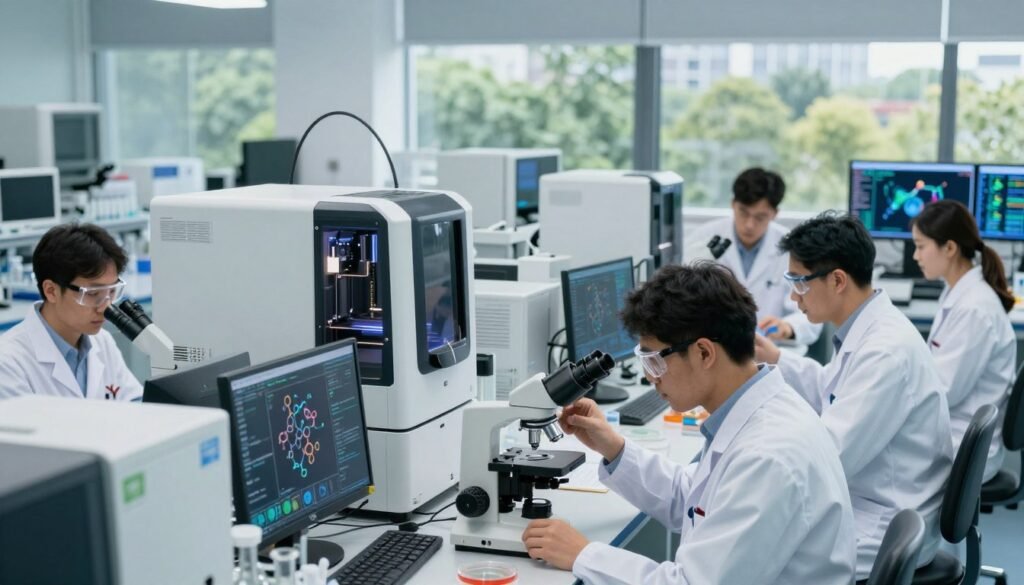
India’s sites are getting better, and there are more skilled people and clear rules. This makes it easier to do big, complex studies. Companies like Dr. Reddy’s and Sun Pharma are working with hospitals to make studies better. This makes studies faster and more reliable.
Academic-industry collaborations and talent development
Places like IISc, IITs, and AIIMS are teaming up with companies. They help turn lab ideas into real products. Programs and new courses are getting students ready for jobs in making and rules.
Advances in biotech, biologics, and precision medicine
Research in protein engineering, genomics, and assay development is moving forward. Startups and big companies are making biosimilars and precision medicine. These efforts open up new chances for exports and help India grow in the global pharma scene.
Manufacturing Expansion and Supply Chain Resilience
We see manufacturing capacity as a key for India Pharma Growth. By growing API and finished-dosage facilities, we reduce reliance on one supplier. This opens doors for exports. Our engineering teams are making sure investments match global demand, keeping supply stable and competitive.
Scaling production capacity for active pharmaceutical ingredients
To scale, we need modular plants and flexible lines. These can quickly switch between different products. Companies like Jubilant Pharmova and Dr. Reddy’s are adding more capacity while focusing on quality.
We suggest using process intensification and single-use systems. These methods can shorten production times and lower contamination risks.
Improving supply chain security and raw material sourcing
Strengthening the supply chain means making key materials in India and finding new suppliers. Having buffer stocks and regional hubs helps handle disruptions. Procurement teams should find and fix single points of failure and create near-shore options.
Adoption of advanced manufacturing technologies
Advanced manufacturing makes production faster and better. It includes continuous processing, PAT, and automation. These technologies reduce waste and help meet demand quickly.
Engineers should focus on automation and digital systems. Training programs should teach both practical skills and systems thinking. This will make India’s pharma industry stronger and more reliable.
Quality Standards and Reputation Management for Global Leadership
We explain how Indian makers can use quality to lead worldwide. They need strong systems and clear steps to make India Pharma Growth real. Good quality and GMP compliance open doors to new markets for medicines.

Quality assurance frameworks
Strengthen Good Manufacturing Practices and use solid quality management systems. ISO certifications show reliability to agencies like the US FDA. Steps include checking equipment, validating processes, and managing suppliers.
Addressing past concerns and restoring trust
Be open with plans to fix issues and have third-party audits. Show improvement with CAPA actions. Good reporting and talking to stakeholders helps keep trust.
Certification, audits, and brand building
Go for successful international inspections and certifications to show you can do it. Reliable supply, clear compliance, and strong monitoring build a strong brand. These actions help lead globally and grow India Pharma.
Export Strategy: Target Markets and Trade Opportunities
We have a solid export plan to help India’s Pharma Growth. We aim at the United States, the EU, Africa, Latin America, and Southeast Asia. Each place needs its own strategy, including market research, finding the right partners, and getting ready for rules.
Key destinations and bilateral ties. Good diplomatic ties and trade deals can open special paths for medicines and biotech. We suggest looking at ties with the UK, Germany, the US, and regional groups. This helps find tariff breaks and speed up health program buys.
Entering regulated markets. To get into the US and EU, you must follow US FDA and EMA rules. We advise making plans for regulatory steps, improving dossier quality, and getting ready for inspections. Working with local partners and contract makers can help get you in faster.
Managing trade barriers. Tariffs are important, but non-tariff barriers often affect access more. These include data rules, regulatory equivalence, and health checks. We suggest working together as an industry and being ready for legal issues and health checks.
Practical steps for exporters. Invest in quality systems, strong clinical data, and safety monitoring. Make strategic partnerships with distributors in each market. Use trade deals to cut costs and use free trade rules when you can.
Measuring success. Watch your export numbers, how fast you get approved, and how your market share grows. These signs show a focused export plan can boost the pharma industry and grow India’s Pharma on the global stage.
Workforce Development and Skill Building in the Pharma Sector
We share steps to get the next generation ready for India Pharma Growth. It needs teamwork from schools, companies, and government. We focus on updating education, creating special training, keeping talent, and growing digital skills in biotech and making.

Education reform is key. Schools need to update their courses in engineering and pharmacy to meet industry needs. Students should learn about bioprocess engineering, regulatory science, data analytics, and quality management.
We suggest making curriculum changes in small steps. Also, having hands-on labs sponsored by companies like Dr. Reddy’s and Sun Pharma. Short-term certificates and micro-credentials help students learn fast.
Training programs should mix classroom learning with apprenticeships and internships. This approach helps new employees learn faster and stay longer. It also shows them a clear path for their careers.
Companies can start their own schools or work with places like the Indian Institute of Technology. They can create courses together.
Retaining talent means paying well, having clear career paths, and ongoing learning. Mentorship and job rotations keep workers interested.
We ask HR leaders to make promotion rules clear and link training to results. This makes it easier to see who’s doing well.
Digital skills are vital in R&D and making. Knowing how to manage data, use AI, and automate processes improves work quality and speed.
Upskilling in cloud data, AI, and automation is key. It helps current staff fit into Industry 4.0 roles in biotech and making.
Implementation should be team-based. This includes sponsored labs, certified courses, and quick upskilling groups. These methods grow talent fast without waiting long.
We suggest checking skills often to find gaps. Then, make training match with goals for India Pharma Growth and staying competitive globally.
Digital Health, AI, and Technology Adoption in Pharmaceuticals
Technology is changing the pharma industry in many ways. It’s affecting discovery, production, and how we care for patients. Fast progress is helping India’s pharma sector grow, but it also needs new skills and rules.
Use of AI for drug discovery and development
AI is making drug discovery faster. It helps find the right targets and improve drug candidates. Companies like Sun Pharma and Dr. Reddy’s are working with startups to use these new tools.
Digital manufacturing, automation, and Industry 4.0
Digital manufacturing uses new tech like IoT sensors and digital twins. These tools help make drugs better and more consistently. By using automation, the pharma industry can grow and make its supply chain stronger.
Telemedicine, digital therapeutics, and integration with pharma
Telemedicine connects doctors and patients, helping to make better medicines. Digital therapeutics use software to help patients, opening up new ways to get paid. When rules and payers work together, this can really help India’s pharma grow.
We suggest focusing on skills in data, model checking, and keeping data safe. This helps use AI, digital manufacturing, and telemedicine safely and correctly.
Challenges and Risks Facing India’s Pharma Leadership Goal
We welcome India’s goal to grow its pharma industry. But, we see many risks that could slow it down. Finding a balance between speed and safety is key to gaining trust worldwide.
Regulatory hurdles and global competition
Regulatory challenges are big: different rules and standards make it hard to get approval in places like the US and EU. We need to improve inspections, quality, and make rules the same everywhere.
China and other countries offer cheap medicines, making it tough for India. Indian companies must focus on meeting rules to keep their place in the market. Clear rules for approval will help them get contracts.
Intellectual property, pricing pressures, and market access
IP issues are tricky: how to protect new ideas without making medicines too expensive. We should look into sharing patents and different pricing to help everyone.
Prices from buyers and agencies are low, making it hard to make money. Companies that use smart IP and cost-effective ways can keep profits up.
Environmental and ethical considerations in scaling production
Growing the industry raises environmental concerns. We must treat wastewater, recover solvents, and use water wisely to avoid harm and damage to reputation.
How we run clinical trials and treat workers in our supply chain matters too. Being open, getting third-party checks, and talking to communities can build trust.
We suggest looking at all risks together, including rules, IP, and the environment. Investing in green tech, better waste treatment, and talking to people will help India’s pharma industry grow and stay respected globally.
India Pharma Growth
We create a clear path for India Pharma Growth. We track important signals and share steps for everyone. A set of key indicators helps us achieve goals in the pharma and biotech fields.
Growth metrics
We suggest watching pharmaceutical exports by value and volume. Also, count new approvals from the US FDA and EMA. R&D investment shows how fast we innovate.
API self-sufficiency and workforce skills tell us about supply and talent.
How stakeholders can drive sustainable growth
The government needs to align policies and incentives. This helps manufacturers and researchers. The industry should invest in quality and R&D.
Academia should train talent and work on research. Investors should focus on long-term growth in pharma and biotech.
Practical steps we endorse
Set clear goals and make roadmaps. Create platforms for sharing best practices. Standardize reporting to show progress.
Start pilot projects to show how to grow sustainably.
Success stories
Indian firms have grown in biosimilar manufacturing. Contract manufacturers got US FDA approvals. Biotech startups got strategic investments.
These stories show hard work, discipline, and investor trust lead to growth.
Call to action
We ask everyone to use these metrics and report clearly. Publish roadmaps that link goals to resources. Working together will make the pharma and biotech sectors stronger in India.
Conclusion
J. P. Nadda has set a big goal for India. He wants to make India a leader in making medicines. This will happen by improving rules, investing wisely, and focusing on quality.
To reach this goal, everyone needs to work together. The government, big companies, schools, and engineers must join hands. They need to set standards, train people, and come up with new ideas.
This teamwork will make India’s healthcare better. It will also grow biotech and make sure medicines are good enough for the world.
We need to work together to make this happen. We must improve what we teach, innovate in how we make things, and work on projects that bring different fields together. This will help us build a strong team and the right tools for success in the pharma world.