



A rare honey badger sighting in Jhargram has thrilled wildlife authorities and conservationists alike. The elusive mammal, known for its nocturnal and solitary habits, was captured on camera deep in the forests of West Bengal, providing one of the few documented records of this species in the region. These images — taken from trap cameras installed as part of routine wildlife monitoring — could be one of the very few documented records of this elusive and little‑seen mammal in the state, marking a significant milestone in regional biodiversity documentation. http://wildlife conservation efforts in West Bengal
Uncovering a Shy Denizen of the Wild
The honey badger — also commonly known as the ‘ratel’ — is a small- to medium‑sized, fierce carnivorous mammal known for its muscular build, sharp claws, thick skin, and remarkable toughness. Despite its global distribution across parts of Africa, Western Asia, and the Indian subcontinent, the species is rarely seen in the wild due to its secretive and largely nocturnal habits.
In India, records of honey badgers have been sporadic and scattered. Camera traps in certain forested regions, including Purulia in West Bengal and parts of northern India like Uttarakhand, have previously documented their presence, but sightings remain few and far between.http://camera traps in Indian forests
This latest discovery from Belpahari and the bamboo forests of the Junglemahal region in Jhargram is being celebrated by forest officials as a promising sign of improving wildlife habitats in the area.
The Discovery: Camera Traps Reveal the Hidden
During a recent wildlife survey, the Forest Department of West Bengal deployed trail cameras in strategic locations across the dense forests of Jhargram. These cameras — motion‑activated and rainproof — are designed to capture images of elusive species that are rarely sighted by forest staff or local communities.
On one such device, images of a honey badger were recorded, prompting surprise and excitement among officials. According to senior forest sources, this is likely the second confirmed record of the species in the state, with earlier evidence also originating from the same Jhargram belt.
Chief Conservator of Forests S. Kulandaivel confirmed that the camera traps yielded two separate recordings of the animal — a remarkable outcome given how rarely this species ventures into the open or intersects with human detection.
Wildlife Department Reaction and Conservation Significance
Forest officials and conservationists have welcomed the finding as a symbol of richening biodiversity in the region. In recent years, the forests of Jhargram — part of the larger Junglemahal landscape — have produced several noteworthy wildlife records, from elusive carnivores to rare felids and other forest dwellers captured via camera traps.
State Forest Minister Birbaha Hansda hailed the sighting as “a testament to the resilience and richness of our ecosystem”. According to statements released by the department, the trend of increasing wildlife sightings reflects successful habitat protection efforts, reduced fire incidences, and greater awareness among local communities.
Officials have underscored that the honey badger’s presence is not only of faunal interest but also an important indicator of ecosystem health, showing that prey species, habitat continuity, and forest cover are sufficiently robust to support even the most cryptic inhabitants.
About the Honey Badger: A Fierce and Adaptable Survivor
The honey badger belongs to the family Mustelidae, a group that includes weasels, otters, martens, and ferrets. Known locally in some Indian contexts as ‘ratel’ or ‘bicchu’, the species is famed for its fearless temperament — capable of intimidating predators much larger than itself and willing to forage across diverse terrain.
Physical Characteristics and Behavior
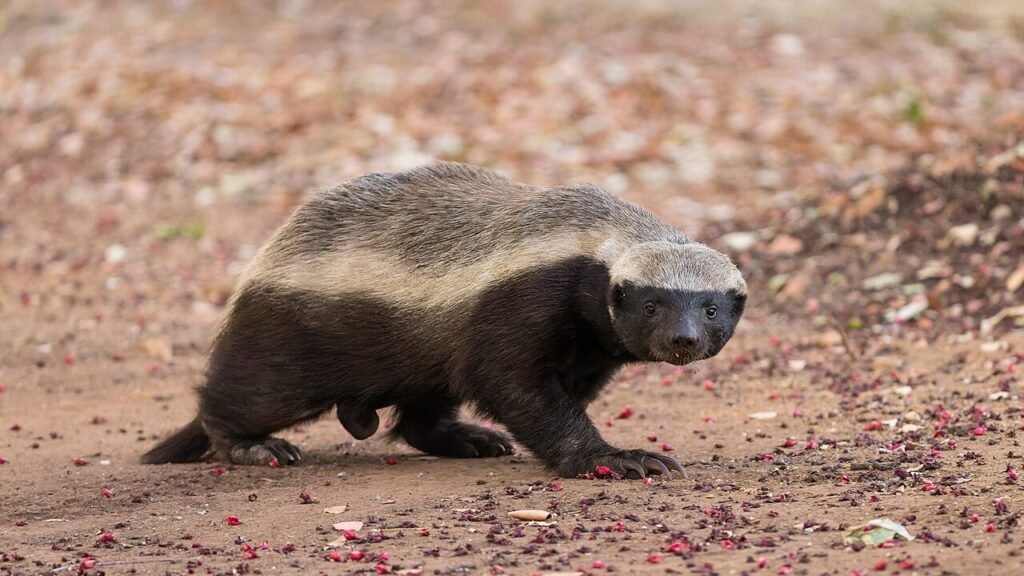
- Appearance: Generally sporting dark fur with a contrasting lighter grey or whitish stripe across its back, honey badgers are compact but powerfully built.
- Strength and Defence: Their thick hide and strong musculature enable them to withstand bites and attacks from snakes and other carnivores.
- Diet: They are opportunistic and omnivorous, feeding on rodents, reptiles (including venomous snakes), insects, bird eggs, and plant matter — with a well-deserved reputation for raiding beehives to eat honey and larval bees.
- Behaviour: Largely solitary and nocturnal, honey badgers are difficult to observe in daylight, making camera traps an important tool for studying their presence.
Despite being classified as Least Concern (LC) on the IUCN Red List due to its widespread but scattered population, the honey badger’s true population trends in India are poorly documented, and localised populations are considered vulnerable to habitat loss, human encroachment, and persecution.
Jhargram’s Forest Ecosystem: A Hub of Biodiversity
The forests of Jhargram — part of West Bengal’s Junglemahal belt — encompass dense patches of tropical woodland, scrub, and grassland mosaics that provide habitat for a range of species. The recent honey badger sighting adds to the growing list of rare and elusive wildlife being documented in the region, underlining its importance as a conservation frontier.
Over recent years, camera traps in the region have recorded diverse wildlife, including sloth bears, wolves, and a variety of felids and smaller carnivores, suggesting that the area may serve as a key wildlife corridor linking species populations across West Bengal, Jharkhand, and Odisha.
This emerging picture — of forests with rich biodiversity and relatively intact ecological networks — emphasises the need for continued habitat management, fire control, and community engagement, all of which are central to the state’s forest conservation strategy.
Challenges and the Road Ahead
While sightings like this are cause for celebration, they also raise questions about the long‑term conservation needs of elusive species like the honey badger. Experts note that despite its scattered range, ongoing threats such as habitat fragmentation, agricultural expansion, and human‑wildlife conflict could erode populations unless scientific monitoring and protective measures are strengthened.
Researchers have repeatedly stressed the importance of systematic camera trapping, field surveys, and community‑based reporting, as the species’ nocturnal habits make traditional survey methods less effective. Increased collaboration with NGOs, universities, and citizen science initiatives could help fill gaps in knowledge about distribution, behaviour, and ecological needs.
A Symbol of Wild Resilience
The honey badger sighting in Jhargram’s forests stands as a powerful symbol of wildlife resilience and hope. It reflects the positive impact of sustained conservation efforts and highlights how even the most elusive denizens of the wild can be documented with careful monitoring.
As wildlife experts and local forest staff celebrate this rare discovery, they also emphasise that continued vigilance, habitat protection, and research are essential to ensuring that future generations will continue to witness the wonders of India’s natural heritage — from tigers and elephants to the humble but indomitable honey badger.