



Smart classroom innovations are transforming the way students learn and teachers teach. Platforms like the Jio‑Shiksha Smart Classroom, recently showcased at the India AI Impact Summit 2026, are reducing physical burdens such as heavy schoolbags while providing advanced digital learning experiences that make education more accessible, interactive, and personalised. Traditional education, once anchored around heavy textbooks, crowded classrooms, and manual note‑taking, is increasingly being reimagined with the help of technological advancements. http://AI in Education
At the centre of this transformation is a concept known as the “smart classroom”, a technologically enriched environment designed to make learning more engaging, efficient, and accessible for both teachers and students. This shift was vividly showcased at the India AI Impact Summit 2026, where several innovations, including the Jio‑Shiksha Smart Classroom, were presented before policymakers, educators, and tech leaders.
Smart classrooms aim not just to digitize teaching tools, but to reinvent education by leveraging digital ecosystems, AI tutors, adaptive learning pathways, and seamless content integration — all with the ultimate goal of reducing the physical and cognitive burdens traditionally associated with schooling.
The India AI Impact Summit 2026: A Showcase of Educational Innovation
The India AI Impact Summit 2026 served as a compelling platform to spotlight how AI can be responsibly and strategically integrated into the education sector. Organised in New Delhi, the summit brought together government officials, industry leaders, academic experts, and innovators to discuss AI’s potential to transform public services and sectors — with education being a central theme.http://Digital Learning Tools
Among the many innovations featured at the summit, Jio’s AI ecosystem was a focal point, especially its education‑centric solutions. Highlighted by Akash Ambani himself during a walkthrough for Prime Minister Narendra Modi and other dignitaries, Jio’s pavilion demonstrated how AI can be harnessed to overcome longstanding educational challenges in India and beyond.
Jio‑Shiksha Smart Classroom: Reducing Burdens, Enhancing Learning
At the Ai Impact Summit, the Jio‑Shiksha Smart Classroom stood out as a prime example of innovation aimed at transforming traditional learning methodologies into interactive, data‑driven digital experiences.http://Jio Shiksha Platform
1. Eliminating Heavy School Bags
One of the most immediately recognisable benefits of the Jio‑Shiksha system is its ability to reduce the weight burden that millions of students carry daily. Through the use of cloud‑connected e‑boards and e‑books, all learning materials — including textbooks, notes, videos, and quizzes — are made available in digital form. This eliminates the need for students to carry multiple heavy textbooks and notebooks physically.
Instead of lugging around bulky school bags, students can access their personalised content on lightweight devices or even through cloud sync — making school life less physically demanding and more organised.
- E‑Books replace textbooks
- Automated note transfer from smartboards to student devices
- Digital content library accessible any time
This transition not only makes daily school routines easier but also supports inclusivity—especially for students in rural and semi‑urban areas who may struggle with access to educational resources.
2. Personalized Learning Through AI
Unlike traditional ‘one‑size‑fits‑all’ education, smart classrooms like Jio‑Shiksha adapt learning experiences based on individual needs and performance.
AI algorithms continuously analyse student progress and tailor content delivery accordingly:
- Adaptive lessons that adjust difficulty based on performance
- Personalized revision paths for students who need extra support
- AI tutors that provide concept clarity and practice suggestions
This kind of personalised learning ensures that no student gets left behind and that each learner can progress at their own pace—a significant leap from the traditional chalk‑and‑talk model.
3. Performance Tracking and Feedback
Smart classrooms enhance the visibility of learning outcomes by enabling real‑time performance tracking:
- Teachers can view analytics dashboards showing student performance
- Principals and parents can access progress reports
- Automated evaluation tools significantly reduce teacher workload
This real‑time feedback loop helps educators intervene early when a learner needs more support and helps administrators measure the effectiveness of instruction.
4. Seamless Integration Between Home and School
The Jio‑Shiksha model supports continuity of learning outside the classroom. Lecture content, notes, videos, and additional resources can be accessed from home, enabling students to revisit lessons and study independently.
In a country where uneven access to educational resources is a persistent challenge, this level of continuity—between classroom and home—can empower students from diverse socio‑economic backgrounds to participate more fully in learning.
5. Support for Teachers and School Administrators
Smart classrooms are not just student‑centric; they also focus on improving the teaching experience.
Features that assist educators include:
- Lesson planner tools
- Automated grading and feedback systems
- Digital resources for curriculum support
- AI‑assisted content creation
By reducing administrative and repetitive tasks, teachers are empowered to focus more on meaningful interaction with students — fostering creativity, critical thinking, and real‑world learning.
Broader Significance: Smart Classrooms in the Future of Education
While Jio‑Shiksha represents one leading example, smart classroom innovations are part of a broader global shift toward education 4.0—where digital tools, AI, IoT (Internet of Things), and data analytics reshape how learning happens.
1. Redefining the Role of the Classroom
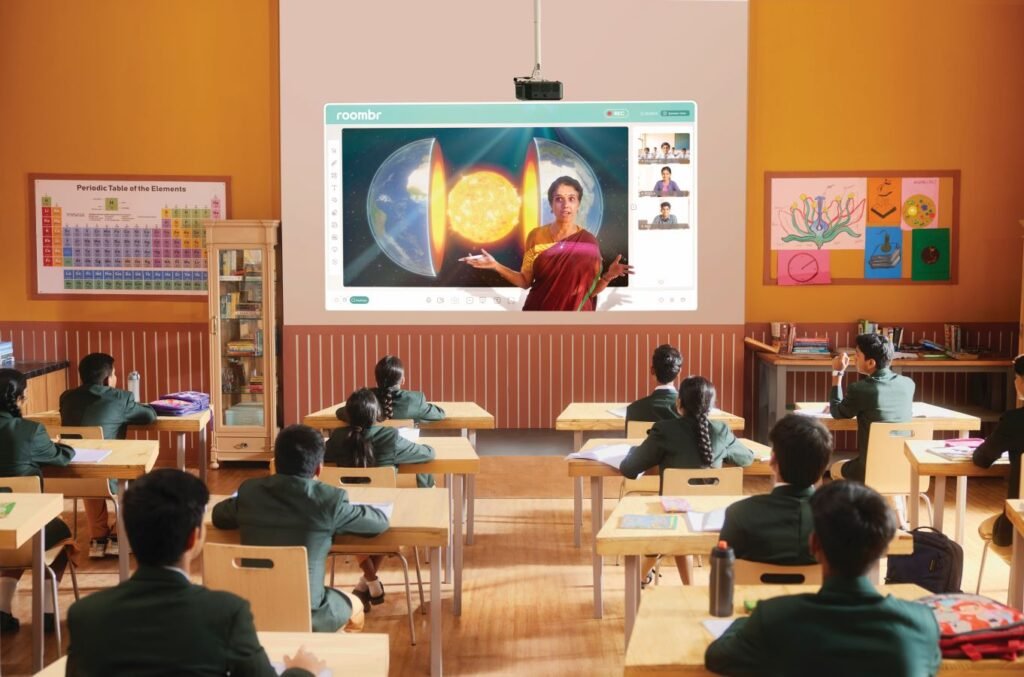
Smart classrooms transform physical spaces into interactive hubs of discovery. Gone are static blackboards and rows of desks; instead, classrooms are equipped with digital screens, connected devices, and adaptive learning systems that make learning richer and more engaging.
Academic research in this area highlights the potential of such systems—from real‑time engagement analytics to IoT‑supported adaptive environments that optimise lighting, sound, and learning conditions based on classroom dynamics.
2. Promoting Education Equity
Digital classrooms help bridge geographic and socio‑economic gaps:
- Students in remote regions gain access to quality content
- AI tools offer multilingual support
- Learning support becomes more consistent across diverse contexts
Through digitisation and scalable implementation, smart classrooms can reduce barriers to information and help democratise access to learning opportunities for all learners.
3. Enabling Future‑Ready Skills
Integrating technology early into classrooms prepares students for a future where digital literacy, computational thinking, and problem‑solving are essential.
Platforms like Jio‑Shiksha encourage:
- Critical thinking through interactive modules
- Collaboration via shared digital spaces
- Exposure to AI concepts through usage and assessment
This hands‑on engagement makes learning more relevant to the demands of the digital economy.
From Heavy Bags to Smart Learning Journeys
The journey from traditional classrooms to smart, AI‑enhanced learning spaces represents one of the most exciting shifts in education today. Innovations like the Jio‑Shiksha Smart Classroom, showcased at the India AI Impact Summit 2026, demonstrate how technology can alleviate physical burdens — such as heavy school bags — while delivering personalised, engaging, and effective learning experiences for students and educators alike.
As digital classrooms continue to evolve, they promise not only greater efficiency and accessibility but also a more inclusive approach to education that adapts to diverse learner needs. By embedding intelligent systems into everyday teaching and learning processes, smart classrooms stand poised to redefine how knowledge is shared, understood, and applied in the 21st century.