



Nearly 12 million Sukanya Samriddhi Yojana accounts have been opened. This shows families in India trust this SSY scheme for long-term goals.
The Sukanya Samriddhi Yojana is a Government of India-backed savings plan. It helps Secure Your Daughter’s Future. It offers a government guarantee, attractive interest rates, and tax benefits under Section 80C.
This scheme is perfect for parents and guardians saving for higher education or marriage. You can deposit between ₹250 and ₹1.5 lakh each year. It has a 15-year deposit period and matures in 21 years, making it disciplined and low risk.
We provide detailed information on Sukanya Samriddhi Yojana accounts. You can move your account to any bank or post office. There are rules for withdrawing funds for education, and the money grows tax-free until maturity. This lets families invest with confidence.
What is the Sukanya Samriddhi Yojana?

This is a special savings plan backed by the government. It’s designed to help secure a girl child’s future. It’s easy to understand who can open an account and where. It also explains why it’s a good choice for parents and guardians.
Overview of the Scheme
The SSY is a savings plan for girls under ten years old. It’s promoted by the Government of India. You can open an account at certain banks and India Post offices.
The plan earns interest based on the government’s rate. Interest is calculated monthly on the lowest balance between the fifth and last day of each month.
Accounts stay open for 21 years. You need to make contributions for the first 15 years. This creates a chance to save regularly. The minimum deposit of ₹250 is low, making it easy for many families to join.
Objectives and Benefits
The goal is to encourage saving for education and marriage. It also aims to help financially include more families. It’s a safe way to build a future fund for girls.
Key benefits include higher interest rates than many fixed options. It also gets tax benefits: deductions under Section 80C, and tax-free interest and maturity proceeds. The SSY has rules for when you can withdraw money for education and marriage. This gives families flexibility when they need funds.
Key Features of the Sukanya Samriddhi Yojana
We explain why this savings plan is great for parents and guardians. It offers guaranteed returns, flexible deposits, and tax benefits. This helps families plan for the future with confidence.
High-Interest Rates
The Sukanya Samriddhi Yojana interest rate is set by the government and reviewed every quarter. For Q2 FY 2023–24, it was 8% p.a. In Apr–Jun FY 2025–26, it was 8.2% p.a. Interest compounds annually, with monthly computation based on the lowest balance between the 5th and the last day of each month.
This setup offers predictable, high returns compared to many other savings options. It helps plan for education and marriage funding without worrying about market ups and downs.
Flexible Deposit Options
The minimum annual deposit is ₹250, and the maximum is ₹1.5 lakh per financial year. Deposits can be made in cash, cheque, demand draft, or electronic transfer. This makes it easy for different families to contribute.
Parents or guardians manage the account until the girl turns 18. Then, she takes over. The account can be moved between banks and India Post offices. If the yearly deposit is missed, the account can be revived with a penalty.
Tax Benefits
Contributions are tax-deductible under Section 80C up to ₹1.5 lakh per year. The interest earned and maturity proceeds are tax-free under Section 10(11A). These tax benefits make saving for a child’s future more effective and affordable.
Deposits over ₹1.5 lakh in a financial year do not earn interest. This rule encourages regular, disciplined saving within the set limits. It keeps the plan tax-efficient.
The SSY scheme offers steady returns, flexible deposits, portability, and strong tax treatment. It’s a smart choice for a child-focused savings strategy.
How to Open a Sukanya Samriddhi Account?

We guide you through opening a Sukanya Samriddhi account. We cover what parents need to know before applying. This includes eligibility, required documents, and the application process.
Eligibility Criteria
The rules for SSY are simple. Any Indian girl under 10 can be a beneficiary. Families can open up to two accounts for each girl child.
Exceptions are for twins or triplets, where more than two accounts are allowed. Only parents or legal guardians can open and manage the account until the girl turns 18. Non-resident Indians and Persons of Indian Origin are not eligible.
Required Documents
Before visiting a bank or post office, prepare these documents. You’ll need the girl’s birth certificate to prove her age.
- Identity proof of the parent or guardian: Aadhaar, PAN, passport, or voter ID.
- Address proof: utility bills, driving license, ration card, Aadhaar, or passport.
- Recent passport-size photographs of the guardian and the child.
- Completed application form for account opening.
Bring originals for verification and photocopies for submission. This makes the process faster. Make sure names and dates match across documents to avoid delays.
Application Process
Choose an authorized post office or bank branch to open the account. Public post offices and banks like Axis Bank offer this service.
- Collect the Sukanya Samriddhi Yojana account form at the branch or download it if available offline.
- Fill the form, attach the required documents, and submit them with the initial deposit; the minimum amount is ₹250.
- Make deposits via cash, cheque, demand draft, or electronic transfer as permitted by the branch.
- Receive the passbook immediately upon account opening and record the account number and branch details.
The account is activated once the bank or post office accepts the form and initial deposit. Regular deposits must be made for 15 years from the account opening date. The beneficiary gains full control of the account at age 18.
Transferring accounts between banks and post offices is allowed without stopping deposits. Keep digital and physical copies of all receipts and the passbook to track contributions and interest.
Investment Options for Parents
We offer practical choices for parents looking to secure their daughter’s future. The Sukanya Samriddhi Yojana is a low-risk option. Use an SSY calculator to see how different contributions affect your goals.
Before planning, know the Sukanya Samriddhi Yojana deposit limits. The minimum each year is ₹250. The maximum is ₹1.5 lakh. Deposits over ₹1.5 lakh won’t earn interest and may be returned.
Minimum and Maximum Deposit Limits
The account has a small annual minimum to make it easy to start. You can deposit from ₹250 to ₹1.5 lakh each year. Deposits over ₹1.5 lakh won’t earn interest and should be avoided.
If you miss a payment, the account goes into default. You can revive it within 15 years by paying the missed deposits plus a ₹50 penalty for each year. This rule makes planning flexible but being on time is key.
Duration of Investment
Contributions must be made for 15 years from when the account opens. After 15 years, the account continues to earn interest until the 21st year. The full maturity period is 21 years from opening.
The guardian manages the account until the girl turns 18. After that, she can manage it herself. This transition is good for funding education or marriage.
We suggest combining SSY with a liquid emergency fund and selective equity for higher growth. Use Sukanya Samriddhi as a fixed-return core. Add short-term savings or custodial mutual funds for liquidity and growth.
Use the SSY calculator to see how different contributions meet your goals. Remember the deposit limits and investment duration when balancing current needs with future goals.
Understanding Interest Calculation
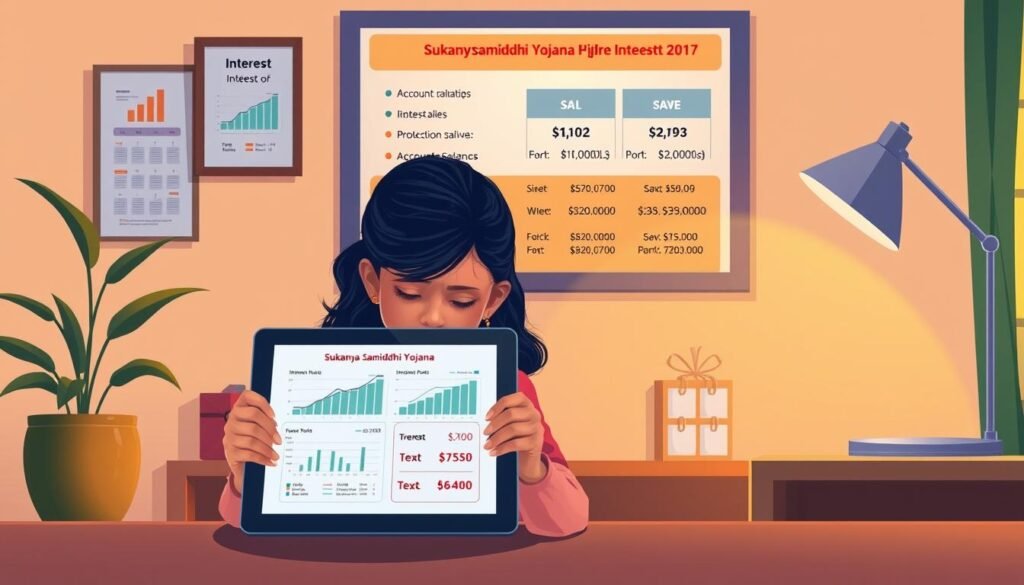
We explain how interest works in the Sukanya Samriddhi Yojana so parents can plan deposits with clarity. The scheme uses a monthly computation and an annual credit cycle. This affects the final corpus. Small timing changes make measurable differences over long tenures.
Compound Interest Explained
The government revises the SSY rate quarterly and applies that rate to accounts. Interest is calculated every month on the lowest balance between the 5th and the last day. Interest earned across the year is credited once annually, which produces compound interest Sukanya Samriddhi Yojana style.
Timing matters. A deposit made early in the month raises the lowest-balance figure and increases interest accrual. Missing deposits can reduce returns and risk an account becoming in default.
How to Track Your Savings Growth
We recommend three practical tracking tools: the official SSY passbook, online bank or post office statements, and an SSY calculator. The passbook shows credited interest and transaction history. Online accounts display running balances and recent credits.
An SSY calculator helps model future corpus using inputs such as annual contribution, tenure, and an assumed rate—common examples are 8% or 8.2%. For best results, use the current government-declared quarterly rate and simulate deposit timing to reflect the monthly lowest-balance rule.
| What to Monitor | How It Affects Returns | Action |
|---|---|---|
| Quarterly interest rate | Changes the growth rate used in compound interest Sukanya Samriddhi Yojana | Check RBI or government announcements each quarter |
| Deposit date each month | Determines the lowest balance for monthly interest calculation | Deposit before the 5th to maximize accrual |
| Annual credited interest | Forms the base for yearly compounding in Sukanya Samriddhi Yojana interest calculation | Verify annual credit in passbook or online statement |
| Passbook vs. online record | Reconciles any discrepancies in credited interest and deposits | Cross-check both records quarterly |
| SSY calculator simulations | Estimate future corpus under different rate and deposit scenarios | Run scenarios annually and adjust contributions |
Practical tips: make deposits early in the financial year and before the 5th of each month, keep clear records to avoid default, and review quarterly rate changes when using an SSY calculator. These steps help us optimize returns under the Sukanya Samriddhi Yojana interest calculation rules.
Tax Benefits for Investors
We look at how Sukanya Samriddhi Yojana helps with saving and taxes for parents and guardians. This guide explains how to claim benefits, stay compliant, and plan to get the most value.
Section 80C deductions
Money put into Sukanya Samriddhi Yojana can get a tax break up to ₹1.5 lakh a year. It’s wise to keep track of your deposits and match them with other 80C options. This way, you don’t go over the limit.
Save your account passbook and deposit slips. They prove your tax deductions when you’re audited. If you put in more than ₹1.5 lakh, the extra won’t earn interest. So, plan carefully to avoid losing money while getting the tax benefit.
Tax-free maturity benefits
The interest and final amount from Sukanya Samriddhi Yojana are tax-free. This means you get to keep more of your money, as it’s not taxed. This is a big plus compared to other investment options.
Think about how tax savings now and a tax-free future add up. This plan is great for saving for education or marriage in a tax-smart way.
Here’s a quick guide to help with planning and following the rules.
| Aspect | What to Note | Practical Tip |
|---|---|---|
| Eligibility for deductions | Contributions eligible under Section 80C up to ₹1.5 lakh | Coordinate with other 80C investments to maximize benefit |
| Interest taxation | Interest earned is tax-exempt throughout the term | Favor SSY for locked, tax-free growth toward long-term goals |
| Maturity proceeds | Final corpus received at maturity is tax-free | Include Sukanya Samriddhi Yojana tax-free maturity in financial projections |
| Excess deposits | Deposits above the annual limit do not earn interest | Plan annual contributions to avoid non‑earning excesses |
| Record keeping | Passbook and receipts validate Section 80C claims | Retain proofs for at least the assessment cycle |
By balancing tax breaks now with future tax-free growth, Sukanya Samriddhi Yojana is a solid choice. It’s a reliable, low-risk way to fund your child’s education and marriage.
Managing Your Sukanya Samriddhi Account

We help families manage Sukanya Samriddhi accounts easily. Parents can choose to handle it online or in person, based on their needs. This guide covers how to manage your account, including online and offline options, and keeping your account details up to date.
Online vs. offline options
Offline management uses a passbook for records. You can deposit money and get services at post offices or banks. Online management lets you deposit money and check your account online. It’s faster for balance checks and transaction history.
When to choose each route
Offline is good for those who like a physical passbook and face-to-face service. Online is better for instant alerts and easy record keeping. Many families use both for convenience.
Monitoring and updates
Regularly check your account details. Make sure to review interest postings and match them with your records. Set reminders for the annual deposit to avoid penalties. Use SMS or email alerts for updates.
Revival, transfers and administrative steps
To revive a defaulted account, pay missed deposits and a penalty. To transfer the account, request portability at the branch and submit forms. For partial withdrawals, use Form-3 and attach required documents.
Records and best practice
Keep digital copies of important documents. Use a checklist for deposits, passbook updates, and annual audits. This helps avoid mistakes and makes future transactions easier.
| Management Mode | Primary Record | Speed | Best Use |
|---|---|---|---|
| Offline (Post Office / Branch) | Physical passbook | Moderate | Official verification, signature-based transactions |
| SSY online management | Electronic statement / e-passbook | Fast | Regular deposits, balance checks, alerts |
| Hybrid approach | Both passbook and online records | Flexible | Families needing both convenience and formal records |
When to Withdraw Funds?
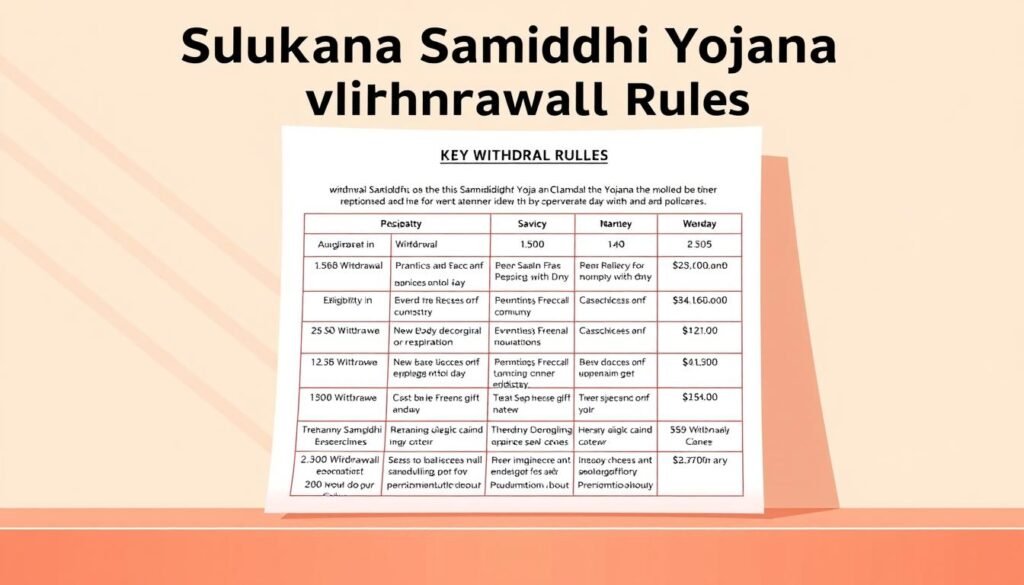
We help parents decide when to take out money from Sukanya Samriddhi Yojana. Knowing the rules helps plan for education and life events. Here’s when you can take out some or all of the money.
Conditions for Partial Withdrawal
You can take out up to 50% of the money when the girl is 18 or finishes Class 10. This is for education or marriage costs.
To withdraw some money, you need Form-3, the passbook, and proof like admission receipts. You can get the money all at once or in up to five parts. The amount must match the costs and the bank’s needs.
It’s best to withdraw money when you need it for school or college. Keep all receipts and letters safe. Banks might not accept requests without the right documents.
Full Withdrawal at Maturity
You can take out all the money after 21 years from when you started the account. This gives you the principal and interest you’ve earned.
If the girl gets married after 18, you can withdraw the money with marriage proof and a statement. You’ll need to show your ID and citizenship papers. The bank will then give you the money.
You can close the account early in special cases like death or serious illness. If the girl becomes an NRI or loses citizenship, interest might stop. We suggest checking with the service provider quickly.
Plan withdrawals with school or wedding schedules. Keep a list of needed documents and check with your bank or India Post. Having everything ready makes the process easier and faster.
Role of Sukanya Samriddhi in Financial Planning

The Sukanya Samriddhi Yojana is a key part of a family’s financial plan. It offers a steady return, backed by the government. This helps parents plan for the future.
For engineering students and professionals, it acts as a safe base. It protects against risks from other investments.
Long-Term Savings Strategy
SSY is a steady savings plan. It helps build a fund with tax benefits. This fund grows predictably over time.
Pair SSY with riskier investments like stocks or mutual funds. This mix can beat inflation and grow your money.
Test different scenarios with SSY. Deposit a set amount each year. Apply the current rate for 15 years. Then, see how it grows until the child turns 21. This helps figure out if more savings are needed for college.
Benefits for Higher Education
SSY helps with college costs at key times. You can withdraw money after Class 10 or at 18. This matches when tuition is due.
The money grows tax-free. This reduces the need for loans. It makes paying for college easier.
Use SSY with other savings and a brokerage account. This mix covers short-term costs and aims for higher returns. It keeps college funds safe and flexible.
| Objective | How SSY Helps | Complementary Tools |
|---|---|---|
| Predictable tuition funding | Guaranteed government rate; EEE tax status | Systematic investment plans in mutual funds |
| Partial funding at critical ages | Allowed withdrawals after Class 10 or age 18 | Liquid savings for immediate expenses |
| Inflation protection | Steady growth; limited inflation hedge | Equities or diversified equity funds for long-term growth |
| Loan avoidance | Tax-free maturity corpus reduces borrowing | Education loans only as last resort; scholarships |
Common FAQs About the Scheme
We answer practical questions to help families use the Sukanya Samriddhi Yojana with confidence. These FAQs cover account limits, missed payments, portability, and tax rules in simple language.
Can you have multiple accounts?
Only one Sukanya Samriddhi account is allowed per girl child. A family can open up to two accounts for two daughters. For twins or triplets, each child can have their own account, as long as each account names a different beneficiary and the paperwork supports those beneficiaries.
What happens if you miss a deposit?
If the minimum annual deposit is not made, the account becomes “in default.” You can revive it within 15 years by paying all missed deposits plus a penalty of ₹50 for each default year. Interest continues on amounts already deposited, so we recommend timely payments to preserve compound growth and tax advantages.
Other quick points we often cover:
- Portability: You can transfer the account between banks and post offices when you move residence; the receiving branch completes the transfer process.
- Nominee and transferability: Nominees may be registered; accounts can move between parents or guardians following scheme rules.
- Excess deposits: Contributions above ₹1.5 lakh in a financial year do not earn interest beyond the limit; track annual totals carefully.
- Taxation: Interest and maturity proceeds remain tax-exempt under current regulations.
For smooth account management, we suggest annual reminders for deposits, keeping the passbook up to date, and contacting your bank or post office promptly for revival or transfer procedures related to multiple accounts SSY and missed deposit SSY.
Success Stories of Sukanya Samriddhi Account Holders
We share stories of families who saved for their daughters’ education. They made small, regular deposits, sometimes just ₹250 a year. This turned into a reliable, tax-free fund.
When families moved, they could keep their accounts open. This helped them continue saving without a break.
Real-Life Experiences
Parents started saving early and made deposits every year. This habit grew into money for college fees and first semester costs. They also used other savings like fixed deposits or PPF to reduce bank loans.
When families moved for work, they could keep saving. This kept their account active and their savings growing. These stories are at the heart of our Sukanya Samriddhi Yojana success stories.
Educational Achievements
SSY helped pay for engineering and professional courses. Families topped up their savings to cover college fees. They used allowed withdrawals for tuition and exam fees.
These achievements made college more affordable. They reduced financial stress and shortened loan terms. The tax benefits and interest made education more accessible without heavy debt.
Lessons learned
- Start early to maximize compound interest.
- Maintain minimum yearly deposits to avoid revival penalties.
- Coordinate SSY withdrawals with college fee schedules for smooth disbursement.
- Pair SSY with growth instruments to protect against inflation.
These stories show that disciplined saving can change educational paths. They prove that tax-efficient saving supports long-term planning and reduces debt.
Conclusion: A Wise Investment for Your Daughter’s Future
The Sukanya Samriddhi Yojana is a smart, government-backed choice for saving for the long term. It offers interest rates near 8%–8.2%, is tax-free under Section 80C, and allows deposits from ₹250 to ₹1.5 lakh. This makes SSY a safe and profitable option.
It has a 15-year deposit period and matures in 21 years. You can also withdraw part of the money for education or marriage. This makes it a solid part of any family’s financial plan.
Recap of Benefits
SSY is backed by the government, offers attractive interest rates, and has tax benefits. You can deduct up to ₹1.5 lakh and the money grows tax-free until maturity. It’s easy to start with a low deposit of ₹250.
There are clear rules for withdrawing the money. This reduces risk and helps families plan for the future. Use an SSY calculator to see how your contributions will grow.
Call to Action for Parents
Parents, it’s time to think about your daughter’s future. Start by assessing her educational goals. Then, open an SSY account at a bank or India Post office.
Make the minimum initial deposit of ₹250 and set reminders for annual contributions. Talk to a bank official or a financial advisor to see how SSY fits into your overall financial plan. Small, regular investments today can lead to a big, secure fund for your daughter’s future.