



A group of junior engineers met in Mumbai to hear about Savitribai Phule’s school for girls. They were eager to learn about leadership and making a difference. This conversation showed why Indian Women Leaders are so important.
These women show us how to go from classrooms to national stages. From Savitribai Phule to Kalpana Chawla, their stories inspire us all.
We’re introducing 15 Women from India who made a mark in politics, science, arts, and more. Women like Indira Gandhi, Mary Kom, and Lata Mangeshkar teach us about perseverance and public service. We also highlight Dr. Manjusha Giri’s work to make medicine more inclusive.
These profiles are meant to inspire and guide the next generation of Indian women leaders. They are practical and relevant for classrooms, teams, and mentorship.
For more on these trailblazers and their achievements, check out this roundup of top Indian pioneers. Also, read about Dr. Manjusha Giri’s historic appointment to see how leadership is evolving today.
top Indian pioneers and firsts and Dr. Manjusha Giri’s historic appointment
Introduction to Indian Women Leaders
We present a list of pioneers important to engineers, educators, and policy makers. Their stories highlight systems thinking, resilience, and policy impact. These examples inspire technical teams and support women in STEM and public service.
The importance of celebrating leaders
Leadership is celebrated because it changes norms. Seeing women succeed in various fields makes gender balance seem possible. Celebrations open new paths and strengthen women’s leadership pipelines.
Leaders like Indira Gandhi, Kalpana Chawla, and Mother Teresa are highlighted. Their achievements show patterns of breaking new ground. Each of these trailblazers helped change the game for others.
Overview of contributions across fields
Contributions span politics, science, public health, arts, policing, and sports. Figures like Rajkumari Amrit Kaur and Muthulakshmi Reddy made significant impacts in hospitals and law. Biotech and engineering leaders set new standards. Athletes and artists raised India’s global profile and challenged stereotypes.
We suggest steps for educators and managers. Create case studies from these careers and use real policy challenges in capstone problems. Develop leadership modules that blend technical skills with social impact. These actions make mentoring effective and empower Indian women.
For inquiries about curriculum design or partnerships, contact info@indiavibes.today
Historical Figures Who Made an Impact
We look at how women in India changed public life through their voices, power, and care. This short look at three women shows how they influenced society. Each one offers lessons for leaders in different fields.
Sarojini Naidu was a poet and activist. Her poetry gave her a strong voice for change. She became a leader in the Indian National Congress and the first woman governor of an Indian state.
Her use of poetry to speak out for rights and women’s freedom is inspiring. It shows how cultural power can open doors in public life. This is important for those working on technical projects.
Indira Gandhi was Prime Minister for many years. She made big changes in the country, including nationalizing industries and improving agriculture. She was honored with the Bharat Ratna in 1971 and named Woman of the Millennium by the BBC.
Her leadership style was bold but risky. It shows the trade-offs between quick action and lasting stability. This is something teams should think about when making big changes.
Mother Teresa founded the Missionaries of Charity and spent her life helping the poor and sick. She won the Nobel Peace Prize and was later made a saint. Her work focused on a clear mission, volunteers, and simple operations in tough places.
Her approach teaches us about effective operations. Clear goals, volunteers, and simple systems can create lasting change. These lessons are useful for engineers and program managers.
| Figure | Primary Domain | Leadership Style | Institutional Impact |
|---|---|---|---|
| Sarojini Naidu | Literature & Politics | Literary-led moral authority | Expanded civic engagement; first woman governor |
| Indira Gandhi | National Governance | Centralized executive leadership | Rapid policy execution; major economic and agricultural reforms |
| Mother Teresa | Humanitarian Care | Mission-driven, volunteer network | Large-scale charity operations; global humanitarian model |
These women show how to break barriers in India. We learn from their leadership to build better institutions. For more information, email info@indiavibes.today.
Women in Politics
We look at how leading women in India have shaped public service and policy. Their careers teach us about governance, crisis response, and community organizing. People from engineering and public policy backgrounds will find useful lessons for designing public systems and managing large programs.
Sushma Swaraj set a high standard for citizen-focused diplomacy. As External Affairs Minister, she was known for her quick and practical help to stranded Indians. Her approach shows how to make public services more personal and effective.
Sushma Swaraj: Trailblazer in Indian Politics
Swaraj’s time in office showed the importance of clear communication and quick action in ministries. Engineers can learn from her to improve digital services. Policy students can see how she made consular help more efficient and effective for citizens.
Other women in history also made a mark. Indira Gandhi was the first woman Prime Minister of India. Vijaya Lakshmi Pandit was the first woman to lead the UN General Assembly. Sucheta Kriplani was the first woman chief minister of an Indian state. These stories are part of a broader look at women’s political roles in India, found at women’s political participation in India.
Mamata Banerjee: A Voice for the Marginalized
Mamata Banerjee founded the All India Trinamool Congress and became West Bengal’s first female Chief Minister. Her strength is in connecting with people and making policy choices that benefit her constituency. She shows how being present in the community can build strong political institutions.
Other influential women worked on public health and social reform. Rajkumari Amrit Kaur helped build health infrastructure and fight malaria. Muthulakshmi Reddy used her power to end exploitation and expand social protections. These leaders show how laws and institutions can have lasting effects.
For engineers and public-policy students, the key lessons are clear. Focus on user needs, create fast response channels, and link local efforts to big programs. When women in leadership use technical skills and empathy, they achieve better results across different areas.
| Leader | Role | Relevant Lesson |
|---|---|---|
| Sushma Swaraj | External Affairs Minister | Design clear escalation paths for urgent citizen services |
| Mamata Banerjee | Chief Minister, West Bengal | Build durable institutions from grassroots organizing |
| Indira Gandhi | Prime Minister | Lead national policy with decisive governance frameworks |
| Vijaya Lakshmi Pandit | Diplomat, UNGA President | Use diplomacy to advance national interests and norms |
| Sucheta Kriplani | Chief Minister of Uttar Pradesh | Translate state-level leadership into reform delivery |
| Rajkumari Amrit Kaur | Health Minister | Invest in public health infrastructure early |
| Muthulakshmi Reddy | Legislator | Champion rights through focused legislation |
We celebrate these influential Indian women and learn from their methods. Their approaches can help more women take on leadership roles in public and technical fields. Contact: info@indiavibes.today
Women in Business and Entrepreneurship
We celebrate a generation of successful Indian women who turned ideas into big companies. Their paths took them from lab benches to boardrooms and global markets. We look at leadership styles that engineers and managers can learn from.
Kiran Mazumdar-Shaw started Biocon in a garage and grew it into a global biologics leader. She did this through focused R&D, navigating regulations, and scaling up. Her story shows how technical teams can turn research into products.
Indra Nooyi led PepsiCo by making smart moves and focusing on nutrition and global markets. Her leadership shows how to align supply chains, brands, and talent to meet consumer needs. Managers can learn from her how to optimize portfolios and lead across cultures.
Women breaking barriers in India share common traits. They focus on data, invest in skills, and turn technical insights into business models. These traits help them move from prototypes to widespread use.
To empower Indian women, we suggest two modules in courses. One is on commercializing products like Biocon, and the other is on strategic changes like PepsiCo’s. Both modules mix technical skills with leadership lessons.
Contact us at info@indiavibes.today for course materials and case studies. They teach how to commercialize, navigate regulations, and lead at a systems level. These skills helped many successful Indian women today.
Women in Science and Technology

We celebrate the achievements of Indian Women Leaders in science and technology. They have made significant contributions to labs, missions, and institutions. Their work shows how technical skills, policy, and mentorship open doors for women in these fields.
Kalpana Chawla followed a clear path from education to space missions. She studied aerospace engineering, worked at NASA, and flew on STS-87 and STS-107. Her journey inspires engineers and students to follow similar steps.
Anna Rajam Malhotra combined administrative skills with technical expertise. She helped set up India’s first computerized container port systems in Mumbai. Her work shows how civil service and engineering can work together to achieve lasting results.
Muthulakshmi Reddy used her medical training to build institutions. She founded the Adyar Cancer Institute, linking medical innovation to community service. Students can learn from her how to make a difference through medical innovation.
Manju Sharma worked as a bioscientist and head of the Department of Biotechnology. She focused on gender balance in science and technology. Her work informs how to increase women’s participation in leadership roles.
We suggest three modules for curriculum design. They include mission analysis, port-computerization projects, and policy studies. These modules help students understand the impact of women’s contributions in science and technology.
Supports like scholarships and mentorship networks are essential. They help reduce barriers and increase opportunities for women in science and technology. Our community can use these insights to create better opportunities for future Indian Women Leaders.
Questions or collaboration proposals: info@indiavibes.today
Women in Arts and Culture
We look at how creative leaders shape our views of technology, society, and identity. Movies, music, and books bring complex ideas to classrooms and public talks. This part shows how art and tech learning connect.
Mira Nair shows how to mix local stories with global views in films. Her movies like Salaam Bombay! and Monsoon Wedding teach about lighting, sound, and storytelling. These lessons help students learn about film production and project management.
Amrita Sher-Gil’s paintings mix European style with Indian themes. Her work teaches about visual theory, color, and conservation. Labs can practice pigment studies and conservation, useful for art and science students.
Lata Mangeshkar changed Indian music. Her recordings show changes in audio production. A module on her work teaches audio restoration and how to share music online.
Arundhati Roy uses stories to critique society. Her book, The God of Small Things, teaches about policy and ethics. Workshops can teach students to make clear messages from data.
We suggest three projects for classes:
- Film-technology lab: recreate a scene using Nair’s methods — planning, lighting, and cloud post-production.
- Audio-archival sprint: digitize and analyze Mangeshkar recordings to study audio choices and format changes.
- Story-to-data studio: turn a Roy chapter into an infographic that shows social issues and policy solutions.
These projects highlight Indian women and their male collaborators. We aim to celebrate these women and teach technical skills through art. Courses that combine art and tech create leaders in both fields, including women.
Contact us at info@indiavibes.today for curriculum outlines, workshop templates, and partnership opportunities. We focus on celebrating influential Indian women and supporting students aiming for leadership roles.
Women in Sports

We celebrate athletes who changed policy, training, and how we see sports. Their stories show how sports science, talent pipelines, and mentorship can uplift communities. Engineers and educators can learn from them to build systems that support future successful Indian women.
Mary Kom started from humble beginnings and became a six-time World Amateur Boxing Champion and a 2012 Olympic bronze medalist. She received the Padma Bhushan, Rajiv Gandhi Khel Ratna, and Padma Shri. Her journey shows how to develop athletes in tough settings: focus on skills, flexible training, and finding talent in communities.
Sports scientists can learn from her about managing her load, adjusting nutrition, and staying mentally strong. These lessons can help groom more Indian women role models.
Mithali Raj set records for batting longevity. She was the first woman to score a double century in Test cricket (214, Wellington, 2004) and led India for many years. Her career shows the importance of long-term planning, technical improvement, and using data to prepare.
Performance engineers can use her career to create injury prevention systems and analytics pipelines. This can help more successful Indian women in cricket and other sports.
Sania Mirza brings a tennis perspective: she won India’s first WTA title in 2005 and became world No. 1 in doubles in 2015. Her journey shows the value of cross-discipline training, navigating international circuits, and personal branding. Coaches should include strategies for adapting to travel and mixed-surface training in talent development for women breaking barriers in India.
| Athlete | Key Achievements | Technical Lessons for Engineers and Educators |
|---|---|---|
| Mary Kom | 6× World Champion; 2012 Olympic bronze; Padma Bhushan | Biomechanics for punching power; conditioning in low-resource contexts; psychological resilience training |
| Mithali Raj | First women’s Test double century (214); long-term team captaincy | Load monitoring across seasons; batting analytics; leadership development modules |
| Sania Mirza | First Indian WTA title (2005); doubles World No. 1 (2015) | Cross-discipline conditioning; travel and recovery protocols; brand and career management |
These athletes are role models for Indian women. Their careers teach us about talent pipelines, training-load analytics, and fair resource allocation. We can use their methods to improve curriculum, labs, and policies. This will help more women break barriers in India and succeed in sports.
Contact: info@indiavibes.today
Women in Activism and Social Change
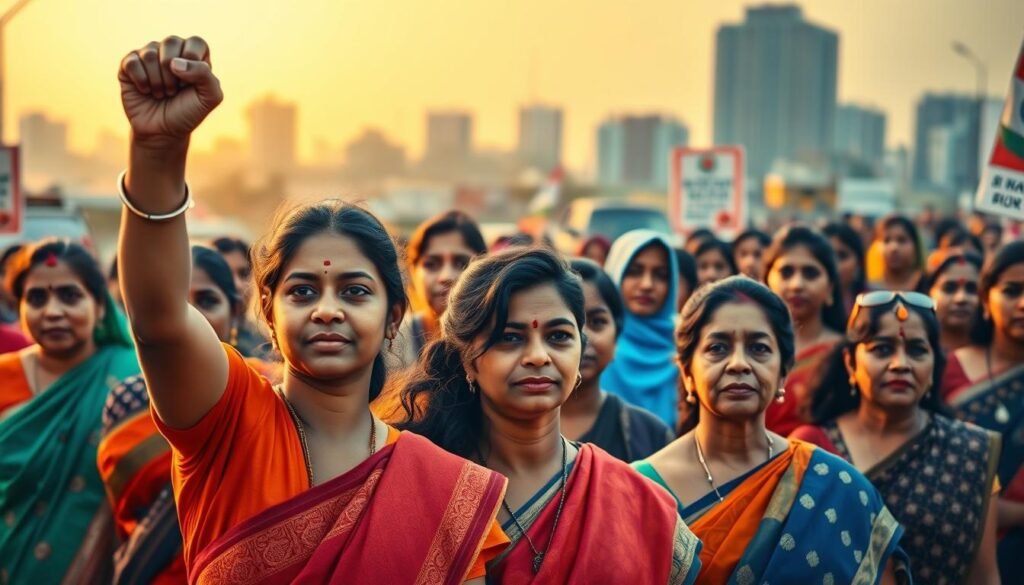
We look at how grassroots efforts and evidence-based advocacy change public policy and community strength. Activists mix urgency with detailed work: they use impact studies, legal documents, and charts to turn local issues into big conversations. This method helps empower Indian women to lead and brings together engineers and community workers.
Malala Yousafzai shows how to fight for girls’ education. Her work shows the power of stories, data, and fundraising to change policies. In India, educators and groups can use these methods to improve education.
Medha Patkar shows how fighting for the environment combines law and science. The Narmada Bachao Andolan used studies and public meetings to challenge big projects. Engineers and planners can work with activists to make solutions that respect the environment.
Irom Sharmila and Savitribai Phule teach us about long-term protests and education changes. Their work shows the importance of staying strong, being clear, and collecting evidence. These qualities are key for women leaders who face many challenges.
For technical teams, here are steps: work with communities to create tools, do impact studies together, and teach students about rights. Projects that show results help convince policymakers and donors. This approach helps empower Indian women by making local efforts big and lasting.
To start collaborations, email us at info@indiavibes.today. We welcome educators, engineers, and activists to work on projects that focus on data, dignity, and lasting change.
Women in Literature and Writing
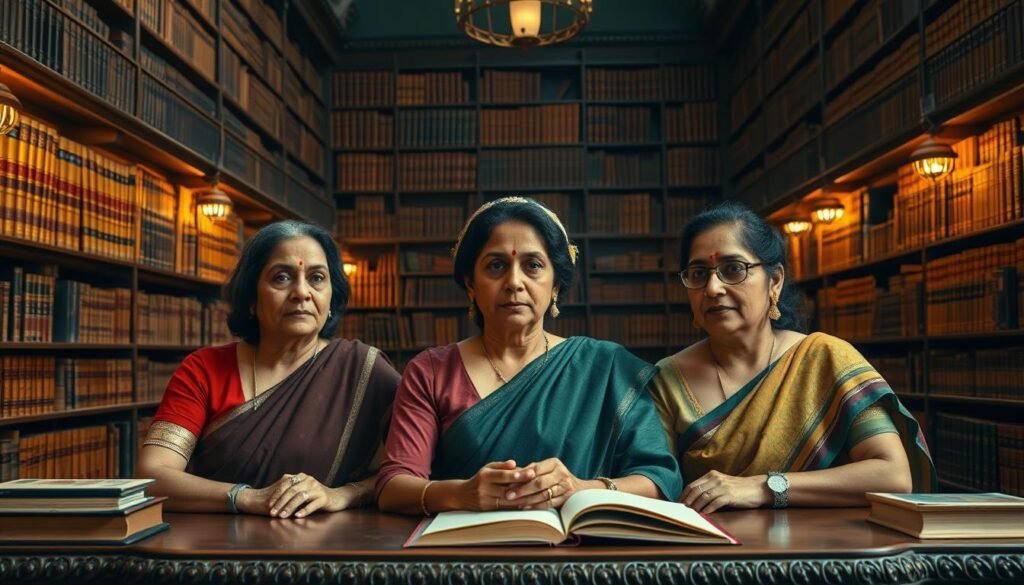
We follow a thread of literature that connects protest, confession, and argument. Indian women’s literature has shaped moral debates and influenced policy. It also offers courage to many, including engineers and students.
Arundhati Roy used both fiction and non-fiction to challenge power. Her novel, The God of Small Things, won the Man Booker Prize in 1997. She also wrote The Ministry of Utmost Happiness in 2017.
Her work links storytelling with activism, criticizing globalization and environmental harm. Assigning her work helps teams see policy and design through a human lens.
Kamala Das brought a frank voice to English and Malayalam poetry. Her poems explore identity, desire, and social limits. Das reshaped conversations about gender and selfhood in India.
Her style models direct communication for professionals. They must translate complex ideas to broad audiences.
Sarojini Naidu combined poetic craft with public leadership. Her collections, like Golden Threshold and The Broken Wing, show how verse can fuel political commitment. Naidu stands among the Indian women role models whose literary practice bridged art and activism.
For coursework and workshops, we recommend three approaches:
- Close reading of narrative strategies to teach empathy and stakeholder mapping.
- Critical essays that link text to environmental ethics and technology critique.
- Creative assignments that ask engineers to write user-centered narratives.
These methods highlight influential Indian women whose writing trains readers to notice social impact. Students learn to frame technical problems within lived experience and cultural context.
| Author | Key Works | Educational Use |
|---|---|---|
| Arundhati Roy | The God of Small Things; The Ministry of Utmost Happiness | Case studies on globalization, readings for ethics and policy critique |
| Kamala Das | Collected Poems; My Story (autobiography) | Modules on voice, gender studies, and candid narrative styles |
| Sarojini Naidu | Golden Threshold; The Broken Wing | Historical context for literature as civic engagement and leadership |
We celebrate these prominent female figures in India as practical models for mentoring and curriculum design. Their work nourishes critical thinking and strengthens communication across disciplines. For course queries or collaboration write to info@indiavibes.today.
The Role of Education in Empowering Women
We believe education shapes careers, confidence, and community. From Savitribai Phule’s first girls’ school to today’s scholarship schemes, learning opens doors to leadership. This section outlines proven initiatives and mentorship strategies that support empowering Indian women into meaningful careers.
Initiatives Supporting Women’s Education in India
Grassroots reforms started with Savitribai Phule’s first girls’ school in 1848. Rajkumari Amrit Kaur and Muthulakshmi Reddy expanded professional pipelines through healthcare education and hospitals. These institutions trained women in medicine.
Targeted support programs accelerated individual firsts. Anandibai Joshi’s medical training, Anna Rajam Malhotra’s civil service entry, and Priya Jhingan’s commissioning in the armed forces show how scholarships and training remove barriers.
We recommend scholarship frameworks tailored to engineering and STEM. These should include transparent eligibility, need-based funding, and summer research grants. They should mirror successful models used by national institutes.
Importance of Mentorship Programs
Mentorship turns aspiration into career plans. Pairing students with industry mentors helps translate classroom learning into workplace skills. Kalpana Chawla’s path to aerospace, Kiran Bedi’s policing career, and Mary Kom’s sporting rise provide role models that guide mentees through concrete milestones.
Structured mentorship should include sponsorship, internship pathways, and periodic assessments. Institutional networks—hosted by universities and public-sector partners—can place mentees in multi-year pipelines. These track retention and progression.
We propose three practical interventions: 1) institution-led mentorship networks linking students with sector-specific mentors; 2) scholarship and internship packages for women in engineering and STEM; 3) measurement systems that track metrics such as enrollment, retention, placement, and promotion rates.
To pilot these ideas, we suggest starting with regional centers. Test pairing students with mentors from both industry and academia. Collect outcomes data quarterly and scale models that show clear gains in career entry and advancement for women in leadership roles.
Contact us at info@indiavibes.today for partnership ideas, program templates, and guidance on implementing mentorship structures. These structures elevate Indian women role models and expand pathways for empowering Indian women into leadership.
Conclusion: The Future of Women Leaders in India
We’ve followed the journey from pioneers like Razia Sultan and Rani Lakshmibai to today’s leaders. Their paths in politics, social reform, science, arts, sports, and business show the power of diversity. This history helps us prepare the next generation of women leaders in India.
Changing curricula and hands-on learning are key. By adding these women to school subjects and providing internships, we give students real-world skills. We aim for more women in STEM fields, more startups led by women, and tracking their success.
To support women leaders, we need a coordinated effort. This includes government scholarships, corporate internships, and women-focused programs. We also need partnerships to make a bigger impact and break down barriers.
We encourage educators, students, and professionals to use these stories to create programs that open up leadership opportunities. For more information and to collaborate, email info@indiavibes.today.