



Nearly 1,500 years ago, a single idea from India changed everything. The use of zero in math set the stage for modern computers. It changed how we process information today.
We explored ten key parts of Indian heritage. These include Vedic knowledge, Indus Valley engineering, and Ayurvedic medicine. We also looked at early metallurgy, engineering, medical thought, textiles, urban planning, and philosophy.
We used Vedic texts, archaeological reports, and medical treatises. We also looked at the math of Aryabhata and Brahmagupta. This helped us see how ancient techniques became lasting technologies.
We explained technical terms simply and looked at how these ideas are used today. Our goal is to inspire educators, students, and engineers. We want to show how solving problems in the past can lead to new ideas today.
By studying these ancient secrets, we learn valuable lessons for today. We aim to make technical education more imaginative and innovative. We want to do this by drawing on India’s rich heritage.
The Concept of Zero: Revolutionizing Mathematics
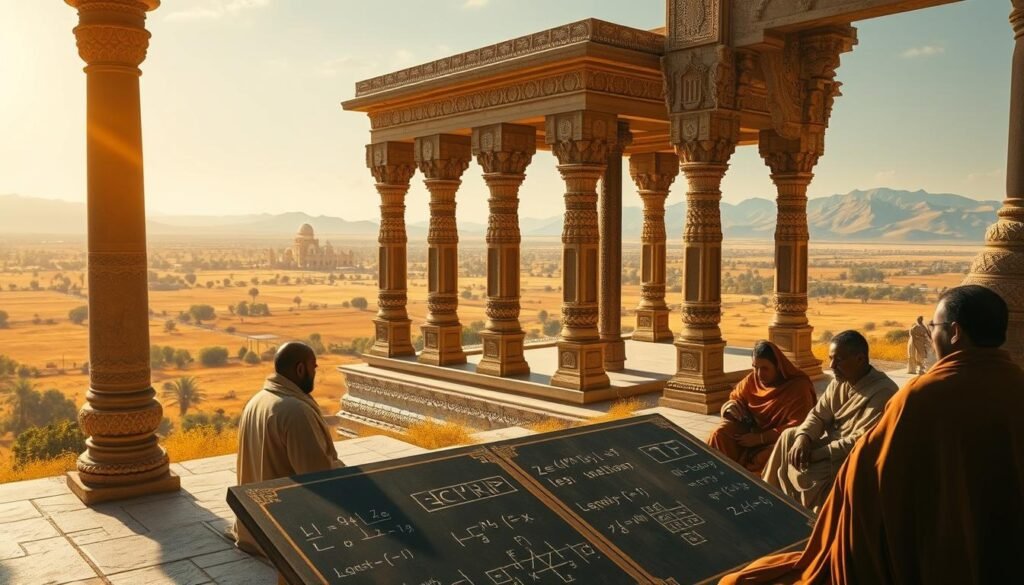
We look at a key moment in math history that changed how we calculate, do science, and engineer. Ancient India Secrets show us how a simple symbol turned into a powerful tool. This journey mixes archaeological finds, manuscript clues, and the wisdom of Vedic knowledge. Here’s a quick look at what’s coming.
The Origins of Zero
Archaeological pieces and inscriptions hint at the slow start of a symbol and system. The Bakhshali manuscript and Brahmi inscriptions show a decimal system used in the first thousand years CE. Brahmagupta’s work gave us rules for zero and negatives, laying a solid foundation.
The term zero invention India pops up in many studies today. Scholars argue over exact dates and where it started, keeping the mystery alive.
The Impact on Mathematics and Science
We need to split the zero symbol from the idea of zero as a placeholder. The symbol itself is just a mark. But the concept of zero as a placeholder lets us write numbers in a new way.
This new way of writing numbers makes math easier. It leads to simpler ways to add, subtract, multiply, and divide. These changes helped create algebra and calculus.
Today, engineers and students benefit from this old idea. It helps with keeping numbers stable, designing algorithms, and encoding data. This is key for digital computing.
From Ancient India to the World
Knowledge spread through scholars and traders. Indian texts influenced Islamic scholars like Al-Khwarizmi. His work was translated into Arabic and later to Europe, showing how ideas moved.
References to Vedic knowledge connect the idea to South Asia’s wisdom. This story shows how local ideas became global, shaping modern computing.
| Aspect | Ancient Evidence | Technical Effect | Modern Relevance |
|---|---|---|---|
| Symbolic Zero | Brahmi inscriptions, manuscript notations | Represents empty quantity | Placeholders in numeric systems, data encoding |
| Placeholder Zero | Bakhshali fragments, positional entries | Enables compact representation of large numbers | Efficient algorithms, binary systems |
| Theoretical Rules | Brahmagupta’s rules on zero and negatives | Formal arithmetic operations with zero | Foundations for algebra, calculus |
| Cultural Transmission | Translations into Arabic; scholarly exchange | Diffusion of notation and methods | Global mathematical curriculum, computing standards |
| Ongoing Questions | Dating and regional development debates | Clarifies origins and evolution | Inspires research into historical mysteries |
Ayurveda: The Science of Life

Ayurveda comes from ancient Sanskrit texts that show centuries of study and practice. The Charaka Samhita and Sushruta Samhita are key to understanding this tradition. They explain the tridosha theory, the six tastes, and focus on prevention and care tailored to each person.
Historical Roots
The roots of Ayurveda are in Vedic culture, with refinement and codification over centuries. The Charaka and Sushruta texts date back to the 1st millennium BCE. They show a deep understanding of how diet, environment, and physiology are connected.
Natural Remedies and Modern Integrations
Pharmacognosy connects ancient herbal knowledge with modern science. Traditional methods like decoction and cold infusion are now backed by HPLC and mass spectrometry. This helps us understand the active compounds in plants like turmeric and ashwagandha.
But there are challenges. India has its own standards, while the U.S. has stricter FDA rules. It’s important for quality and safety in integrative medicine.
The Growing Popularity in the U.S.
There’s a growing interest in Ayurveda in the U.S. This includes more demand for supplements and integrative clinics. People are looking for natural and preventive care, and there’s a cultural exchange happening.
Engineers, educators, and clinicians can all play a role. They can help make Ayurveda safer and more effective. This way, we can respect tradition while meeting today’s safety standards.
Indus Valley Civilization: Urban Planning

We dive into the genius of one of South Asia’s oldest urban plans. The Indus Valley holds secrets of ancient India. It shows how planners managed density, sanitation, and water in a civilization that thrived from 2600–1900 BCE.
Advanced city layouts
At Harappa, Mohenjo-daro, and Dholavira, archaeology reveals grid patterns and streets aligned to the cardinal directions. Standardized bricks show uniform construction. The division into citadel and lower-town areas shows municipal control.
These designs allowed for efficient land use and movement. They also provided ventilation, daylight, and heat control for warm climates.
Sanitation systems ahead of their time
Excavations found covered drains, per-house outlets, and public baths. These were built with advanced materials. Gravity-driven channels flowed without pumps, and soak pits separated waste.
These systems used hydraulic principles to keep water clean. They directed stormwater and sewage away from homes.
Lessons for modern urban development
We apply ancient wisdom to today’s cities. Dense grids with narrow streets reduce heat and improve walking. Decentralized sanitation cuts costs and boosts resilience.
Dholavira’s water management is a model for today. It shows how to handle variable rains. Experts like Mahindra and the Indian Institute of Science recommend these strategies.
Research and preservation continue with new technologies. Tools like remote sensing and GIS mapping help us learn from the past. They allow us to apply ancient wisdom without idealizing it.
The Art of Navigation: Ancient Indian Maritime Skills

We explore coastal shipbuilding and seafaring through ancient sites and texts. Archaeological finds at Lothal and Sopara match Rigveda and Periplus of the Erythraean Sea. This shows a long history of maritime tradition.
Craft techniques helped predict voyages. Ships had sewn-plank hulls, strong keels, and efficient rigging. Sails were set for monsoon winds.
Mastery of monsoon patterns allowed safe crossings. These skills were key to Ancient India’s regional connections.
We look at celestial navigation next. Sailors used sun, stars, and moon phases for bearings and timing. Vedic knowledge helped plan departures and routes.
H3: The Role of Astrology in Navigation
Seafarers used astrolabe-like methods for sky reading. Solar and stellar alignments guided them day and night. This blend of observation and timing shows the meeting of sacred texts and science at sea.
H3: Ancient Trade Routes Establishing Global Links
Trade networks spanned from South Asia to Mesopotamia, Egypt, East Africa, and Southeast Asia. Goods like spices, cotton, and beads were traded. Roman coins and amphorae confirm these exchanges.
Ports were key hubs with organized storage and weights. These systems teach modern supply-chain lessons. Together, they reveal the mysteries of Indian heritage.
Cotton Textiles: A Fabric of Innovation

We follow the journey from seed to sari. Archaeobotanical finds, spindle whorls, and dyes show a deep technical tradition. This journey links craft to engineering, showing how Ancient India Secrets shaped material practice across continents. We aim to highlight methods, materials, and trade networks that influence textile engineering today.
The Birthplace of Cotton Cultivation
Early domesticated cotton—Gossypium arboreum—was found in the subcontinent as early as the third millennium BCE. Excavations at Mehrgarh and Indus Valley sites uncovered seeds and fibers. These confirm cultivation and fabric production, linking ancient farming to later spinning and weaving.
The core production stages include sowing and selective breeding, ginning to remove seeds, spinning, and handloom weaving. Each stage required precise control of fiber tension and twist. These controls mirror modern fiber mechanics and inspire textile innovation today.
Influence on Global Textile Trade
Indian textiles like muslin, chintz, and kalamkari drew demand from Rome, the Middle East, and later Europe. Merchants prized the finesse of muslin and the colorfastness of indigo-dyed cloth. Records show these goods fueled maritime routes and shaped early trade hubs along the Indian coastline.
We explain the dye chemistry relevant to materials engineers. Natural dyes like indigo require reduction-oxidation cycles and mordants such as alum to fix pigments. These chemical steps affect fiber strength and color durability, linking ancient practice to modern textile science.
Guilds and workshop clusters organized labor, quality control, and knowledge transfer. This socio-economic structure supported export-oriented production centers. These evolved into India’s modern textile districts. The continuity of Indian heritage is visible in techniques and community-based production models that persist today.
Technical Legacy and Modern Relevance
Fine muslin demanded strict fiber sorting and loom tension, an early study in process control. Those craft metrics anticipate contemporary standards in fiber testing and mechanical modeling. We draw parallels to current sustainable textile engineering and circular-economy designs.
- Process insight: ginning and combing determine yarn uniformity.
- Material insight: natural dyes interact with cellulose via mordants.
- Economic insight: export patterns shaped the early global textile trade.
By studying these threads, engineers and historians uncover actionable lessons. The narrative of cotton origin India and textile innovation enriches our understanding of Indian heritage and its ongoing role in the global textile trade.
Yoga: A Pathway to Wellness

We explore yoga’s roots in ancient India, from the Upanishads and Bhagavad Gita to Patanjali’s Yoga Sutras. These texts show how yoga combines physical postures, breathing techniques, and meditation. They also reveal deep spiritual teachings that guide us to live ethically and seek inner wisdom.
Yoga is not just for spiritual seekers. It’s also for engineers, therapists, and educators. We look at how yoga poses work, how to avoid injuries, and how to adapt it for therapy. This approach connects ancient practices with modern science.
Historical roots and philosophical context
Yoga’s history is rich with milestones. We see how ancient texts and Patanjali’s work shaped yoga. Upanishadic meditation also played a big role in yoga’s contemplative side. These elements teach us about ethics, breath control, and mental focus.
Major styles and their benefits
There are many yoga styles, each with its own focus. Hatha yoga emphasizes alignment and flexibility. Raja yoga is about deep meditation. Bhakti yoga connects us to our hearts, while Karma yoga encourages action and service.
Modern yoga schools like Ashtanga, Iyengar, and Vinyasa have made these styles accessible. They help people reduce stress, improve heart health, and enhance mental well-being.
Standards, training, and therapeutic practice
Teaching yoga requires training and standards. We discuss what teachers need to know and how to teach safely. Physiotherapists and engineers use technology to improve yoga poses and help with rehabilitation.
Adoption and the global landscape
The yoga movement has spread worldwide. It’s recognized by the United Nations and is part of workplace wellness and public health programs. Yet, there’s a need to respect Indian heritage and teachings.
We suggest working together on yoga research and teaching. This could include using technology to study yoga and creating better teaching environments. Such efforts can help yoga grow in a way that’s both traditional and scientifically sound.
The Science of Surgery: Sushruta Samhita
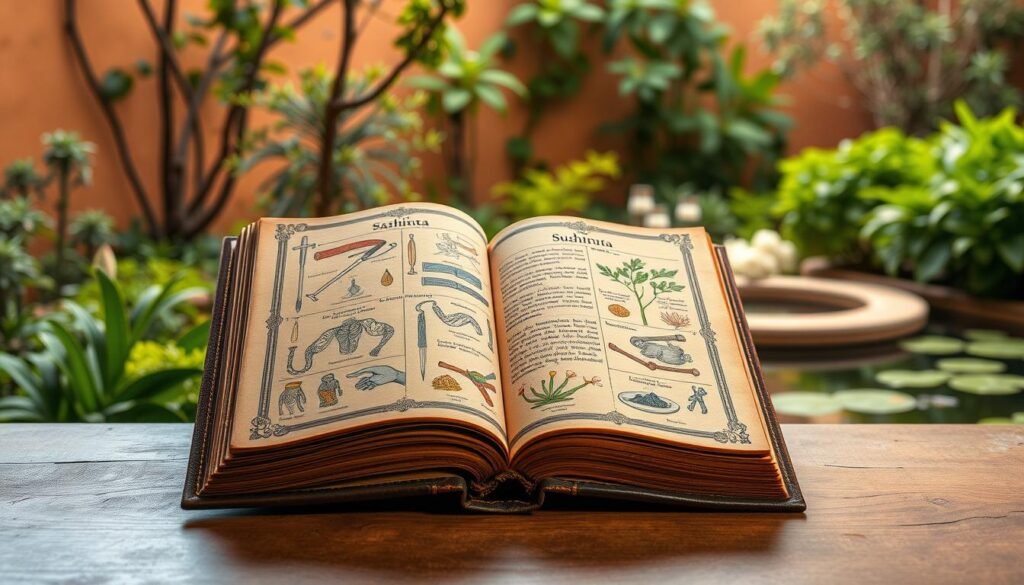
We dive into a key part of Vedic knowledge that changed ancient surgery and impacts us today. The Sushruta Samhita is a detailed guide on surgery. It covers tools, how to classify wounds, and step-by-step guides for surgeries like nose jobs and eye treatments.
Pioneering instruments and techniques
Sushruta talks about scalpels, forceps, and other tools with great detail. He explains how to use flaps for nose repairs and how to move tissue in stages. He also stresses the importance of keeping wounds clean with honey and herbs, and how to stitch wounds.
Lineage into modern practice
The Samhita hints at ideas used in today’s plastic, ear, nose, and eye surgeries. Scholars link its ideas to ancient Greek and Islamic medicine, showing how knowledge spread. For those in engineering and education, it offers insights for designing tools and training methods.
Ethics and training in ancient texts
Sushruta pushes for formal training for surgeons, including studying the body on cadavers. He also talks about getting patient consent and keeping things clean before surgery. These ideas match today’s medical ethics and how we teach doctors.
Practical relevance for educators and engineers
Using the Sushruta Samhita in teaching can be very useful. It helps learn about tool design, how to practice surgeries, and teaching ethics. By carefully checking these ideas, teachers can use ancient methods to spark new ideas without risking patient safety.
Legacy and ongoing questions
The Samhita is a vital part of Ancient India Secrets. It shows how ancient wisdom can guide today’s medical practices. Studying it helps keep the connection between old and new medicine alive.
Mathematics and Astronomy: Aryabhata’s Contributions

We dive into a key part of Ancient India Secrets where math and astronomy come together. Aryabhata’s work is a mix of exact math and a scientific view based on Vedic knowledge. His methods changed how people measured time, predicted eclipses, and made calendars.
Aryabhata’s Aryabhatiya introduced place-value arithmetic and smart ways to do math. He gave a close guess of pi—about 3.1416 in many readings—and made early sine table approximations. These tools helped astronomers reduce mistakes and find planet positions more accurately.
He used geometric models to explain how planets move: their relative motions and cycles, not myths. This view helped predict eclipses. Aryabhata also created ways to track the Earth’s rotation and the planets’ movements. This improved calendar making and navigation timing.
Aryabhata’s Theories and Discoveries
Aryabhata thought the Earth rotates on its axis, a bold idea for his time. He gave trigonometric rules that were early steps towards modern sine series. His way of writing numbers made big calculations easier and helped in quick math.
The Calculations for Calendar and Time
He explained how to figure out lunar and solar positions, eclipse times, and adjustments for calendars. These methods helped make calendars that matched real observations. This was useful for farming and rituals tied to Vedic knowledge.
Modern Implications of Ancient Astronomy
Aryabhata’s work shows the power of algorithmic thinking: using approximations, controlling errors, and spherical trigonometry. These ideas are part of a line that leads to today’s space science, computer astronomy, and GPS timekeeping.
| Aspect | Aryabhata’s Contribution | Modern Parallel |
|---|---|---|
| Place-value arithmetic | Compact notation enabling complex calculations | Positional numeral systems in computing |
| Pi approximation | Value ~3.1416 for design and sky models | Precision constants in numerical simulations |
| Trigonometric tables | Sine approximations and interpolation rules | Spherical trig foundations for orbital mechanics |
| Eclipse prediction | Mechanistic algorithms replacing mythic accounts | Ephemerides and predictive astronomy |
| Calendar calculations | Rules for lunisolar alignment and intercalation | Timekeeping systems and navigation calendars |
| Influence | Impact on Varahamihira and later scholars | Transmission to Islamic and European astronomy |
Metalwork: The Age of Iron
We look into how early ironworking changed societies across the subcontinent. Archaeology shows that the late 2nd millennium to 1st millennium BCE saw the start of iron use. This discovery is part of the Ancient India Secrets that change how we see technology.
The growth of Indian metallurgy is fascinating. It moved from simple furnaces to advanced crucible techniques. Charcoal was used to reduce local iron ores, creating blooms. Smiths then hammered these blooms to remove slag.
Later, crucible work allowed for controlled carbon addition. This was an early step towards wootz steel, a key development in metallurgy.
Development of metallurgy
- Archaeological chronology: sites and radiocarbon dates that map early iron adoption.
- Bloomery smelting: low-oxygen furnaces that yielded workable iron blooms.
- Crucible practices: small, sealed vessels enabling higher-carbon steels.
Smelting chemistry and technique
Smelting turned iron oxides into metallic iron and slag using carbon. The chemistry of slag tells us about furnace temperatures and ore quality. Forging then refined the iron, making it stronger and more durable.
Wootz and high-carbon experimentation
Crucible steel production involved heating iron and carbon in clay crucibles. This process created a unique structure in the steel. This made the steel blades sharper and more resilient, a step towards modern steel.
Tools and weapons
- Agricultural implements: ploughshares and sickles that boosted yield and labor efficiency.
- Hand tools: chisels and adzes enabling carpentry and construction.
- Weapons: swords and pattern-welded blades combining hardness and toughness for battlefield advantage.
Mechanical properties
Heat treatment and forging created strong and flexible steel. This is why many Indian blades were sharp and strong. Their microstructure was key to their durability.
Industrial legacy and research methods
Today’s steelmaking owes a lot to ancient India. The control of carbon, temperature, and deformation is vital. Archaeometallurgy uses advanced techniques to study ancient steelmaking.
| Aspect | Ancient Practice | Modern Parallel |
|---|---|---|
| Ore reduction | Charcoal-fueled bloomery furnaces | Controlled atmosphere reduction in blast and direct-reduction units |
| Carbon control | Crucible infusion to vary carbon content | Alloying and heat treatment to target microstructures |
| Microstructure study | Empirical forging tests and pattern-welding | Metallography and SEM for microstructure-property links |
| Socioeconomic effect | Higher farm productivity and stronger weapons | Industrialization, urban growth, and defense technology |
Ironworking changed communities in big ways. It led to more productive farms and stronger weapons. These changes are part of India’s heritage and inspire today’s engineers and historians.
Ancient Indian Literature: Shaping Philosophy and Ethics
Ancient Indian literature is a treasure trove of wisdom. It includes the Vedas, Upanishads, Bhagavad Gita, Mahabharata, and Ramayana. These texts offer insights into ethics, governance, and inquiry.
Classical schools like Nyaya, Mimamsa, and Vedanta developed deep epistemologies. They guided logic, debate, and public life. Key themes like dharma, artha, kama, and moksha are essential for making decisions today.
These texts also shaped reasoning and social structures. The Vedic hymns and knowledge provide ritual and cosmological context. The Upanishads explore consciousness and knowledge, while the Bhagavad Gita offers ethics for action.
Philosophical texts refined argumentation and evidence tools. These ideas have influenced education and administration. Scholars like Amartya Sen and social reform movements have used these texts to rethink justice and policy.
Preserving and transmitting these texts was a priority. Oral tradition, palm-leaf manuscripts, and layered commentary were used. Today, digital humanities projects and libraries are making these texts more accessible.
For our community, these works are vital. They connect technical practice to human values. Vedic knowledge and philosophical texts provide ethical lenses for design and innovation.
The collective lesson is clear: Ancient India Secrets offer practical inspiration. They provide ethical frameworks and knowledge for engineers and educators to tackle modern challenges.